Call us now:

The uses of carpet in a hotel corridor and a private lounge are not the same, and treating them the same is how procurement teams end up with a floor that fails inspection or wears out in eighteen months. A fire rating that doesn’t clear customs, a fiber that can’t survive daily foot traffic, a shipment that arrives four weeks late — these are budget problems, not design problems. This guide breaks down what actually determines carpet performance by application, so your next spec sheet holds up on-site and on paper.
Why Carpet Selection Is an Engineering Decision, Not a Style Choice
Carpet does five jobs at once: it absorbs sound, retains heat, cushions impact, traps airborne particles, and reduces slip risk. Design blogs stop there. Procurement teams need the numbers behind each claim.
- Acoustic: commercial-grade wool carpet typically delivers an NRC (Noise Reduction Coefficient) between 0.25 and 0.45, depending on pile height and backing.
- Safety: DCOF (Dynamic Coefficient of Friction) above 0.42 is the baseline most commercial codes reference for slip resistance.
- Air quality: carpet fiber holds particulates until vacuumed — but only if it carries a low-VOC certification. Otherwise you’ve solved one air quality problem and created another.

The same construction that performs well in a guest room will fail in a corridor. That’s the variable most buyer’s guides skip, and it’s the one that determines your total cost of ownership.
Uses of Carpet by Commercial Application
Hospitality: Hotels and Resorts
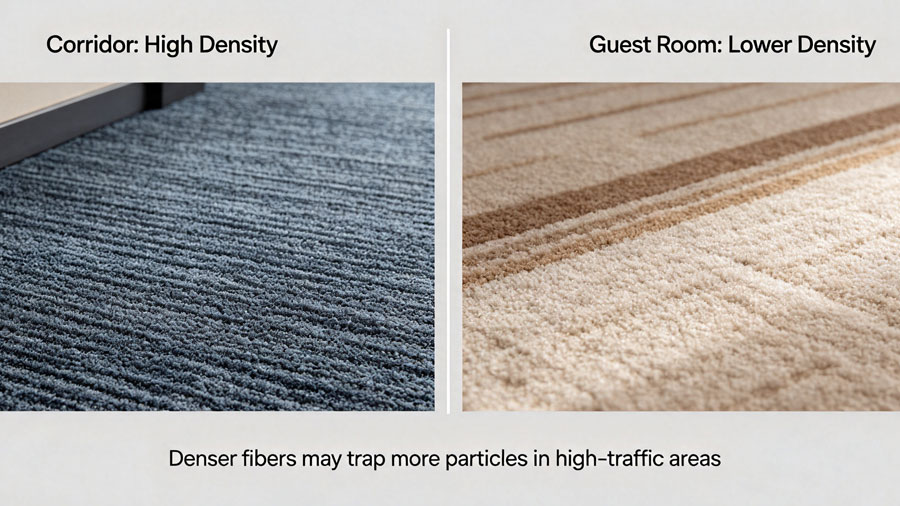
Corridors need Heavy Duty wear ratings and a construction that hides soiling between deep cleans — Axminster carpet handles this well because its woven pile locks pattern and color into the fiber rather than printing on top. Ballrooms need pattern flexibility for branding; guest rooms can run lighter density since foot traffic is lower and comfort underfoot matters more.
High-Traffic Commercial Spaces and Entertainment Venues
Spaces with continuous 24-hour foot traffic — entertainment venues, transit hubs, large-format retail — need Class I fire rating as a non-negotiable baseline, plus antistatic backing and extra-heavy wear classification. This is where fire code compliance and abrasion resistance matter more than pattern design.
Marine and Cruise Applications
Marine carpet answers to a different rulebook entirely. IMO regulations govern flammability, smoke toxicity, and weight per square meter — standard commercial fire ratings don’t automatically satisfy marine compliance. Fab Carpet’s marine-grade constructions carry MED Wheelmark certification specifically because IMO approval requires separate testing from land-based fire codes, not just a stricter version of the same test.
Healthcare, Corporate, and Retail
Healthcare flooring needs antimicrobial treatment and easy spot-cleaning. Open-plan offices lean on acoustic performance to cut ambient noise. Retail floors need wear resistance concentrated at entrances and high-dwell zones, not uniform density across the whole floor plate.
Application-to-Specification Matrix
| Use Case | Recommended Construction | Min. Fire Rating | Wear Rating | Fiber |
|---|---|---|---|---|
| Hotel Corridor | Axminster / Machine-Tufted | Class I | Heavy Duty | Wool-Nylon Blend |
| Marine Cabin | Hand-Tufted | MED Wheelmark | Medium | Wool |
| Entertainment Venue | Axminster | Class I / Bfl-s1 | Extra Heavy | Solution-Dyed Nylon |
| Corporate Office | Machine-Made | Class I | Medium-Heavy | Wool-Blend |
compare wool vs synthetic commercial carpet performance
Material Deep-Dive: Wool, Density, and the Formula Buyers Skip
Premium New Zealand wool outperforms most synthetics on natural crush resistance and inherent flame resistance — wool’s protein structure is harder to ignite than petroleum-based fibers, which is one reason it clears fire testing at lower treatment cost. Synthetic fibers can match wool on price but need heavier chemical treatment to hit the same fire rating.
Pile weight and pile height alone don’t tell you how a carpet will wear. Density does:
Density = Pile Weight (oz/yd²) ÷ Pile Height (inches) × 36
A higher density number means the fibers are packed tighter, which resists crushing and matting under repeat foot traffic. Two carpets can carry identical pile weight and perform completely differently on the floor because their density differs.
Construction Methods Compared
| Construction | Best For | Custom Pattern Capability |
|---|---|---|
| Axminster | Hospitality, large patterned areas | High (multi-color, woven-in) |
| Hand-Tufted | Mid-scale commercial, custom logos | High |
| Hand-Knotted | Luxury and heritage projects | Very High |
| Machine-Made | Large-volume standardized projects | Medium |
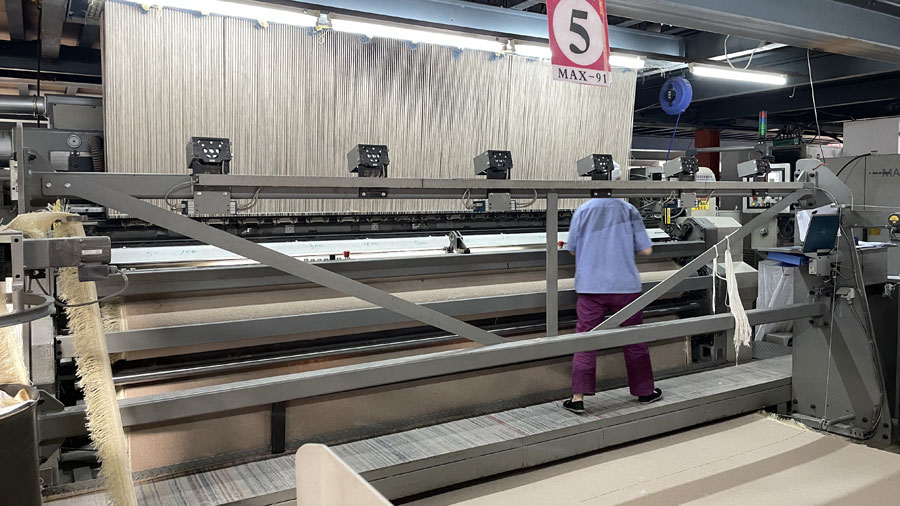
Fab Carpet runs all four constructions at its Qinghai production facility, which is the reason a single order can mix a hand-knotted lobby centerpiece with machine-made corridor runs from one supplier instead of three.
Fire Safety, Acoustic, and Compliance Standards You Must Verify
Understanding Class I / Bfl-s1 Fire Rating
ASTM E648 measures how far a flame spreads across a carpet surface under radiant heat — a Class I rating means the carpet resisted ignition across the full test panel. Bfl-s1 is the equivalent EU classification, covering flame spread and smoke development together. A carpet rated for one market doesn’t automatically clear the other; always request the specific certificate for your project’s jurisdiction.
Acoustic Ratings for Procurement Teams
NRC measures sound absorption within a room; STC measures sound blocked between floors. Specify both if the project involves multi-story hospitality or office builds — a carpet with strong NRC can still transmit impact noise downward without proper underlay.
The Certification Checklist
- CRI Green Label Plus (GLP9123 / GLP5308) — indoor air quality
- EN 14041 (CE marking) — European construction product compliance
- MED Wheelmark — IMO marine safety
- UKCA / UKMCA — UK post-Brexit market access
- ISO 9001 / 14001 / 45001 — quality, environmental, and safety management systems
Verify certification status
Review the full fire testing methodology
Every Fab Carpet product line carries documented Class I fire testing and full traceability back to the batch, so buyers aren’t relying on a supplier’s word — the report ships with the order.
[Downloadable Resource: Download Free B2B Carpet Procurement Checklist PDF]
Sourcing Right: The Factory-Direct Advantage
Why Middlemen Cost You 20–30%
Trading companies mark up carpet without adding testing, tooling, or QC capacity. That markup buys you nothing on the compliance or delivery side — it’s pure margin sitting between you and the factory floor.
Supply Chain Red Flags to Check Before You Sign
- Ask for the factory’s actual production address, not a trading company’s office address
- Request current certificates, not expired ones — GLP and ISO certifications lapse and renew
- Confirm who runs QC: an in-house lab, or a third party billed separately
- Get a real sample before committing to a full production run, not a catalog photo
Fab Carpet operates OEM/ODM production directly from its Qinghai facility, which means design revisions, sample approval, and bulk production run through one accountable line instead of passing through a broker who adds time at every handoff.
MOQ, Lead Time, and Tiered Pricing
Pricing typically scales down per square meter as order volume increases, but lead time is the variable buyers underestimate — custom pattern approval and dyeing add weeks that standard-stock carpet doesn’t require. Build that into your project timeline before you commit to an install date.
Maintenance and Total Cost of Ownership
Upfront price per square meter is the wrong number to optimize. A denser, certified carpet costs more at purchase and less over five years, because it resists matting, holds color longer, and doesn’t need early replacement in high-traffic zones. Run the comparison on a five-year cycle, not a purchase order.
Use the calculator below to estimate area and material cost for your project before requesting a formal quote:
Interactive Tool: Carpet Calculator
FAQ: Common Buyer Questions
What fire rating do hospitality projects need?
Most commercial hospitality projects require Class I under ASTM E648, or Bfl-s1 for EU markets. Marine projects need MED Wheelmark separately.
What’s a typical MOQ for custom commercial carpet?
MOQ varies by construction — hand-tufted and Axminster runs typically require higher minimums than machine-made stock. Request project-specific MOQ during your RFQ.
How long does sample delivery take?
Standard swatch samples ship within days; custom pattern samples requiring dye matching take longer, since color approval happens before bulk production starts.
Can wool carpet meet commercial fire codes?
Yes. Wool’s natural flame resistance often requires less chemical treatment than synthetics to reach the same Class I rating.
Does Fab Carpet provide fire test reports with orders?
Yes — documented test reports and batch traceability ship with every certified order.
What’s the typical lead time for custom hospitality carpet?
Lead time depends on construction and pattern complexity; factor in sample approval time separately from production time when setting your install date.
Request Your Project Quote
Compliance documents and construction specs answer half the question — the other half is seeing the material in hand. Request free sample swatches, submit an RFQ for your project specifications, or download the technical data sheet (TDS) before you finalize your spec.