Call us now:

Introduction
What is carpet pile, and why does it decide whether your next hotel refurbishment passes fire inspection or gets flagged at the final walkthrough? Pile construction sets density, fire behavior, and lifespan before color or texture ever enter the conversation. Get the spec wrong and you’re looking at re-orders, delayed openings, or a rejected import shipment. This guide breaks pile down into the numbers procurement teams actually need.
What Is Carpet Pile, Exactly?
Carpet pile is the fiber layer that stands above the backing. It’s what your foot touches, what wears down, and what determines acoustic and fire performance. Three layers sit beneath it: primary backing, the pile yarn itself, and secondary backing (sometimes with a cushion layer added for hospitality applications).
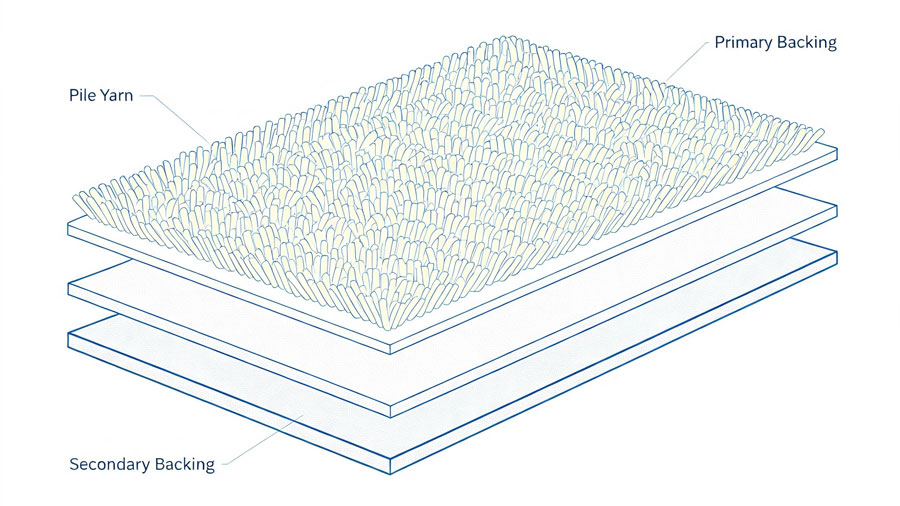
Pile isn’t a style decision. It’s a performance spec. Two carpets can look identical on a sample board and behave completely differently after 18 months of lobby foot traffic — because the pile construction underneath was never matched to the traffic class.
Carpet Pile Types: Construction Methods That Matter for Commercial Projects
Loop Pile (Level Loop & Multi-Level Loop)
Loop pile carpet keeps fiber loops uncut. Level loop gives you a dense, uniform surface built for corridors and stairwells. Multi-level loop adds texture and hides soil better, at a small cost to durability. Either version resists crushing far better than cut pile, which is why you’ll find loop pile in almost every high-traffic commercial spec.
Cut Pile (Saxony, Frieze, Velvet)
Cut pile carpet trims the loops open, producing a softer surface. Saxony suits guest rooms and executive offices. Frieze twists the yarn tightly, which hides footprints and works in moderate-traffic zones. Velvet delivers the plush look hotels want in suites — but it shows every vacuum mark, so it belongs in low-traffic areas only.
Woven Construction: Axminster vs. Tufted
Woven carpet locks pile into the backing during weaving rather than punching it through afterward. It costs more and takes longer to produce, but it lasts significantly longer and supports intricate, multi-color patterns — which is why Axminster remains the standard for hotel lobbies and ballrooms where custom branding or logo carpets are required.
Fab Carpet runs Axminster, hand-tufted, hand-knotted, and machine-made production lines in parallel at its Qinghai facility, which means the construction method gets matched to the project brief rather than the other way around. A hotel corridor doesn’t need the same construction as a boardroom.
[Comparison Table 1: Construction Method | Lead Time | Durability Rating | Best-Fit Application]
| Construction | Typical Lead Time | Durability | Best For |
|---|---|---|---|
| Machine Tufted | 3–5 weeks | Moderate | Guest rooms, offices |
| Hand-Tufted | 5–7 weeks | Moderate-High | Feature areas, custom logos |
| Axminster (Woven) | 6–9 weeks | High | Lobbies, corridors, ballrooms |
| Hand-Knotted | 10–16 weeks | Very High | Luxury suites, boardrooms |
Axminster vs Hand-Tufted carpet comparison
Carpet Pile Density and Weight: The Formula Procurement Should Use
Pile height is not pile thickness. Pile height measures the exposed fiber only — from backing to tip. Thickness includes backing and any attached cushion. Confusing the two leads to bad door-clearance planning and mismatched maintenance budgets.
Density is the number that actually predicts performance. The working formula:
Pile Density = Face Weight (oz/yd²) ÷ Pile Height (inches)
A carpet with 40 oz/yd² face weight and 0.4-inch pile height gives a density of 100 — solid for a moderate-traffic corridor. Push pile height up without increasing face weight proportionally, and density drops, which means faster crushing under rolling luggage carts or banquet chairs.
Higher density isn’t automatically the right answer, either. A guest suite with light foot traffic doesn’t need lobby-grade density — you’d be paying for performance the space will never use.
Fire Safety and Compliance: What Pile Construction Means for Certification
This is where most buying guides stop short — and where rejected shipments happen. Pile fiber and backing composition directly determine fire behavior test results.
Fab Carpet’s production lines are built to hit Class I Fire Rating (ASTM E648 / Bfl-s1) as standard, not as a premium add-on. That matters because retrofitting a non-compliant batch after production is far more expensive than specifying correctly at the RFQ stage.
Certifications commercial buyers should confirm before placing a PO:
- CRI Green Label Plus (GLP9123 / GLP5308) — indoor air quality compliance for North American commercial interiors
- EN 14041 (CE marking) — mandatory for flooring placed on the EU market
- MED Wheelmark (IMO Marine Standard) — required for cruise and marine vessel interiors
- UKCA / UKMCA — post-Brexit market access for the UK
- ISO 9001 / 14001 / 45001 — quality, environmental, and safety management systems at the factory level
CRI Green Label Plus certified product directory
[Comparison Table 2: Certification | Region | Applies To]
| Certification | Region | Typical Use Case |
|---|---|---|
| CRI GLP | North America | Hotels, offices, healthcare |
| EN 14041 (CE) | European Union | All EU commercial flooring |
| MED Wheelmark | International | Marine, cruise vessels |
| UKCA/UKMCA | United Kingdom | UK commercial projects |
A carpet without the right certificate on file doesn’t just risk rejection at customs — it can hold up a project’s occupancy permit. Confirm test reports before, not after, the container ships.
Fiber Comparison: Wool vs. Nylon vs. Polyester vs. Olefin
Fiber choice changes abrasion resistance, natural fire behavior, and long-term feel underfoot.
Premium New Zealand Wool carries natural flame resistance, strong resilience recovery (it bounces back after compression instead of matting), and a hand-feel synthetic fibers still can’t fully replicate. It costs more up front and earns that cost back in lifespan — wool carpet in a well-maintained lobby regularly outlasts nylon by several years.
Nylon holds up well under heavy rolling traffic and resists staining. Polyester feels soft and costs less, but compresses faster under sustained weight. Olefin resists moisture, which makes it useful below-grade, but it’s the least durable of the four under commercial traffic.
[Comparison Table 3: Fiber | Abrasion Resistance | Cost Index | Best Application]
| Fiber | Abrasion Resistance | Cost | Best For |
|---|---|---|---|
| Wool | High | High | Lobbies, luxury suites |
| Nylon | High | Moderate | Corridors, high-traffic zones |
| Polyester | Moderate | Low | Guest rooms |
| Olefin | Low-Moderate | Low | Below-grade, moisture areas |
Maintenance and 5-Year Total Cost of Ownership
Low pile carpet costs less to maintain — dirt sits on the surface instead of working into the fiber, so vacuuming stays effective longer. High pile traps more soil and needs professional cleaning more often.
Run the numbers over five years, not just the purchase invoice, and the picture changes. A cheaper low-density carpet that needs replacement at year three often costs more than a well-specified mid-density option that lasts seven.
[Comparison Table 4: Pile Type | Purchase Cost Index | Annual Maintenance | Expected Lifespan | 5-Year TCO]
| Pile Type | Purchase Cost | Annual Maintenance | Lifespan | 5-Yr TCO Index |
|---|---|---|---|---|
| Low Pile Loop | Low | Low | 8–10 yrs | Lowest |
| Cut Pile (Saxony) | Moderate | Moderate | 5–7 yrs | Moderate |
| Woven (Axminster) | High | Low-Moderate | 12–15 yrs | Low |
Total cost of ownership calculator for hotel carpet
From Factory to Project Site: Sourcing, MOQ, and Lead Time
Pile complexity drives production time directly. Hand-knotted work takes months; machine-tufted runs take weeks. Neither is wrong — the mistake is not budgeting the right lead time against your project’s opening date.
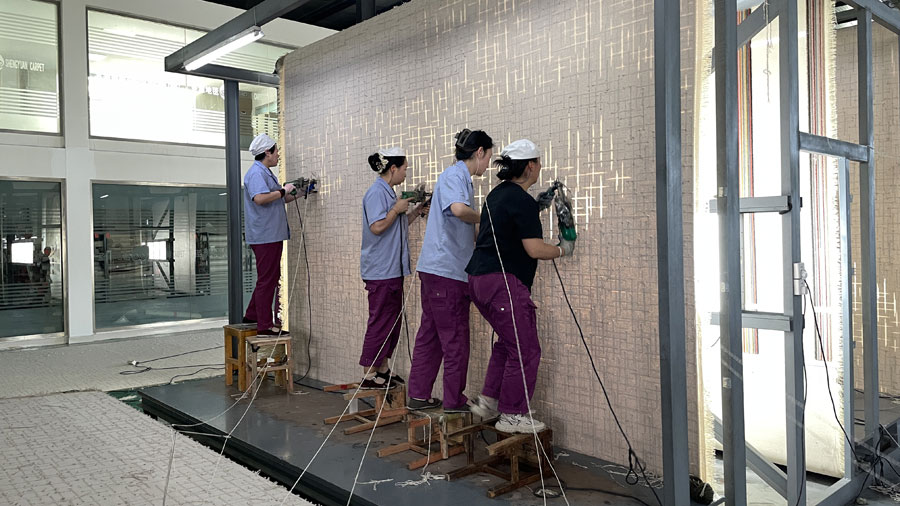
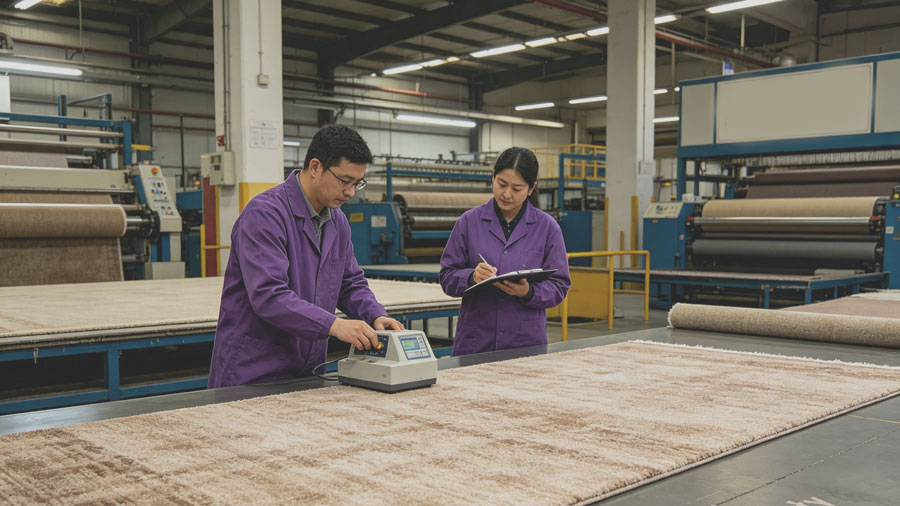
Sourcing through a middleman typically adds 20–30% to the unit price for the same specification, and it adds a layer between you and the actual QC data. Fab Carpet runs pile density testing and tufting uniformity checks on-line, batch by batch, so the test report a buyer receives reflects the actual shipment — not a reference sample from months earlier.
For custom projects, the OEM/ODM path runs: design confirmation → yarn and color matching → pile density and construction sample → client sign-off → bulk production. Each stage gets a physical sample checkpoint before the next one starts, which is what keeps bulk orders matching the approved sample instead of drifting from it.
OEM/ODM custom hotel carpet development process
How to Read a Commercial Carpet Pile Spec Sheet
Before signing off on any quote, confirm these eight data points are on the spec sheet:
- Pile height (inches/mm)
- Face weight (oz/yd² or g/m²)
- Pile density
- Fiber content and blend ratio
- Fire rating and test standard
- Certifications (CRI, CE, MED, UKCA)
- Backing type
- Recommended traffic class
[Downloadable Resource: Download Free B2B Carpet Procurement Checklist PDF]
Estimate Your Project Cost
Match pile height, density, and fiber type to your square footage before you request quotes.
[Interactive Tool: Carpet Calculator
FAQ
What’s the minimum order quantity (MOQ) for custom carpet pile projects?
MOQ depends on construction method — hand-tufted and Axminster runs typically start lower than fully custom hand-knotted orders. Request project-specific MOQ during your RFQ.
How long does sample production take?
Standard reference samples usually ship within 7–10 days. Custom color or pattern samples take longer, since yarn dyeing has to match the approved spec first.
What’s a typical ocean freight lead time?
From Chinese ports to North America or Europe, ocean freight generally runs 25–40 days depending on destination port and season, on top of production lead time.
Can you provide fire test reports before shipment?
Yes — ASTM E648 and CRI GLP test reports should be requested and confirmed at the PO stage, not after production completes.
Does higher pile height always mean lower durability?
Not on its own. Durability depends on density (face weight relative to height), not height alone. A tall, low-density pile wears faster than a shorter, dense one.
Is wool carpet worth the higher upfront cost for hotels?
For high-visibility, high-traffic areas, wool’s resilience and natural fire resistance often lower total cost of ownership over 5–10 years compared to synthetic alternatives.
Get a Quote or Sample Swatches
Request free sample swatches, a technical data sheet (TDS), or submit an RFQ directly to Fab Carpet’s engineering team for project-specific pile recommendations.