Call us now:

Introduction
What is a good carpet density? For commercial buyers, the wrong answer costs far more than a discolored corridor. It means fire-rating disputes, failed inspections, or a supplier who shipped 3,200 when the invoice said 4,800. This guide gives architects and procurement teams the exact numbers, testing methods, and verification steps needed before a single order is placed.
What Is Carpet Density, Exactly?
Density measures how tightly fibers are packed per unit area — not how tall or plush the pile feels. A carpet can have a long pile and still fail under traffic if the yarn is loosely set. That distinction matters more in hospitality and commercial fit-outs than almost anywhere else, because pile height sells the sample, but density determines what the corridor looks like in year four.
Buyers who confuse the two often approve a beautiful showroom swatch, then watch it flatten within eighteen months.
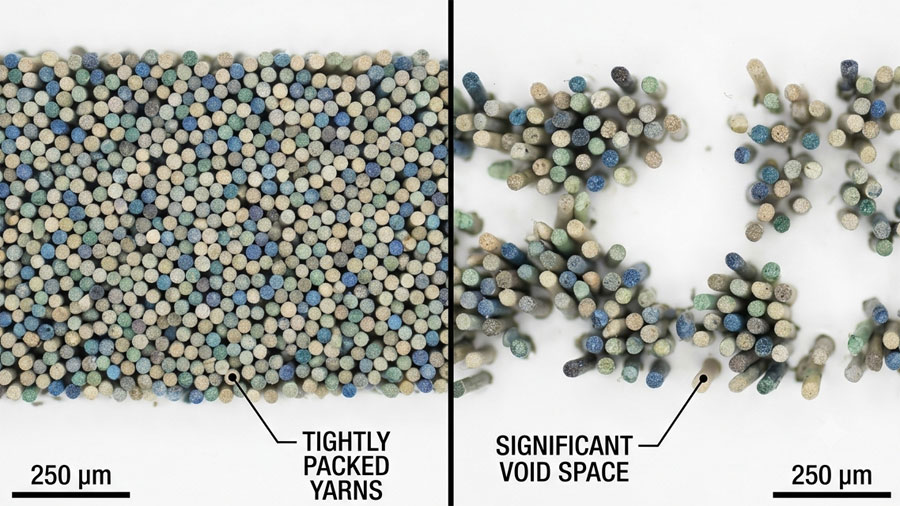
Why Density Gets Misread on Spec Sheets
Suppliers sometimes list face weight alone, letting buyers assume it equals durability. It doesn’t. Two rolls with identical face weight can perform completely differently depending on pile height and tuft count. On Fab Carpet’s production floor, density and face weight are tested and reported as separate figures on every batch — because reporting only one number hides the other half of the story.
How to Calculate Carpet Density (With the Formula)
The standard formula:
Density = (Face Weight × 36) ÷ Pile Height
Face weight is fiber weight per square yard; pile height is fiber length in inches; 36 converts the units. Run the math on two carpets with the same face weight but different pile heights, and the density gap becomes obvious — often by a factor of 1,000 or more.
Net Carpet Area 0.00 sq.ft
Total Carpet Required (With Waste Factor) 0.00 sq.ft
Square Yardage Equivalent 0.00 sq.yd
Waste & Cutting Allowance
Estimates generated are approximate calculations for preliminary planning. Actual roll layouts and seam placements may vary. Professional measurement recommended before ordering.
Good Carpet Density by Traffic Level: The Reference Table
There’s no single “good” number — density needs match traffic load and space function.
| Space Type | Density Rating | Traffic Level | Typical Construction |
|---|---|---|---|
| Hotel Guestroom | 2,500–3,500 | Low-Medium | Machine or hand tufted |
| Hotel Corridor / Lobby | 4,500–6,000+ | Very High | Axminster, wool blend |
| Ballroom / Banquet Hall | 5,000+ | Very High | Axminster |
| Office Walkway | 3,500–4,500 | Medium-High | Tufted, solution-dyed nylon |
| High-Traffic Entertainment & Hospitality Venues | 5,500+ | Very High | Axminster, fire-rated wool |
| Marine Cabins (IMO-Compliant) | 5,000+ | Very High, fire-rated | Wheelmark-certified wool |
ASTM E648 flooring radiant panel test
Material Performance: Wool vs. Synthetic at the Same Density
Density alone doesn’t finish the comparison — fiber type changes how that density behaves under load.
- Premium New Zealand Wool: natural crimp lets fibers spring back after compression, so a wool carpet holds its rated density longer than synthetic equivalents under identical foot traffic.
- Nylon/Synthetic blends: cost-effective, but fibers can permanently deform once crushed past a threshold, even at comparable density ratings.
- Axminster vs. Hand Tufted vs. Hand Knotted: construction method affects how consistently density holds across a large-format roll — Axminster looms typically produce tighter, more uniform density across wide widths than hand methods, which is why it dominates ballroom and corridor specs.
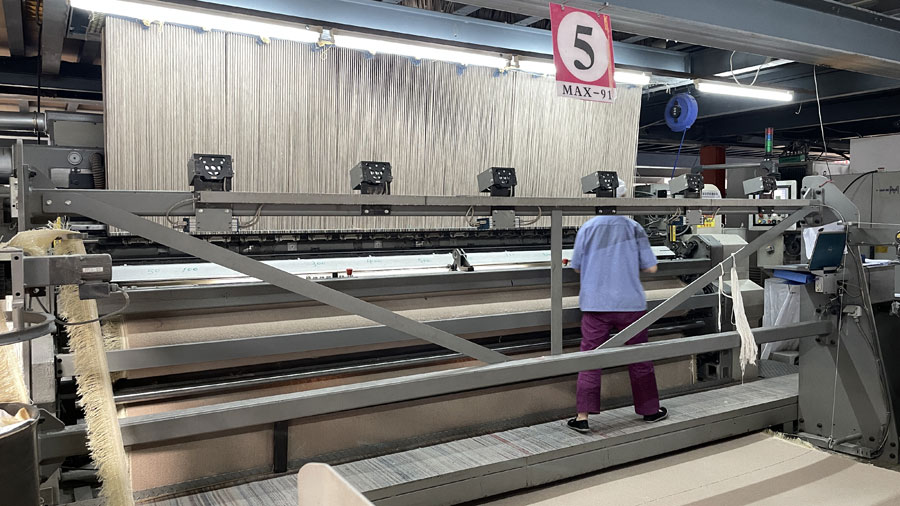
Fire Rating and Certification: What Density Doesn’t Guarantee
A high-density carpet is not automatically compliant. Density and flammability are tested separately, and both belong on a procurement checklist:
- ASTM E648 / Class I — the U.S. standard for critical radiant flux, required for most commercial interiors.
- EN 14041 (CE) / Bfl-s1 — the European equivalent for flooring reaction-to-fire.
- MED Wheelmark — required for any carpet installed on IMO-regulated vessels.
- CRI Green Label Plus (GLP9123 / GLP5308) — indoor air quality certification, increasingly requested by hospitality groups with sustainability mandates.
- ISO 9001 / 14001 / 45001 — quality, environmental, and safety management systems at the manufacturing level.
Fab Carpet’s product lines carry Class I / Bfl-s1 fire ratings and MED Wheelmark certification, tested alongside density on every production batch rather than as a separate afterthought.
browse fire-rated commercial carpet collections
How to Verify a Supplier’s Density Claims Before You Order
This is where most procurement mistakes happen — not in choosing a number, but in trusting an unverified one.
- Request a third-party test report, not just a spec sheet. It should list face weight, pile height, and the resulting density calculation separately.
- Ask for a cut sample, not a photo. Density is measurable by hand on a physical swatch; it isn’t on a screen.
- Check batch consistency. A supplier should be able to explain how density is monitored across production runs, not just on a single approved sample.
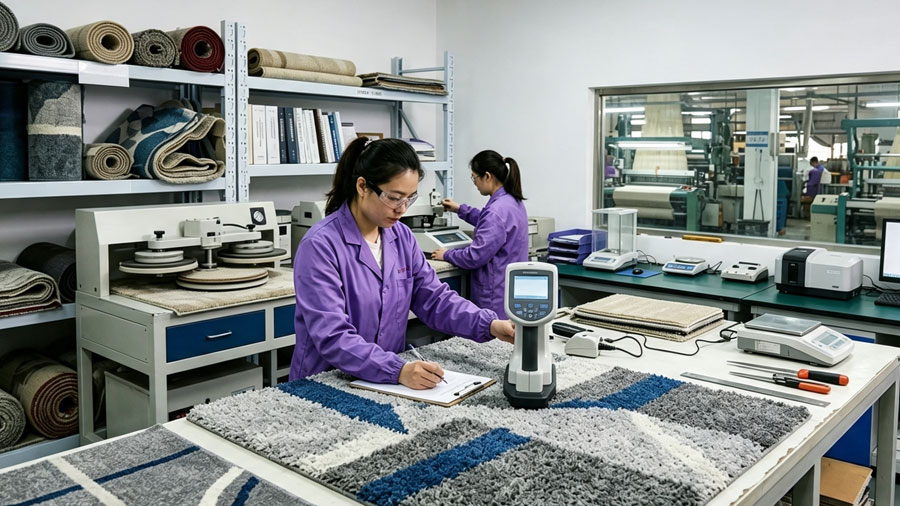
Fab Carpet ships every commercial order under its AAAAA quality standard, with in-house lab testing and documentation attached to the shipment — so the number on the invoice matches the number in the corridor.
Density and Long-Term Cost: Building the Life-Cycle Model
Low-density carpet is cheaper on day one and more expensive over ten years.
| Density Tier | Typical Lifespan | Replacement Frequency | Relative Lifecycle Cost |
|---|---|---|---|
| Low (under 2,000) | 3–5 years | High | Highest over 10 years |
| Medium (2,500–3,500) | 5–8 years | Moderate | Moderate |
| High (4,000+) | 8–12+ years | Low | Lowest over 10 years |
For a 200-room hotel corridor, one avoided replacement cycle often outweighs the entire density upgrade cost. This is the math procurement teams should run before comparing unit prices alone.
Custom Density Specs: MOQ, Lead Time, and Direct-Factory Sourcing
Density can be customized to project spec through OEM/ODM production — but customization affects minimum order quantity and lead time, and buyers should ask about both upfront, not after sampling.
Sourcing directly from a source factory instead of a trading company typically removes 20–30% in middleman markup, because the density, fiber, and fire-rating specs are controlled at the loom rather than negotiated through an intermediary who didn’t manufacture the product. This isn’t a sales point — it’s an engineering one: fewer hand-offs between spec and production means fewer discrepancies between sample and shipment.
Is Higher Density Always Better?
No. A private lounge or guestroom doesn’t need ballroom-grade density, and over-specifying adds cost without added performance. The right question isn’t “how high can density go” — it’s “what traffic level is this space actually built for.”
FAQ
What is a good carpet density for commercial hospitality projects?
Generally 4,500 and above for corridors and lobbies; 2,500–3,500 is sufficient for guestrooms.
What’s the MOQ for custom OEM/ODM density specs?
MOQ varies by construction method — Axminster typically requires higher volume than hand-tufted runs. Request project-specific MOQ during the RFQ stage.
How long does sampling take before bulk production?
Standard samples usually ship within 1–2 weeks; custom density/color matching can take longer depending on approval rounds.
Does Fab Carpet provide third-party fire rating test reports?
Yes — Class I (ASTM E648) and Bfl-s1 (EN 14041) documentation is available for every certified product line.
Is wool always higher density than synthetic?
Not automatically — but wool holds its rated density longer under repeated compression due to natural fiber recovery.
Ready to Specify With Confidence?
Match your project’s traffic level to a verified density spec before the RFQ goes out. Request free sample swatches, a full TDS technical data sheet, or submit your project details for a direct factory quote.