Call us now:

Carpet pad thickness decides more than comfort. Get it wrong on a hotel renovation and you face fire code rejections, acoustic complaints from guests, or a pad that flattens within two years. This guide gives architects, designers, and procurement teams the exact thickness, density, and compliance numbers used on real commercial projects — not generic home-improvement advice.
1. Carpet Pad Thickness vs. Carpet Pile Height — Two Different Measurements
Most online guides mix up carpet pad thickness with carpet pile height. They are not the same thing, and the confusion causes real spec errors.
Pad thickness measures the cushioning layer under the carpet. Pile height measures the fiber layer on top. A spec sheet that lists only one number leaves your installer guessing about the other — and on ADA-regulated projects, the combined height at doorways and transitions has a hard compliance limit.
Why This Matters for Spec Writers
When you write “3/8 inch pad,” confirm whether that figure includes the carpet face or refers to the pad alone. Total system height (pad + carpet backing + pile) is what inspectors measure against ADA threshold rules, typically capped at 1/2 inch for wheelchair transitions.
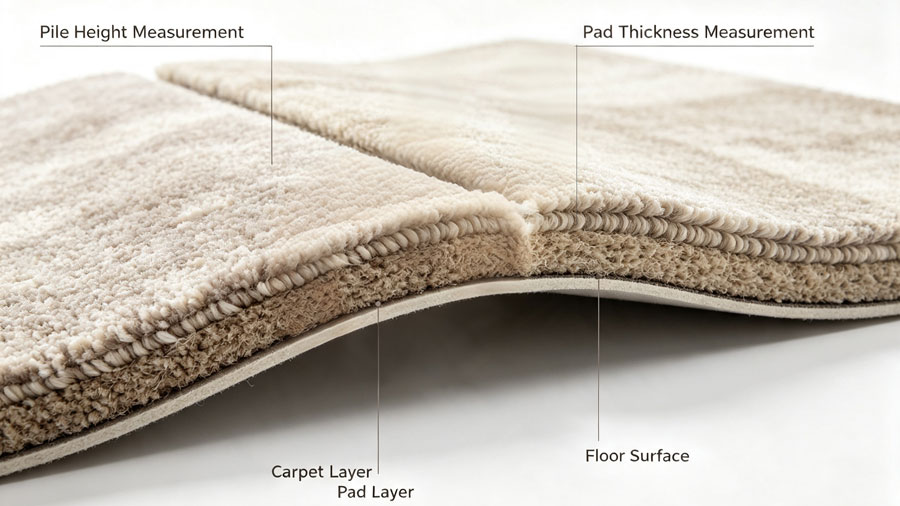
| Measurement | What It Covers | Typical Commercial Range |
|---|---|---|
| Pad Thickness | Cushioning layer only | 1/4″ – 3/8″ |
| Pile Height | Carpet fiber layer | 1/8″ – 1/2″ |
| Total System Height | Pad + backing + pile | Must meet ADA threshold limits |
2. Standard Carpet Pad Thickness Ranges for Commercial Projects
Residential guides recommend up to 7/16 inch. That range does not transfer to commercial floors, and using it on a hotel job is a common procurement mistake.
Residential Range vs. Commercial Reality
Homes prioritize softness. Commercial spaces prioritize load resistance and long-term flatness under rolling carts, foot traffic, and furniture. A 7/16-inch pad in a hotel corridor compresses unevenly within months.
Recommended Thickness by Zone
Guest rooms tolerate slightly thicker pad (up to 3/8 inch) because traffic is lighter. Corridors, lobbies, and high-traffic commercial spaces need thinner, denser pad — often 1/4 inch or less — to resist matting and maintain a stable surface for wheeled equipment.
High-Traffic Entertainment Areas and Lobby Zones
Venues with constant foot flow — conference centers, entertainment and leisure facilities, banquet halls — need pad selected for density first, thickness second. A thin, dense pad outlasts a thick, soft one by years in these zones.
3. The Density Formula B2B Buyers Actually Need
“8-pound pad” tells you weight. It does not tell you how the pad performs under sustained load. Density (measured in pounds per cubic foot) and compression set rating together determine actual lifespan.
Compression Set Rating Explained
Compression set measures how much a pad’s thickness permanently decreases after repeated pressure. Two pads at the same weight can have very different compression set percentages depending on manufacturing process. This number, not the weight label, predicts how your carpet will look in year three.
Matching Density to Traffic Volume
| Area Type | Recommended Density | Recommended Thickness |
|---|---|---|
| Guest Rooms | 6–8 lb/ft³ | 3/8″ |
| Corridors & Stairwells | 8–10 lb/ft³ | 1/4″ |
| Lobbies & Ballrooms | 10 lb/ft³+ | 1/4″ or less |
| High-Traffic Entertainment Areas | 10 lb/ft³+ | 1/4″ or less |
Test each production batch, not just the product line. Fab Carpet runs compression recovery testing on every batch at its Qinghai facility before shipment, because pad performance can shift between production runs even within the same nominal density rating.
Interactive Tool: Calculate your project’s recommended pad thickness and density
4. Material Deep-Dive: Pad and Face Fiber Working Together
Pad selection cannot happen separately from face material selection. The two interact.
Pad Materials Compared
Rebond pad, made from recycled foam offcuts, offers reliable density at moderate cost and remains the standard choice for most commercial floors. Urethane foam gives a softer feel but compresses faster under heavy rolling loads. Fiber pad handles moisture better and suits areas with spill risk.
Face Material and Thickness Interaction
Premium New Zealand wool holds its pile height longer than synthetic fibers, which means it pairs well with thinner pad in high-traffic zones — the wool itself provides resilience that synthetic fibers rely on the pad to supply.
Axminster construction, woven with intricate patterns, needs a stable, low-thickness pad so the pattern does not distort under foot traffic. Hand-tufted and hand-knotted carpets carry their own backing weight, which changes the total system height calculation and needs pad thickness adjusted accordingly.
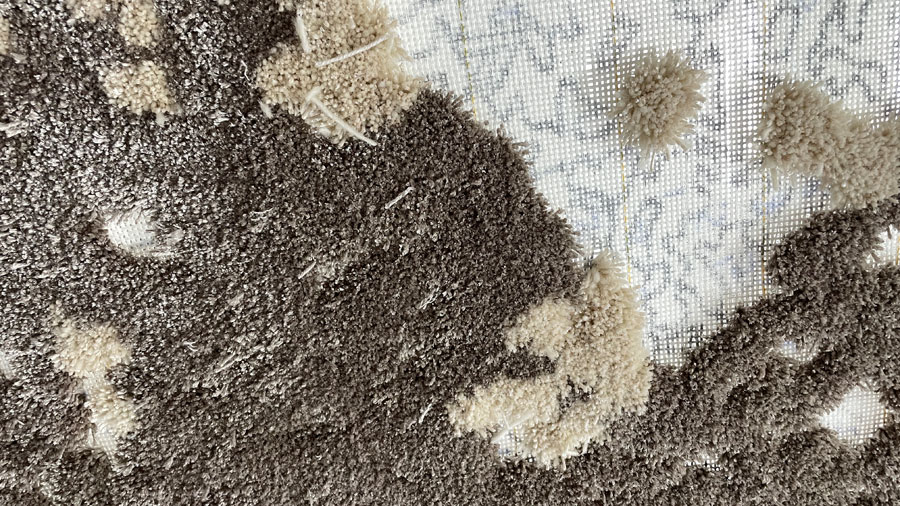
Fab Carpet produces across all four constructions — Axminster, hand-tufted, hand-knotted, and machine-made — under one facility, which lets a single order combine construction types without splitting across multiple suppliers.
5. Fire Rating, Acoustic Performance, and Certification Requirements
This is the section most guides skip entirely, and it is where commercial projects fail inspection.
Fire Safety Classification
Commercial carpet systems in North America need Class I fire rating per ASTM E648, based on critical radiant flux testing. European projects reference Bfl-s1 under EN 13501-1. These are not interchangeable labels — confirm which standard your project’s jurisdiction requires before ordering.
Acoustic Performance
Pad thickness and density directly affect Noise Reduction Coefficient (NRC) and Impact Insulation Class (IIC) ratings. Thicker, softer pad absorbs more impact noise but performs worse under heavy rolling traffic. Hotel developers need to balance guest room acoustic comfort against corridor durability — they are different specs for different zones.
Marine and Regional Compliance
Cruise and marine hospitality projects require MED Wheelmark certification under IMO Marine Standards, a separate approval process from land-based building codes. For EU projects, confirm EN 14041 (CE marking). UK projects post-Brexit need UKCA or UKMCA marking. North American buyers should request CRI Green Label Plus certification (GLP9123 for pad, GLP5308 for adhesives) as proof of indoor air quality compliance.
CRI Green Label Plus certified products
Fab Carpet holds ISO 9001, 14001, and 45001 certification alongside AAAAA Quality Standard rating and Class I fire rating documentation — the paperwork buyers need on file before a project passes inspection, not after.
View our full certification documentation
6. Matching Pad Thickness to Project Type
| Project Type | Thickness | Density | Fire Class |
|---|---|---|---|
| Guest Rooms | 3/8″ | 6–8 lb/ft³ | Class I |
| Corridors | 1/4″ | 8–10 lb/ft³ | Class I |
| Ballrooms & Entertainment Areas | 1/4″ or less | 10 lb/ft³+ | Class I |
| Cruise/Marine | Per MED spec | 10 lb/ft³+ | MED Wheelmark |
Retail and office fit-outs generally follow the corridor spec — thin, dense, stable under rolling loads.
7. Sourcing, MOQ, and Landed Cost: What Procurement Teams Miss
Distributor markup on commercial carpet orders typically runs 20–30% above factory pricing. That margin covers warehousing and reselling, not manufacturing.
Factory-Direct vs. Distributor
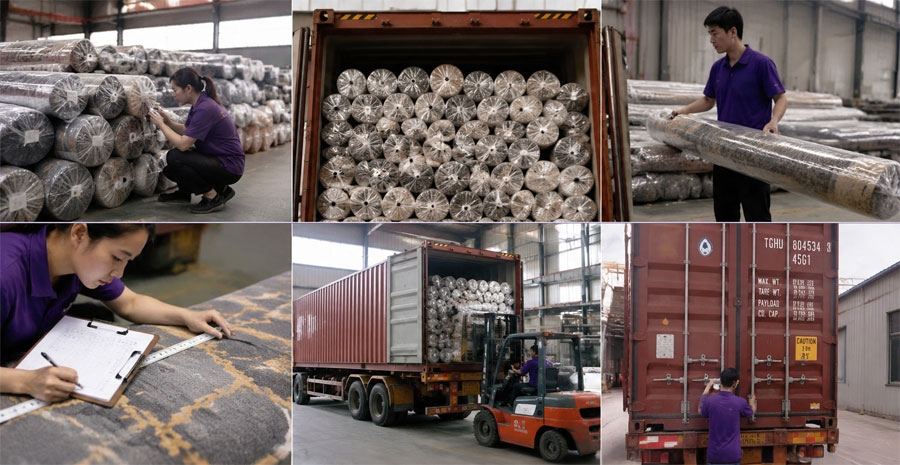
A factory-direct order gives you FOB pricing, tiered MOQ based on order volume, and direct visibility into container loading schedules. A distributor adds a layer between you and the production floor, which also adds a layer of risk when specs need last-minute adjustment.
Supplier Vetting Checklist
Ask any supplier for three things before signing a PO: current test reports for fire and acoustic ratings, factory audit access, and a sample from the exact production batch — not a marketing sample. Fab Carpet supports OEM/ODM orders with tiered MOQ structures and factory audit access, so procurement teams can verify production standards before committing to full-volume orders.
Request tiered pricing for your project volume
8. Total Cost of Ownership: The Number Competitors Skip
Upfront pad price rarely reflects the real cost of a commercial flooring decision.
Replacement Cycle by Density
Low-density pad in a high-traffic corridor often needs replacement within 3–4 years. Mid-to-high density pad in the same location commonly runs 7–10 years before replacement. Multiply that gap by square footage across a full hotel property and the cost difference is significant.
The Cheapest Pad Is Often the Most Expensive Choice
A renovation budget built around lowest upfront pad cost usually pays for a second full replacement cycle within a decade. Spec density and compression set rating first, price second.
9. Installation and Quality Control From Factory to Site
Pre-Installation Checklist
Confirm moisture barrier presence, subfloor condition, and seaming plan before pad arrives on site. Mismatched pad thickness across a single floor creates visible seams and uneven wear patterns.
Batch Traceability
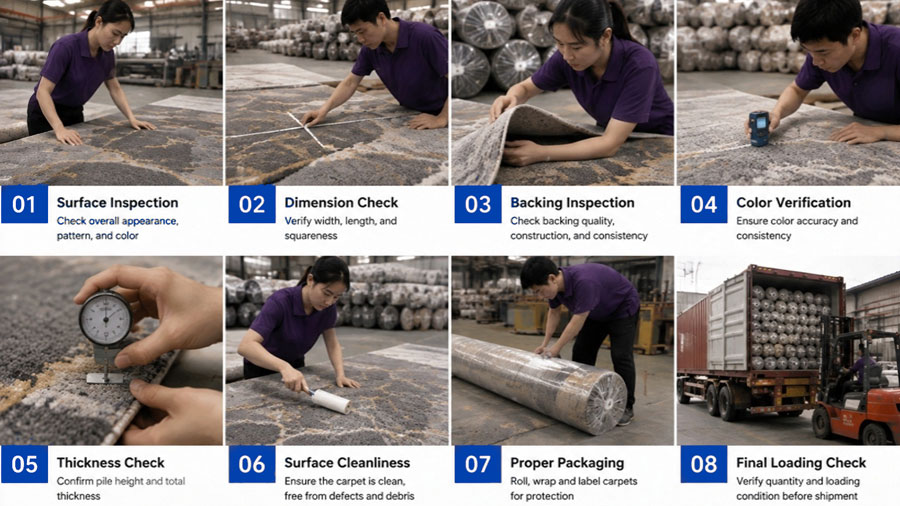
Every Fab Carpet order carries batch-level documentation, so if a defect surfaces after installation, the production run can be traced and addressed without guessing which shipment caused it.
Frequently Asked Questions
What is the standard carpet pad thickness for hotel corridors?
Most hotel corridors use 1/4 inch pad at 8–10 lb/ft³ density, chosen for stability under rolling luggage carts and housekeeping equipment rather than for softness.
Does a thicker pad automatically improve fire rating?
No. Fire rating depends on the tested assembly — pad plus carpet face plus adhesive — not thickness alone. Always request the ASTM E648 or Bfl-s1 test report for the exact assembly you plan to install.
What is the typical MOQ for OEM/ODM carpet orders?
MOQ varies by construction type and customization level. Fab Carpet offers tiered MOQ structures, with lower thresholds for machine-made carpet and higher thresholds for fully custom hand-knotted orders.
How long does sample shipping take?
Standard sample swatches typically ship within 3–5 business days of request confirmation.
What is the typical sea freight lead time from a Chinese factory?
Ocean freight to North America or Europe generally runs 25–40 days depending on port and destination, plus production lead time based on order volume and construction complexity.
Can I get a copy of fire and acoustic test reports before ordering?
Yes. Request current ASTM E648, EN 13501-1, or CRI Green Label Plus documentation directly from your supplier before finalizing a purchase order — any reputable manufacturer will provide this without delay.
Get Your Project-Specific Spec Recommendation
Pad thickness is one variable in a larger system. Density, fire class, acoustic target, and certification all need to align with your project type before you finalize a spec.
Request free sample swatches, submit an RFQ for your project volume, or download the full technical data sheet (TDS) for Fab Carpet’s commercial pad and carpet construction options.