Call us now:

A wrong novelty commercial carpet order costs more than money. It costs a failed fire inspection, a missed opening date, or a floor that wears out in three years instead of fifteen. This guide breaks down the engineering, compliance, and sourcing decisions that separate a durable contract-grade floor from an expensive mistake — written from the factory floor, not a showroom.
What Actually Defines a “Novelty” Commercial Carpet
Buyers use “novelty,” “custom,” and “bespoke” interchangeably. Suppliers don’t. A novelty carpet uses a stock pattern library with color changes. A custom carpet involves a new design file built to your specification. A bespoke order includes fiber blend, construction method, and pattern engineered together for one project.
That distinction changes your minimum order quantity, your lead time, and your price per square meter. Ask your supplier which category your project falls into before you request a quote — it prevents scope confusion later.
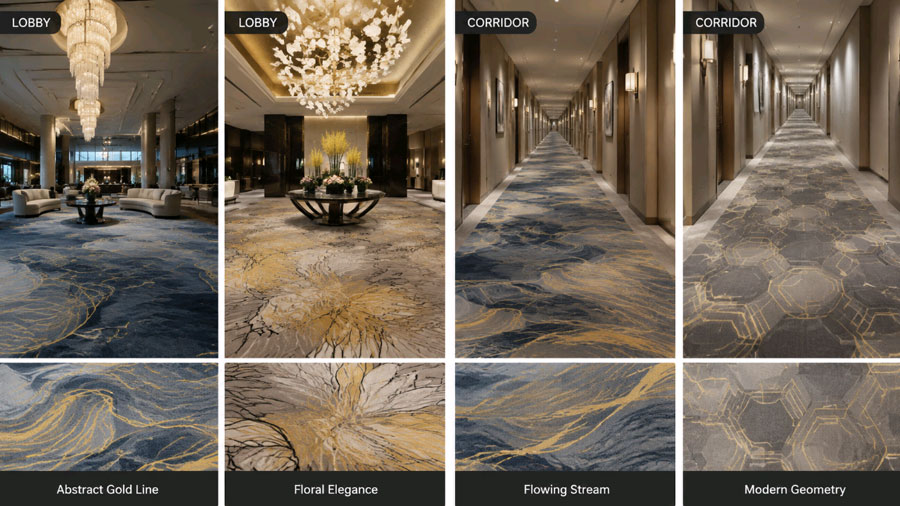
Pattern choice isn’t decorative alone. It’s a wear-management tool. Busy corridors and high-traffic commercial spaces hide soil and vacuum lines far better under a broken pattern than under a solid color. Lobbies, guest floors, and high-traffic entertainment areas all carry different wear loads, and the pattern scale should match that load — not just the room’s mood board.
Material & Construction: The Engineering Behind Performance
Aesthetics get the meeting scheduled. Fiber and construction decide whether the contract renews.
Fiber Comparison: Wool, Wool-Nylon Blend, and Solution-Dyed Nylon
Premium New Zealand wool gives natural flame resistance, color depth, and a resilient pile that recovers after heavy foot traffic. Solution-dyed nylon costs less and resists staining well but compresses faster under continuous commercial use. An 80/20 wool-nylon blend splits the difference — most hospitality specifications land here for a reason.
| Fiber | Wear Resistance | Fire Resistance | Stain Resistance | Relative Cost |
|---|---|---|---|---|
| 100% New Zealand Wool | High | Excellent (natural) | Moderate | High |
| 80/20 Wool-Nylon Blend | High | Very Good | Good | Mid-High |
| Solution-Dyed Nylon | Moderate-High | Requires treatment | Excellent | Mid |
Construction: Axminster, Hand Tufted, Hand Knotted, or Machine-Made
Axminster weaving produces the sharpest pattern definition and the longest service life — the standard for lobbies and ballrooms that need to look flawless for a decade. Hand tufted work suits faster turnarounds and mid-range budgets. Hand knotted construction is reserved for heritage or ultra-premium suites where texture and craftsmanship carry the design. Machine-made broadloom and carpet tile fit budget-sensitive, high-volume rollouts across multiple properties.
At Fab Carpet’s production lines, each construction method runs on dedicated equipment calibrated to a fixed pile weight tolerance — a detail that matters more than most quotes disclose, because pile weight variance between rolls is what causes visible pattern mismatch on-site.
Pile Height, Pile Weight, and Density
Density determines durability more than any other single spec:
Density = (Pile Weight in oz/yd² × 36) ÷ Pile Height in inches
For high-traffic commercial spaces, specify a density above 4,000. Below 3,000, the carpet will show traffic lanes within eighteen months regardless of fiber quality.
Material × Construction × Density Specification Table
View full fiber and construction specifications
| Fiber Material | Construction Type | Typical Specs (Weight / Height) | Calculated Density | Durability Level | Traffic Suitability | 18-Month Matting Risk |
|---|---|---|---|---|---|---|
| Nylon 6,6 (Premium Synthetic) | Axminster Woven | 36 oz/yd² | 0.28 in | 4,628 | Severe Duty | Hotel Corridors, Ballrooms, Airports | Very Low (< 5%) |
| Nylon 6,6 (Premium Synthetic) | Level Loop Tufted | 28 oz/yd² | 0.18 in | 5,600 | Severe Duty | High-Traffic Offices, Classrooms | Very Low (< 3%) |
| Wool Blend (80% Wool / 20% Nylon) | Axminster Woven | 42 oz/yd² | 0.32 in | 4,725 | Heavy Duty | Luxury Hotels, Casino Floors, Suites | Low (< 8%) |
| Wool Blend (80% Wool / 20% Nylon) | Hand-Tufted / Cut Pile | 55 oz/yd² | 0.50 in | 3,960 | Moderate Commercial | VIP Lounges, Executive Boardrooms | Moderate (15-20%) |
| Solution Dyed Nylon (SDN) (Commercial Standard) | Textured Loop Tile | 24 oz/yd² | 0.15 in | 5,760 | Severe Duty | Open Plan Offices, Banks, Retail | Extremely Low |
| Solution Dyed Nylon (SDN) (Commercial Standard) | Cut & Loop Patterned | 32 oz/yd² | 0.28 in | 4,114 | Heavy Duty | Hotel Guestrooms, Conference Rooms | Low (< 10%) |
| Polypropylene (Olefin) (Economy Synthetic) | Multi-Level Loop | 20 oz/yd² | 0.20 in | 3,600 | Light-Medium Commercial | Low-Traffic Offices, Meeting Rooms | Moderate (20-30%) |
| Polypropylene (Olefin) (Economy Synthetic) | Cut Pile Plush | 26 oz/yd² | 0.35 in | 2,674 | Sub-Standard (<3k) | Low-Traffic Residential / Light Office | High Matting Failure (> 80%) |
| Polyester (PET) (Eco Soft Fiber) | Cut Pile Tufted | 30 oz/yd² | 0.40 in | 2,700 | Sub-Standard (<3k) | Guest Bedrooms (Light Traffic Only) | High Matting Failure (> 75%) |
Compliance & Safety Standards Most Guides Skip
This is the section that decides whether your carpet clears customs, passes fire marshal review, and gets approved by the architect of record. Skip it and the rest of the specification is irrelevant.
Fire Rating: ASTM E648 Class I vs. Bfl-s1
North American commercial projects require Class I fire rating under ASTM E648 — a critical radiant flux above 0.45 W/cm². European and UK projects reference Bfl-s1 under EN 13501-1. Confirm which standard your local authority having jurisdiction enforces before ordering; the two aren’t interchangeable on a compliance document.
Indoor Air Quality: CRI Green Label Plus
CRI Green Label Plus certification (product certificate numbers such as GLP9123 and GLP5308) confirms low VOC emissions — a growing requirement for LEED-tracked hospitality and corporate projects.
Marine Projects: IMO MED Wheelmark
Cruise line and marine interior projects require IMO MED Wheelmark approval under the Marine Equipment Directive. This is a separate certification from land-based fire ratings and often gets missed in early-stage RFQs.
UK Market Access: UKCA / UKMCA
Post-Brexit UK imports need UKCA or UKMCA marking. A CE mark alone no longer guarantees UK market entry for carpet shipments.
Supplier Risk: Why ISO 9001 / 14001 / 45001 Matters
These aren’t marketing badges. ISO 9001 confirms documented process control at the factory. ISO 14001 confirms environmental management. ISO 45001 confirms workplace safety systems. A supplier without these certifications is a supplier without an audit trail — and no audit trail means no accountability when a shipment fails inspection.
Fab Carpet holds ISO 9001, 14001, and 45001 certification alongside CRI Green Label Plus, EN 14041 (CE), MED Wheelmark, and UKCA/UKMCA — the certification set that covers North American, European, UK, and marine project requirements without requiring a second supplier relationship.
[Downloadable Resource: Download Free International Commercial Carpet Compliance & Certification Checklist PDF]
Reference full standard requirements
High-Traffic Performance & Acoustic Requirements
Acoustic Ratings: NRC and STC
Corridors and open lobbies in hospitality projects often carry acoustic requirements alongside wear requirements. NRC (Noise Reduction Coefficient) measures sound absorption; STC (Sound Transmission Class) measures sound blocking between floors. Wool-rich construction with a felt or rubber backing typically outperforms thin nylon tile on both metrics.
Matching Wear Rating to Traffic Zone
| Zone | Recommended Density | Recommended Construction |
|---|---|---|
| Guest Rooms | 3,000–4,000 | Hand Tufted / Machine-Made |
| Corridors | 4,000–5,000 | Axminster |
| Lobby / Ballroom | 5,000+ | Axminster |
| High-Traffic Entertainment Areas | 5,500+ | Axminster, wool-nylon blend |
2026 Novelty & Pattern Design Trends for Commercial Spaces
Geometric patterns with tone-on-tone contrast continue replacing dense floral medallions in new-build hospitality projects — they read as current without dating quickly. Recycled-content wool blends are moving from a sustainability checkbox to a standard spec line in RFQs. Carpet tile adoption is rising in mixed-use lobbies because it allows phased replacement without shutting down the space. Subtle logo or brand-motif integration remains popular, but the direction is toward understatement — a tonal watermark rather than a bold repeat.
Fab Carpet’s design studio runs CAD-to-loom sampling, which shortens the concept-to-physical-sample cycle to roughly two to three weeks for standard Axminster patterns — a timeline that matters when a project’s design approval window is tight.
Browse current pattern and colorway options
From Concept to Installed Floor: The Source-Factory Procurement Process
Supplier Vetting: Red Flags for Trading-Company Middlemen
Ask for the factory address, production capacity, and a video walkthrough of the actual production floor. A supplier who can’t provide these — or who routes every question through a sales office with no factory access — is likely a trading company adding a markup layer with no manufacturing control.
MOQ, Tiered Pricing, and Cost Breakdown
Custom Axminster orders typically carry higher MOQs than machine-made tile due to loom setup costs. Tiered pricing usually breaks at three volume points — sample/pilot quantity, single-property rollout, and multi-property portfolio orders. Ask for the cost breakdown by yarn, weaving, backing, and finishing — a supplier who won’t itemize this is padding the quote somewhere.
Sampling, QC, and Shipment
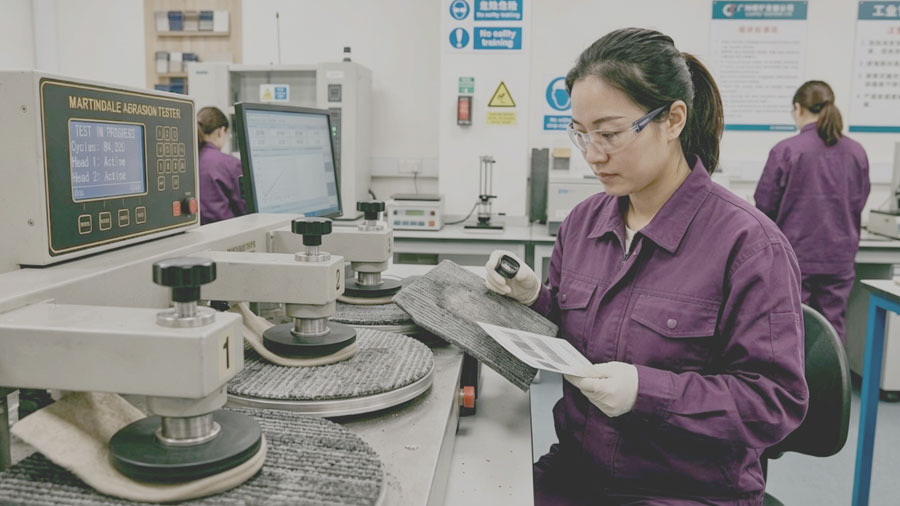
Digital color-matching and physical strike-offs should happen before bulk production starts. Fab Carpet runs in-line quality checks at three production stages plus a final third-party AQL inspection before any shipment leaves the facility — a control point that catches pattern drift or color variance before it reaches a job site, not after.
The Middleman Markup
Sourcing through a trading company typically adds 20–30% to landed cost, with less visibility into production timelines and no direct QC access. Factory-direct sourcing removes that layer — the trade-off is that the buyer needs to do more upfront vetting, which is exactly what the checklist above is built for.
Interactive Tool: Estimate your project cost and lead time
Maintenance & Total Cost of Ownership
Wool fiber requires professional dry extraction cleaning and resists soiling naturally due to its scale structure. Nylon tolerates more frequent hot-water extraction but shows matting sooner under heavy traffic.
A well-specified Axminster wool-blend carpet in a corridor or lobby typically runs 10–15 years before replacement, versus 5–8 years for budget machine-made nylon in the same traffic zone. The higher upfront cost of premium construction usually resolves into a lower cost per year of service — run the numbers for your specific traffic volume before defaulting to the cheaper quote.
Frequently Asked Questions
What’s the MOQ for a custom OEM/ODM novelty carpet order?
It depends on construction method — machine-made tile MOQs are lower than custom Axminster, which requires loom setup. Request a project-specific MOQ during your RFQ.
How long does sampling take before bulk production?
Digital strike-offs typically take 5–7 business days; physical loom samples for Axminster run two to three weeks.
What fire rating do I need for a US hospitality project?
Class I under ASTM E648 is the standard requirement for most US commercial interiors — confirm with your local fire marshal for project-specific codes.
Can I get a test report before placing a bulk order?
Yes. Reputable manufacturers provide third-party lab test reports for fire rating and CRI Green Label Plus compliance on request, before contract signing.
What’s a typical sea freight lead time from a China-based factory?
Production plus sea freight to North America or Europe typically runs 8–12 weeks total, depending on order volume and destination port.
Does Fab Carpet support both hand-tufted and Axminster production for one project?
Yes — mixed-construction orders for a single property (e.g., Axminster for public areas, tufted for guest rooms) run on parallel production lines to meet a single delivery date.
Next Step
Specifications only prove value once they’re in hand. Request free sample swatches to test fiber and colorway in your actual lighting conditions, or submit an RFQ for a project-specific quote with lead time and landed cost included.