Call us now:

How often does carpet need to be replaced in a hotel or commercial project? Most specified carpet lasts 7 to 15 years, but a wrong spec can cut that in half. The cost shows up as budget overruns, a fire certificate rejected at inspection, or a late shipment that triggers penalty clauses. Every figure below is indicative and tied to a test or standard. This guide gives you replacement cycles by zone, the engineering variables behind them, a simple total cost method, and a sourcing checklist drawn from our factory delivery experience. Use it to write a tighter spec and a budget you can defend.
How Often Does Carpet Need to Be Replaced? Cycles by Space Type
Commercial carpet has no single lifespan. Timing depends on zone traffic, fiber, construction, cleaning regime and brand standards. In most hospitality projects, guest-room carpet runs 8 to 12 years. Entrances and lift lobbies often need replacing in 4 to 7.
Indicative Replacement Cycles for Hotels and Commercial Projects
| Space | Typical cycle | Main cause of replacement |
|---|---|---|
| Guest rooms | 8–12 years | Appearance loss, staining |
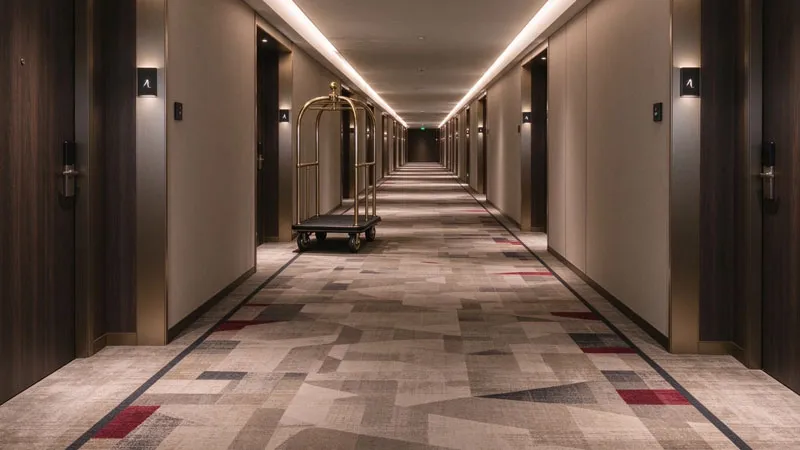
| Corridors | 6–10 years | Rolling loads, pile crush |
| Lift lobbies and entrances | 4–7 years | Grit, moisture, abrasion |
| Main lobbies | 5–8 years | Heavy foot traffic, seating zones |
| Ballrooms and meeting rooms | 7–12 years | Furniture marks, event turnover |
| High-traffic entertainment areas | 4–7 years | Continuous traffic, spills |
| Offices | 8–12 years | Chair castors, seam wear |
These ranges reflect field experience, not warranties. Your result moves with the variables in the next section.
Why Homeowner Lifespan Advice Does Not Apply
Consumer articles quote 5 to 15 years and halve it for pets. Commercial buyers face different triggers.
Hotels rarely replace carpet because it wore through. They replace it because it no longer meets brand standard: crushed pile, shaded traffic lanes, permanent stains, frayed seams. Engineers call this appearance retention. Specify for it, and you extend real service life more than any cleaning contract will.
What Determines Commercial Carpet Lifespan: The Engineering Variables
Four variables decide how often carpet needs to be replaced: fiber, pile density, construction and installation.
Fiber: Premium New Zealand Wool, Nylon 6.6 and PET
| Fiber | Resilience | Colorfastness | Typical use |
|---|---|---|---|
| Premium New Zealand Wool | High, recovers from crush | Good | Guest rooms, corridors, ballrooms |
| 80/20 wool-nylon blend | Very high | Good | Corridors, lobbies, entertainment areas |
| Solution-dyed nylon 6.6 | High | Excellent, color runs through the fiber | Entrances, spill-prone areas |
| PET | Moderate, crushes sooner | Good in light use | Low-traffic, budget-led zones |
Fab Carpet works mainly with Premium New Zealand Wool. Wool is naturally flame-resistant and recovers well from compression. Blending in 20% nylon raises abrasion resistance and keeps the soft hand feel guests expect.
Premium New Zealand wool carpet collection
Pile Weight, Pile Height and Density
Two carpets with the same height can last very different periods. Density explains why. Use this formula:
Pile density (kg/m³) = Pile weight (g/m²) ÷ Pile height (mm)
Example: 700 g/m² ÷ 7 mm = 100 kg/m³. Higher density packs more fiber into each cubic meter, so the pile resists crushing.
Ask every supplier for pile weight, pile height and gauge in writing. If a quote only says “high-quality wool,” ask for the numbers. Every Fab Carpet quotation lists them on the technical data sheet.
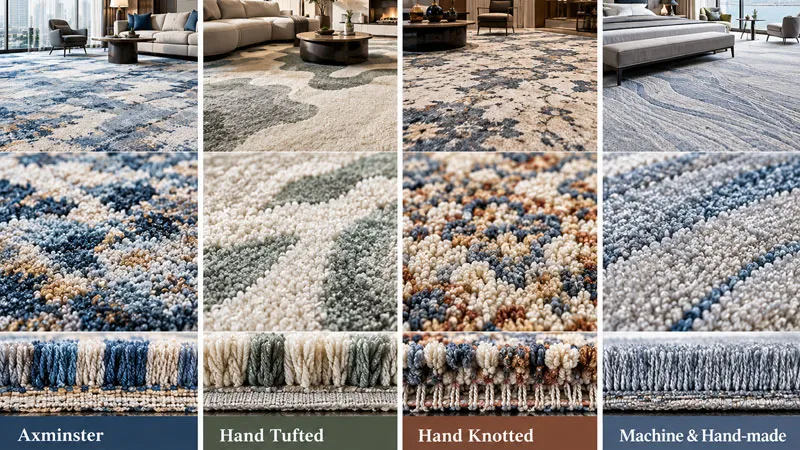
Construction: Axminster, Hand Tufted, Hand Knotted and Machine & Hand-Made
| Method | Strength | Best for | Production capacity |
|---|---|---|---|
| Axminster | Precise patterns, consistent batches, volume | Guest rooms, corridors | 1,800,000 sqm |
| Hand tufted | Free-form design, sculpted effects | Ballrooms, suites, VIP areas | 36,000 sqm |
| Machine & hand-made | Machine base with hand-finished detail | Feature zones, logos | 100,000 sqm |
| Hand knotted | Highest detail, fully bespoke | Statement areas | Made to order |
We run all four methods in one factory network. That means one color-matching standard across zones, and one supplier to hold accountable when a project mixes methods.
Underlay, Installation and Maintenance
Weak underlay kills face fiber early. Match underlay density to the traffic class. Glue-down suits corridors with trolleys. Stretched installation suits guest rooms with quality underlay.
Maintenance sets the rest. Vacuum traffic lanes daily. Treat spills within minutes. Schedule hot-water extraction by zone, not by calendar. Hand a written maintenance plan to the operations team at project handover.
How to Verify a Lifespan Claim: Wear Ratings and Test Standards
Any supplier can say “15 years.” Ask for the test behind it.
EN 1307 Use Classes
EN 1307 groups carpet by intended use. Classes 31 to 33 cover commercial use from moderate to heavy. Classes 41 to 43 cover heavy-duty use. Many specifiers target Class 31 or 32 for guest rooms and Class 33 for corridors and lobbies.
Appearance Retention Testing
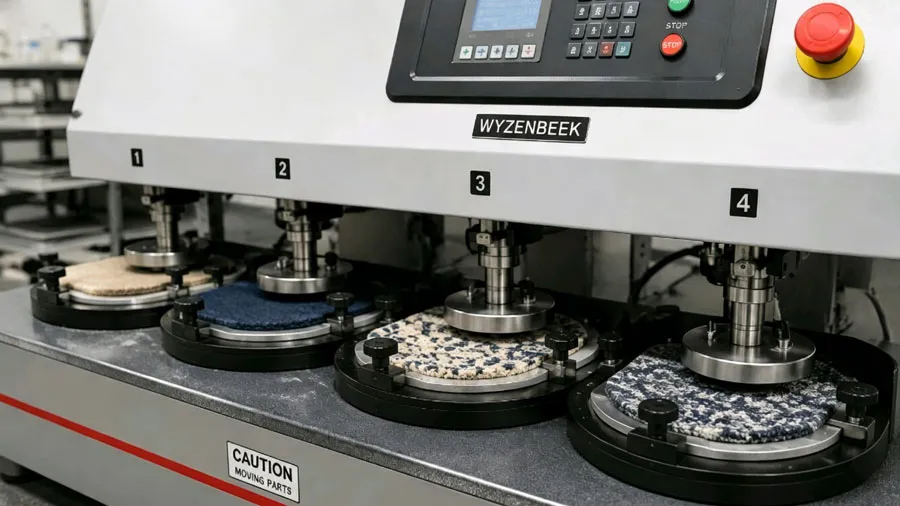
Hexapod tumbler and Vettermann drum tests simulate foot traffic and castor wheels. Assessors then grade the change in surface appearance. Both methods sit under ISO 10361.
Request the report for the exact construction you are buying, not a similar one. We release test data per construction, so buyers can compare it with the project spec before ordering.
ISO 10361 textile floor coverings appearance change test standard
Certifications That Affect Approval and Replacement Timing
A carpet that fails certification gets removed before it wears out. Check the paperwork against the destination market.
Fire Performance: ASTM E648 Class I and EN 13501-1 Bfl-s1
ASTM E648 measures critical radiant flux. Class I means a result of at least 0.45 W/cm². EN 13501-1 grades reaction to fire in Europe, and Bfl-s1 is a common hospitality requirement. Fab Carpet products carry Class I (ASTM E648) and Bfl-s1 ratings.
Indoor Air Quality: CRI Green Label Plus
CRI Green Label Plus tests for low VOC emissions. It supports LEED and WELL documentation. Our certificates are GLP9123 and GLP5308. Check any supplier’s number in the public directory before you sign.
CRI Green Label Plus certified products directory
Market Access and Factory Systems
- EU: EN 14041 with CE marking
- UK: UKCA and UKMCA
- Cruise and marine: MED Wheelmark (IMO standard)
- Factory systems: ISO 9001, ISO 14001, ISO 45001 and AAAAA Quality Standard
Management certificates matter because they show process control. Process control is what keeps batch two identical to batch one.
Specifying for High-Traffic Corridors and Entertainment Venues
Acoustic Performance: NRC and Impact Noise
Carpet raises NRC (ASTM C423) and cuts impact noise (IIC or ΔLw). STC depends mainly on wall and floor assemblies. Do not expect carpet to fix airborne sound transmission. Wool over a dense underlay gives strong impact-noise and room-echo reduction.
Rolling Loads, Pattern and Color
Luggage carts, room-service trolleys and cleaning machines drive corridor wear. Use dense pile and glue-down installation. Choose medium-tone, multi-color patterns, which hide traffic marks and extend perceived lifespan. Plain light colors show wear first.
Signs It Is Time to Replace Commercial Carpet
- Physical failure: tuft loss, exposed backing, seam opening, rippling, delamination
- Appearance failure: shaded traffic lanes, permanent stains, color fade near windows
- Health and safety: musty odor that survives extraction, moisture damage, trip hazards
- Compliance: a new code or brand standard the installed carpet cannot meet
Repair, Spot Replace or Full Replacement
Repair isolated burns and seam issues. Spot replace damaged areas from reserve stock. Replace the full zone when patches become visible from standing height.
Keep 3 to 5 percent attic stock from the same dye lot. It makes spot replacement possible years later.
Total Cost of Ownership: What Carpet Really Costs per Year
Purchase price tells you little. Use this formula:
TCO per sqm per year = (purchase + freight and duties + installation + removal + maintenance + downtime loss − residual value) ÷ service years
Illustrative example for a 10,000 sqm corridor refit:
- Option A: $38/sqm installed, lasts 5 years. Two cycles in 10 years cost $76/sqm, or $760,000.
- Option B: $56/sqm installed, lasts 10 years. One cycle costs $56/sqm, or $560,000.
The gap is $200,000 before removal costs and room downtime. These numbers are assumptions. Replace them with your own quotes.
To size your area and material quantity, use the calculator below, then add the cost lines above.
Where Factory-Direct Savings Come From
Each trading layer adds margin, and each layer hides the production details you need to check. Buying direct removes those layers. It also gives you one party responsible for spec, color and delivery.
We do not promise the lowest price. We promise a quote that lists every parameter, so you compare like with like.
Sourcing Guide: How to Avoid Delivery Delays, Color Variation and Spec Mismatch
Supplier Qualification Checklist
- Confirm the supplier owns the looms and tufting lines, not just a showroom.
- Verify certificate numbers in the issuer’s public directory.
- Ask for capacity proof by construction method.
- Request test reports for the exact construction.
- Ask for reference projects in your region.
- Get the warranty terms in writing.
- Confirm dye-lot control and approval-sample sign-off.
MOQ, Sampling and Production Time
Our MOQ is 50 sqm. Paid sampling takes about 7 days, and the sample fee is credited in full against your bulk order. Bulk production takes about 35 days. Large projects ship in scheduled batches, so installation teams never wait for the whole order.
Request paid carpet samples with full order credit
Quality Control and Packaging
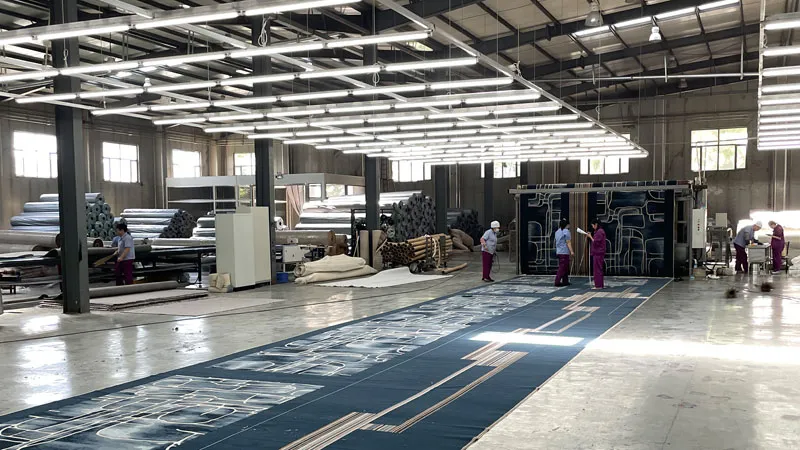
Our production line checks yarn, dye lot, pile height and backing before rolls leave the floor. SGS or BV can run pre-shipment inspection on request. Rolls are sealed in moisture-resistant film for sea freight and labeled by lot.
Our warranty runs five years. If a problem appears, send the batch number, photos and installation record. We review the evidence and agree a remedy under the contract.
FAQ: Ordering Commercial Carpet From a Factory
Product & Customization
How do samples work, and is the fee refundable?
Samples are paid. When you place a bulk order, we credit the full sample fee against it.
Which materials, sizes and patterns can you customize?
Our core materials are Premium New Zealand Wool and 80/20 wool-nylon. Nylon and polypropylene options suit selected applications. Sizes, patterns and colors can be customized through Axminster, hand tufted, hand knotted and machine & hand-made methods. We support OEM and ODM. We confirm feasibility at RFQ.
OEM/ODM custom hotel carpet service
Which certifications do your carpets hold?
CRI Green Label Plus (GLP9123, GLP5308), EN 14041 with CE, UKCA/UKMCA, MED Wheelmark, and Class I under ASTM E648 with Bfl-s1 under EN 13501-1. Certificates are available on request.
Pricing & Sample Policy
How do samples work, and is the fee refundable?
Samples are paid. When you place a bulk order, we credit the full sample fee against it.
How long does sampling take?
About 7 days for production. Courier time depends on your destination.
Lead Time & Shipping
What is the bulk lead time?
About 35 days after sample and artwork approval, plus sea freight. Large projects ship in batches.
Which trade terms do you offer?
We quote FOB and CIF. DDP can be arranged for selected destinations. Confirm landed cost at RFQ.
How do you protect carpet during sea freight?
We roll carpet on cores, seal each roll in moisture-resistant film, protect the ends and label by lot and roll number.
Payment & After-Sales
What are your payment terms?
Standard terms are 50% deposit and 50% balance. Balance timing is set in the contract.
Can SGS or BV inspect my order?
Yes. We support third-party pre-shipment inspection and give inspectors access to the finished goods.
What happens if there is a quality problem?
Our warranty is five years. Send the batch number, photos and installation record. We review, test if needed, and agree a remedy under the contract.
Next Step: Get Specs, Swatches and a Quote
Replacement cycles are an engineering decision. Specify the right fiber, density and certificates, and the carpet earns its full service life.
- Request free sample swatches to check color and hand feel.
- Submit an RFQ with area, zone type and target market for tiered pricing.
- Download the TDS for pile weight, density and test data.