Call us now:

Picking what color carpet goes with gray walls sounds simple until the order is 40,000 square feet, the fire marshal wants a Class I rating, and the vessel sails in six weeks. Wrong color choices cost budget. Wrong specs cost the whole project. This guide covers both — color logic and the compliance, durability, and sourcing decisions that sit behind it.
Why Gray Walls Dominate Commercial and Hospitality Design
Gray reads as neutral, current, and easy to build a palette around. Hotel groups use it in lobbies to stay flexible between seasonal decor refreshes. Corporate tenants use it because it photographs well and ages slowly. Healthcare and senior living projects use it because it reads calm without feeling clinical.
The design question — “which color works with this wall” — is the easy 20% of the job. The other 80% is whether that carpet survives five years of rolling luggage carts, spilled coffee, and 400 pairs of shoes a day.
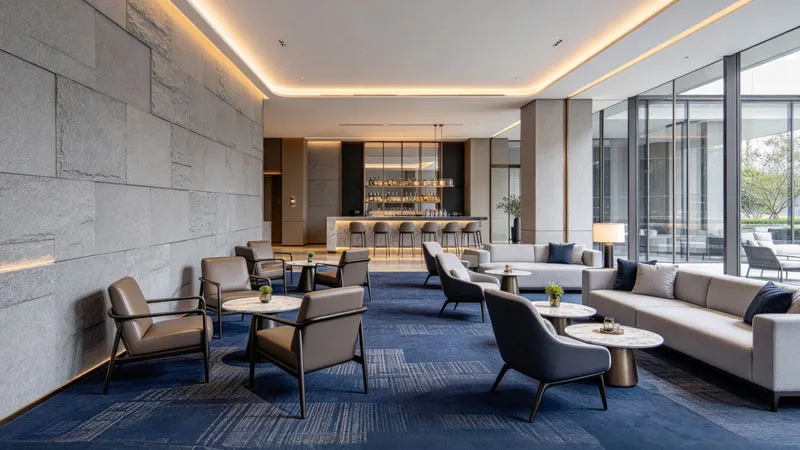
LRV Matters More Than “Warm vs. Cool Gray”
Light Reflectance Value (LRV) tells you how much light a surface bounces back, on a 0–100 scale. It’s a standard architectural lighting metric, and it’s more useful than guessing at undertones.
Cool-Undertone Gray Walls (Blue or Green Base)
These walls typically sit at LRV 45–65. Pair them with warmer carpet tones — taupe, deep brown, or navy — in the LRV 10–35 range. The contrast keeps the space from reading cold under fluorescent or daylight LED fixtures.
Warm-Undertone Gray Walls (Beige or Taupe Base)
These sit closer to LRV 50–70. Lighter neutral carpets in the LRV 30–50 range hold the warmth without flattening the room.
How LED Color Temperature Shifts Perceived Color
A 5000K fixture makes cool grays look colder and can push navy carpet toward black. A 3000K fixture warms everything, including carpets that read neutral on a sample card. Always request lighting specs before finalizing a color order.
Comparison Table: Wall LRV Matching
| Wall Undertone | Wall LRV Range | Recommended Carpet LRV | Recommended Colors | Best Space Type |
|---|---|---|---|---|
| Cool Gray | 45–65 | 10–35 | Navy, Charcoal, Deep Brown | Lobbies, boardrooms |
| Warm Gray | 50–70 | 30–50 | Taupe, Warm Beige, Soft Green | Guest rooms, offices |
| Neutral Gray | 55–65 | 20–45 | Multi-tone Pattern, Mid-Grey | Corridors, retail |
Best Carpet Colors for Gray Walls, by Space Function
Color choice should follow how a space is used, not just how it photographs.
Lobbies and High-Traffic Public Areas
Deep navy, charcoal, and patterned multi-tone constructions hide soiling between cleanings and hold visual weight against high ceilings and open sightlines.
Guest Rooms and Suites
Lower foot traffic allows softer choices — warm beige, taupe, or blush — where comfort underfoot matters more than soil-hiding performance.
Corridors and Circulation Zones
These carry the heaviest daily wear in any hospitality building. Textured Berber or multi-tone constructions mask crushing and staining far longer than solid light colors.
Boardrooms and Corporate Offices
Charcoal, forest green, and navy read as formal and also assist with sound dampening in glass-heavy conference rooms.
Healthcare and Senior Living Common Areas
Muted warm neutrals support a calming environment. Contrast between flooring and walls also matters here for low-vision accessibility.
Comparison Table: Color by Space Type
| Space Type | Recommended Color | Traffic Level | Recommended Construction |
|---|---|---|---|
| Lobby / Entertainment Venues Reception | Navy, Charcoal, Multi-tone | High | Axminster |
| Guest Room | Taupe, Warm Beige | Low | Hand-tufted |
| Corridor | Textured Berber, Multi-tone | Very High | Axminster or Machine-tufted |
| Boardroom | Charcoal, Forest Green | Medium | Hand-tufted |
View our Axminster carpet collection for hospitality corridors
The Performance Layer Buyer’s Guides Usually Skip
Color is the visible decision. These are the ones that determine whether the carpet still looks acceptable in year five.
Fire Safety: Class I Rating and Bfl-s1
US projects generally require Class I fire rating under ASTM E648. EU projects reference Bfl-s1 under EN 13501. These aren’t optional extras for commercial buildings — they’re baseline code requirements in most jurisdictions. Every roll off our production line is tested against these standards before it ships, not tested on request.
ASTM E648 flooring fire test method
Abrasion and Wear Resistance
Wear resistance gets tested against Martindale or Wyzenbeek cycle counts. Darker colors and textured constructions show wear later than flat, light-colored loop piles — a real factor in five-to-ten-year lifecycle cost, not just upfront price per square meter.
Acoustic Performance (NRC / STC)
Pile height and density affect sound absorption more than color does. This matters in open-plan offices and in hotel corridors sitting above guest rooms, where footfall noise is a recurring complaint on post-occupancy surveys.
Indoor Air Quality and the Global Compliance Stack
Commercial buyers working across markets need a supplier that clears multiple certification bars at once:
- CRI Green Label Plus (GLP9123 / GLP5308) — low VOC emissions
- EN 14041 (CE marking) — required for flooring sold in the EU
- MED Wheelmark — IMO marine standard, required for cruise and marine hospitality projects
- UKCA / UKMCA — required for UK market access post-Brexit
- ISO 9001 / 14001 / 45001 — quality, environmental, and occupational safety management
CRI Green Label Plus certified product directory
Material and Construction: Choosing the Right Build
Premium New Zealand Wool vs. Synthetic Fiber
Wool holds color depth better under UV exposure, resists soiling naturally, and recovers pile crush faster than most synthetics — worth the premium in high-visibility areas like lobbies.
Axminster
Best for multi-color patterns in corridors and lobbies where soil-hiding and design complexity both matter.
Hand-Tufted
A middle ground on cost and turnaround for custom color and moderate design detail.
Hand-Knotted
Longest lifecycle, highest design flexibility, reserved for signature lobbies and bespoke commissions.
Machine-Made vs. Hand-Made
Machine construction moves faster and costs less at volume. Hand-made construction wins on design complexity and durability where budget allows.
Comparison Table: Construction Types
| Construction | Best Use Case | Typical Lifecycle | Lead Time | Design Flexibility |
|---|---|---|---|---|
| Axminster | Patterned corridors, lobbies | 10–15 years | Medium | High |
| Hand-Tufted | Guest rooms, boardrooms | 8–12 years | Medium | Medium-High |
| Hand-Knotted | Signature lobbies | 15–20+ years | Longer | Highest |
| Machine-Tufted | Budget-conscious volume orders | 6–10 years | Fastest | Lower |
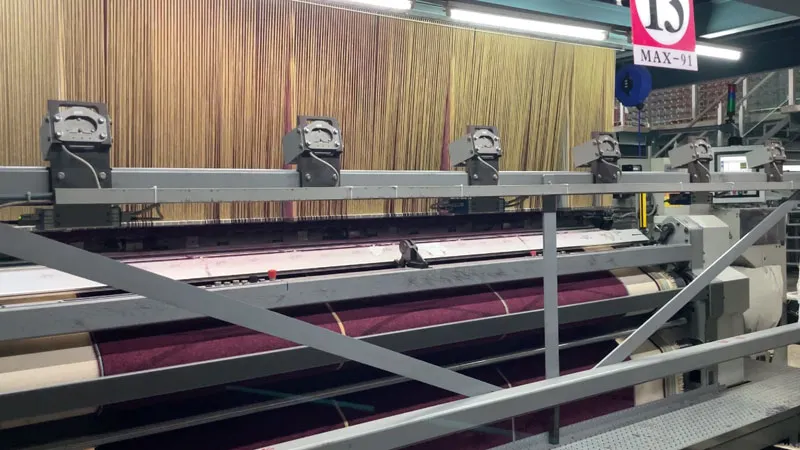
Sourcing Gray-Compatible Carpet: A Factory-Direct Framework
The Color-Matching Process
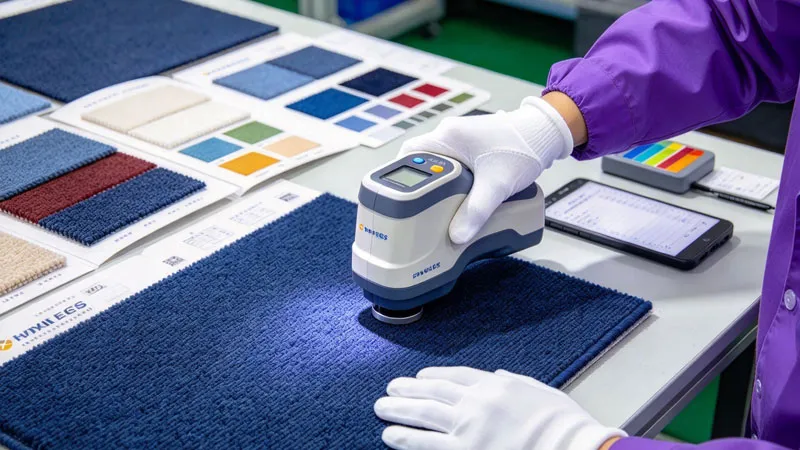
A wall swatch or Pantone reference goes to the lab for a yarn dip sample. Once approved, that formula scales to the bulk dye lot, and QC checks the finished batch against the original swatch before it ships — not after a client complains it doesn’t match.
MOQ, Tiered Pricing, and Lead Time
Order volume, custom color, and construction type all move the cost curve. Ask any supplier for their MOQ by construction type and their lead time from sample approval to bulk shipment — vague answers here are a warning sign.
Quality Control Before Shipment
Our AAAAA quality standard checks batch color consistency, pile density variance, backing integrity, and dimensional tolerance on every production run, documented before goods leave the facility.
Why Factory-Direct Sourcing Matters
Buying direct from a certified factory typically removes 20–30% in middleman markup. It also removes a layer of miscommunication risk on color and spec — provided the factory already holds the export certifications the project needs. Without that certification stack, direct sourcing just moves the risk closer to the buyer.
Request compliance documentation for a specific project
Estimate your project cost and lead time with our Carpet Calculator
Procurement Red Flags to Check Before You Commit
- No third-party certification documentation available on request
- Refusal to send physical lab samples before a bulk order
- Lead times given verbally only, with nothing in writing
- No factory audit records or production traceability
- History of batch-to-batch color inconsistency on repeat orders
FAQ
Should commercial carpet be lighter or darker than gray walls in high-traffic areas?
Darker or multi-tone carpet works better in high-traffic areas because it hides soiling between cleaning cycles longer than solid light colors.
What fire rating is required for hotel corridor carpet, US vs. EU?
US projects typically require Class I under ASTM E648. EU projects reference Bfl-s1 under EN 13501. Always confirm with the local fire authority for the specific building class.
Does New Zealand wool carpet cost more than synthetic, and is it worth it?
Yes, wool carries a higher upfront cost. In high-visibility, high-traffic hospitality areas, its better recovery and color retention usually lowers total cost over a 10-year lifecycle.
What is the typical MOQ for OEM/ODM custom carpet orders?
MOQ varies by construction type and custom color requirements. Axminster and hand-tufted orders generally carry different minimums — request a written MOQ breakdown before quoting a project.
How long does sample approval to bulk shipment usually take?
Standard lead time runs from initial lab dip approval through bulk dyeing, production, and QC. Request a written production schedule tied to your specific construction and volume.
Can you provide fire rating and compliance test reports before order confirmation?
Yes. Test reports for ASTM E648, EN 13501, CRI Green Label Plus, and other applicable certifications should be available on request before you commit to an order — any supplier unwilling to share these is a risk flag.
Get Your Project Specified Right
Color decisions are reversible. Compliance failures and missed shipping windows are not. Request free sample swatches matched to your wall specification, submit an RFQ for your project scope, or download the technical data sheets for our certified constructions.