Call us now:

Choosing the wrong commercial carpet grades costs projects money. Specs get misread, fire certificates arrive late, and a hotel opening slips by weeks. Most delays trace back to one problem: there is no single global grade scale. This guide shows you how to read EN 1307 classes, TARR ratings and fire classes, match them to each space, and verify them before you pay. We write it from the factory side. Fab Carpet produces Axminster, hand tufted and hand knotted carpet in Qinghai, so these are numbers we test and ship against every week. Use it as a spec reference and a sourcing checklist.
Key Takeaways
- “Heavy commercial” on a label is a marketing term, not a standard.
- Ask for three numbers: an EN 1307 class or TARR value, a fire class, and the test report behind both.
- Pile weight and density predict wear better than pile height alone.
- Factory-direct sourcing removes trader margin, but only if the factory can prove its certificates and capacity.
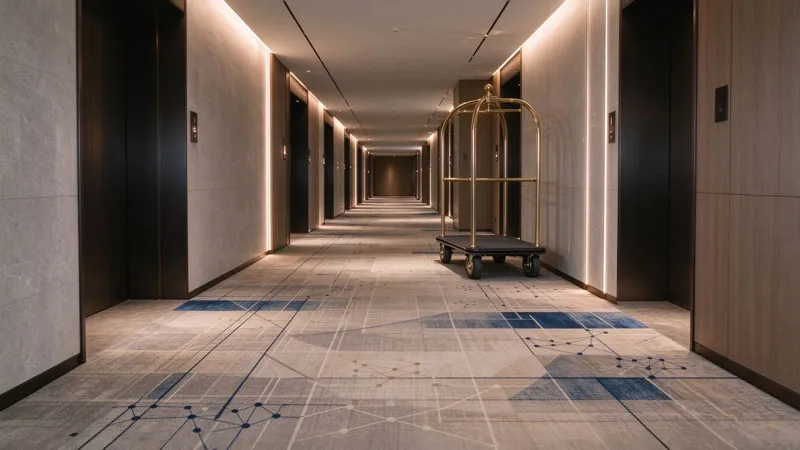
What Do Commercial Carpet Grades Actually Mean?
A grade tells you how a carpet performs in a defined environment. Nothing more.
Suppliers use “grade,” “class” and “rating” as if they were the same thing. They are not.
- Class usually refers to a standard’s category, such as EN 1307 Class 33.
- Rating is a measured score, such as a TARR of 3.5.
- Grade is often an internal label with no test behind it.
Labels like “Grade A,” “Extra Heavy” or “Walk-off” vary by supplier. Two mills can print the same word on two very different products.
A useful grade answers four questions:
- Wear: How long does it keep its appearance under traffic?
- Fire: What flame spread and smoke class does it hold?
- Acoustics: How much sound does it absorb or block?
- Emissions: Does it meet indoor air quality limits?
If a quote answers only the first question, ask for the rest before you compare prices.
Commercial Carpet Grading Systems Compared: EN 1307, TARR and ISO 10361
Three systems cover most projects in North America and Europe.
EN 1307 is the European classification. Classes 21 to 23 cover domestic use. Classes 31 to 34 cover commercial use, from light contract (31) to extra heavy (34). Luxury Class adds a comfort scale.
CRI TARR (Texture Appearance Retention Rating) is the North American approach. CRI guidelines set minimums by use:
- Moderate: ≥ 2.5
- Heavy: ≥ 3.0
- Severe: ≥ 3.5
ISO 10361 covers the Vettermann drum and hexapod tumbler tests. Both simulate years of foot traffic in a lab, then compare the sample to a reference. Castor chair suitability is tested separately under EN 985.
| Standard | Region | What It Measures | Typical Hotel Spec | Report to Request |
|---|---|---|---|---|
| EN 1307 | Europe, UK | Appearance retention class | Class 33 for corridors and lobbies | EN 1307 classification report |
| CRI TARR | North America | Texture appearance retention | ≥ 3.5 for severe use | TARR test report |
| ISO 10361 | International | Simulated traffic wear | Supports both of the above | Lab test report, with method named |
| EN 985 | Europe | Castor chair suitability | Required for office and meeting areas | EN 985 report |
Test reports should match your target market. For European projects, we issue EN-based reports. For US projects, we align to CRI and ASTM methods. One generic report rarely satisfies both.
commercial Axminster carpet manufacturer
Which Commercial Carpet Grade Fits Each Space?
Match the grade to the traffic, not to the room name. A hotel lobby and a hotel guest room need different specs.
| Space | Traffic Level | Suggested EN Class | Suggested TARR | Fire Class |
|---|---|---|---|---|
| Guest rooms | Moderate | 31–32 | ≥ 2.5 | Class I or Bfl-s1 where code requires |
| Corridors | Heavy | 33 | ≥ 3.0 to 3.5 | Class I (ASTM E648) |
| Lobbies, ballrooms | Severe | 33–34 | ≥ 3.5 | Class I |
| High-Traffic Entertainment Areas | Severe | 33–34 | ≥ 3.5 | Class I |
| Offices | Moderate to heavy | 32–33 | ≥ 3.0 | Per local code |
| Cruise and marine interiors | Heavy | 33 | ≥ 3.0 | IMO, MED Wheelmark |
Treat these as starting points. Local building codes and the owner’s brief come first.
Two ratings get forgotten in many specs:
- Castor suitability. Rolling chairs destroy carpet that was never tested for them.
- Stair suitability. Fiber type and construction change how carpet wears at stair nosings.
Marine projects add a layer. Ships need IMO-compliant floor coverings, and the MED Wheelmark is the proof. A carpet that passes land-based tests does not automatically pass marine approval.
Pile Weight, Density and Fiber: The Numbers Behind the Grade
Pile height gets the attention. Pile weight and density do the work.
Pile weight is the mass of yarn per area, in g/m² or oz/yd². Density is how tightly that yarn is packed. The standard formula is:
Density = (pile yarn weight in oz/yd² × 36) ÷ pile thickness in inches
Worked example: 40 oz/yd² pile weight at 0.25 in. thickness gives (40 × 36) ÷ 0.25 = 5,760 oz/yd³.
More stitches do not guarantee more density. Yarn size, stitch rate and tuft height all feed the result. Two carpets with the same pile height can differ sharply in density.
Fiber choice then sets the ceiling for the grade.
| Fiber | Abrasion | Resilience | Fire Behavior | Stain Resistance | Typical Use |
|---|---|---|---|---|---|
| NZ Wool | High | Excellent | Naturally flame resistant | Moderate, treatable | Hotels, premium lobbies |
| 80/20 Wool-Nylon | Very high | Excellent | Strong | Good | Axminster hotel carpet |
| Nylon 6.6 | Very high | Very good | Good | Good, slower stain diffusion | Corridors, offices |
| Nylon 6 | High | Good | Good | Good | Projects needing recyclability |
| PET | Moderate | Fair | Varies | Good | Budget-led projects |
| Polypropylene | Moderate | Low | Varies | Fair | Light-duty areas |
We work mainly with Premium New Zealand Wool. It resists crushing, recovers well and carries a natural flame resistance that helps in fire testing. Blends with nylon add abrasion strength where traffic is heaviest.
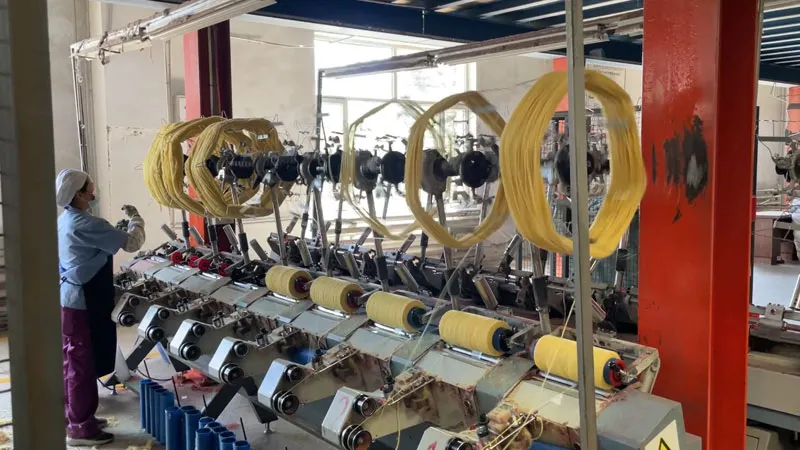
Ask any supplier for a pile weight tolerance, not only a nominal figure. Our production standard sets weight checks at the loom, not only at final inspection.
Fire, Acoustic and Compliance Certificates: What Your Project Needs
Fire Ratings
ASTM E648 measures flame spread with a radiant panel. Class I is the best result, with a critical radiant flux of at least 0.45 W/cm². Class II sits between 0.22 and 0.44. Many codes require Class I in corridors and exits.
EN 13501-1 is the European system. Bfl-s1 means a low flammability flooring class with low smoke. The test method is EN ISO 9239-1.
Our standard Axminster range is tested to Class I (ASTM E648) and Bfl-s1.
Acoustics
Carpet absorbs airborne sound, which NRC measures. It also cuts impact noise, which IIC or ΔLw measures. Both depend on the whole build-up: pile, backing and underlay. Request test data for the finished build-up, not for the face yarn alone.
Certificates by Market
| Certificate | Covers | Needed For |
|---|---|---|
| CRI Green Label Plus | Indoor air emissions | North American green building projects |
| EN 14041 (CE) | Essential characteristics of floor coverings | EU market |
| UKCA / UKMCA | UK conformity | UK market and marine equipment |
| MED Wheelmark | IMO marine fire standards | Ships and cruise vessels |
| ISO 9001 / 14001 / 45001 | Quality, environmental, safety management | Supplier qualification |
Fab Carpet holds CRI Green Label Plus (GLP9123 and GLP5308), EN 14041 (CE), MED Wheelmark, UKCA/UKMCA, and ISO 9001, 14001 and 45001. We also hold the AAAAA Quality Standard. Certificates are supplied at the quotation stage.
Always check a certificate against the issuer’s database. A valid certificate for one product does not cover another.
CRI Green Label Plus certified products directory
How Fab Carpet Verifies Commercial Carpet Grades
A grade on paper means little without a QC chain behind it. Ours runs in three stages:
- Raw materials. Wool and yarn lots are checked and logged on arrival, so any batch can be traced.
- In-process. Pile weight, tuft bind, backing adhesion and pattern accuracy are checked during production.
- Pre-shipment. Final inspection covers size, colour against the approved sample, and packing.
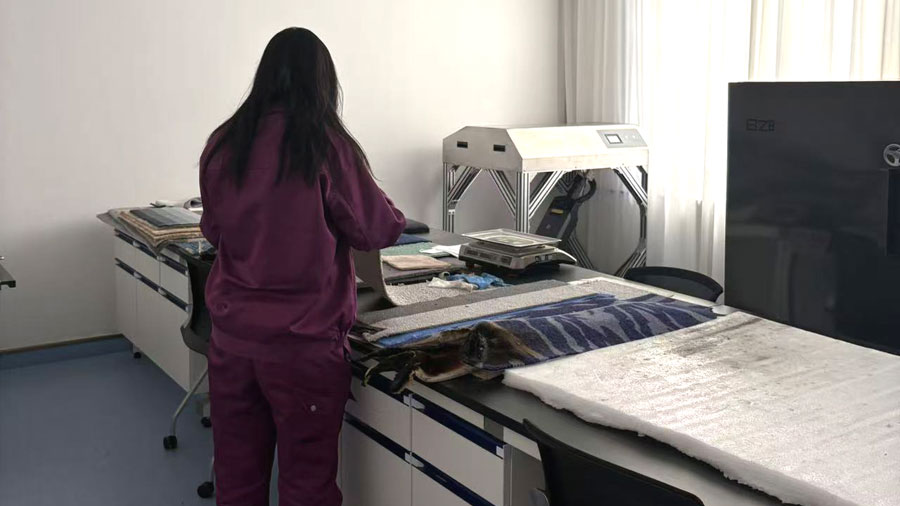
For third-party checks, we support SGS and BV inspection. Brief the inspector with your approved sample, the pile weight tolerance and your acceptance criteria. Put these in the purchase contract, not in an email.
Sample-to-bulk consistency is the real test. Colour and weight drift between lots is the most common complaint in carpet purchasing. Dye lot control and a signed-off sample reference are the best defences.
Buying Commercial Carpet Direct From the Factory
Eight Common Sourcing Mistakes
- Approving a sample, then receiving a different bulk product
- Accepting a certificate that covers a different product
- Vague delivery dates with no penalty clause
- No moisture-proof packaging on sea freight
- No third-party inspection clause
- An unclear warranty scope
- Comparing quotes with different pile weights
- Ignoring wastage allowance at installation
Supplier Qualification Checklist
- Verifiable factory address and production capacity
- Test reports matched to the exact product
- Certificates confirmed with the issuing body
- Written sample and bulk tolerance policy
- Warranty terms in writing
- References from comparable projects
How MOQ and Tiered Pricing Work
A price is built from yarn, weaving, dyeing, backing, packing, freight and duties. Small runs carry fixed costs such as loom setup and colour matching, so unit prices drop as volume rises. Our MOQ is 50 sqm.
Capacity matters for large jobs. Our annual output is 1,800,000 sqm for Axminster, 36,000 sqm for hand tufted, and 100,000 sqm for machine and hand-made carpet. A hotel group with a multi-property roll-out needs to know a supplier can hold schedule across all of them.
Where Middlemen Margin Sits
In a traded chain, a trading company or agent adds margin between you and the mill. Factory-direct buying removes that layer. You also deal directly with the people who control the loom schedule and the QC. We do not publish blanket savings figures, because they depend on spec and volume. A line-by-line quote shows the difference.
Total Cost of Ownership
Purchase price is one input. Use this:
Annual cost per sqm = (purchase + installation + annual maintenance × years) ÷ years of service
A higher-grade wool Axminster often wins on this measure over a cheaper carpet replaced early.
Tool: Estimate area, wastage and budget with the Carpet Calculator
Custom hotel carpet OEM/ODM service
From Sample to Shipment: The Realistic Timeline
- Sampling: About 7 days. Samples are paid, and the fee is credited in full against your bulk order.
- Production: About 35 days for standard orders. Hand tufted and hand knotted projects are scheduled by size and complexity, and we confirm dates at quotation.
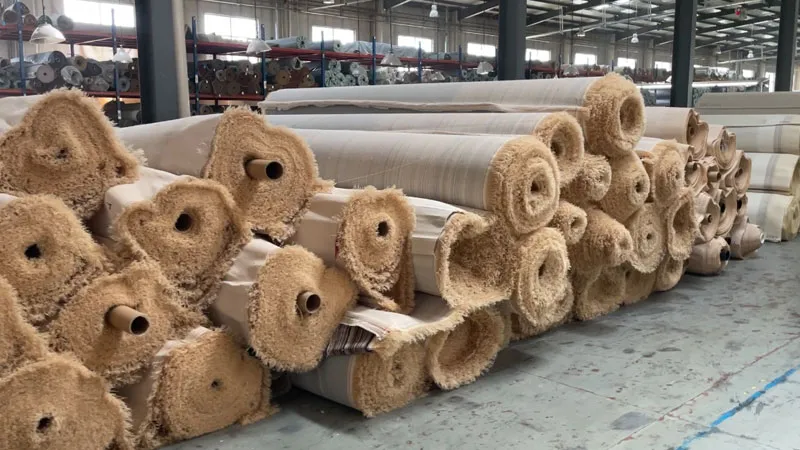
- Packing: Rolls are wrapped in moisture-proof film and packed to protect the pile edges during sea freight.
- Installation support: Rolls are labelled by area and dye lot. Plan wastage into your order so the installer is not left short.
Warranty: What Five Years Should Cover
We provide a five-year warranty. What it covers and excludes is printed on the warranty card, which we share before you order.
Read any warranty for three things: the covered defects, the exclusions (usually misuse and improper maintenance), and the claims process. A clear claim needs photos, batch numbers and installation records. Keep them on file.
Maintenance protects the grade. Vacuum often, place walk-off mats at entrances, remove spills at once, and schedule periodic hot-water extraction. Write the maintenance plan into the specification. Carpet that is never maintained loses its rating in practice.
Commercial Carpet Grades FAQ
Product & Customization
What is your MOQ for custom commercial carpet?
Our MOQ is 50 sqm. This applies to custom designs across our main processes. Larger volumes bring lower unit prices.
Which materials, patterns and certifications can you supply?
We work with Premium New Zealand Wool, wool-nylon blends and nylon. Patterns can be custom woven (Axminster), hand tufted or hand knotted. Certifications include CRI Green Label Plus, EN 14041 (CE), Class I fire rating (ASTM E648) and Bfl-s1. Marine projects can use our MED Wheelmark products.
Can you match a specific size, colour or pattern?
Yes. Send artwork, a Pantone reference or a physical sample, and we will quote it with a development sample.
Pricing & Sample Policy
How do your samples work?
Samples are paid up front. If you place a bulk order, the sample fee is deducted in full from the order value.
How long do samples take?
About 7 days from artwork or colour approval, plus courier time.
Lead Time & Shipping
What is your production lead time?
About 35 days for standard orders after sample approval and deposit. We confirm hand-made schedules per project.
Which trade terms do you offer, and how is carpet packed?
We quote FOB, CIF and DDP on request. Rolls are wrapped in moisture-proof film and packed to resist damage during sea freight.
Payment & After-Sales
What are your payment terms?
Standard terms are 50% deposit and 50% balance before shipment. We discuss project-specific terms at quotation.
Do you support third-party inspection, and how are claims handled?
We support SGS and BV inspection. For quality claims, send photos, batch numbers and installation details. We review under the warranty card terms and propose a remedy.
Get the Right Grade on Paper Before You Order
Send us your space type, area and target market. We will return a spec recommendation, certificates and a line-by-line quote.
- Request free sample swatches to check colour and hand-feel
- Submit an RFQ with your drawings or area schedule