Call us now:

Face weight for carpet is the number every spec sheet leads with — and the number that gets projects into trouble. A hotel corridor spec written around face weight alone can still fail fire code, wear out in 18 months, or arrive with a container short on yardage. This guide breaks down what the number actually tells you, and what it hides.
What Is Face Weight for Carpet? A Definition Procurement Teams Can Actually Use
Face weight is the weight of the visible pile fiber, measured in ounces per square yard. It excludes backing, latex, and any secondary layers. A 40-ounce carpet has 40 ounces of fiber sitting on top of one square yard of backing — nothing more.
That’s a narrow definition, and it matters. Vendors sometimes quote total weight (fiber plus backing) as if it were face weight. The two numbers can differ by 15-20%, which changes your cost-per-yard math and your durability assumptions at the same time.
Face Weight vs. Total Weight vs. Density
Three separate metrics get conflated constantly:
- Face weight — fiber only, oz/sq yd
- Total weight — fiber plus backing, oz/sq yd
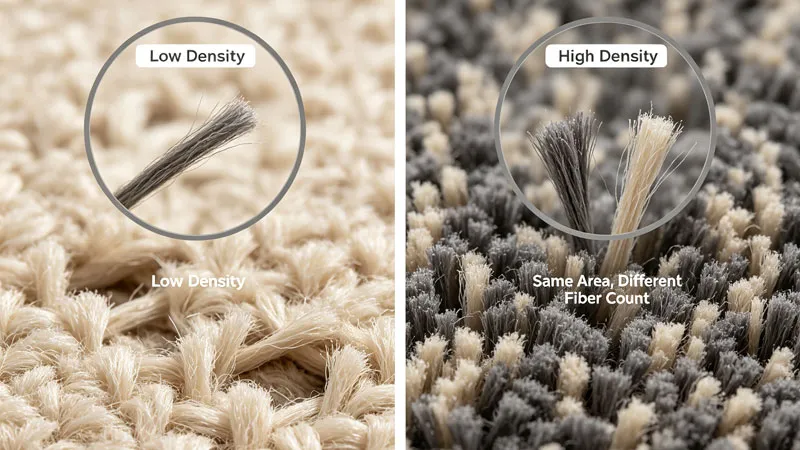
- Density — how tightly fiber is packed, oz/cubic yard
Density is calculated by dividing face weight by pile height, then converting to a per-cubic-yard figure. Two carpets can share identical face weight and perform completely differently because their density diverges. On a Fab Carpet production line, density is checked alongside face weight on every batch — one number without the other tells an incomplete story.
Carpet Density Formula Explained
Why Face Weight Alone Misleads Commercial Buyers
A higher number on paper does not guarantee a longer-lasting carpet. Construction and fiber type change what that number means.
50oz Loose Pile vs. 40oz Dense Wool — Real Performance Gap
Take a 50-ounce nylon cut pile with tall, loosely packed fiber against a 40-ounce New Zealand wool Axminster with tight density. Under Martindale abrasion testing, the denser 40oz construction frequently outlasts the lighter 50oz one. The lower number wins because packing, not weight, resists crushing.
| Spec | 50oz Loose Nylon | 40oz Dense Wool Axminster |
|---|---|---|
| Face Weight | 50 oz/sq yd | 40 oz/sq yd |
| Density | 3,200 oz/cu yd | 4,800 oz/cu yd |
| Pile Height | 0.62″ | 0.35″ |
| Twist Level | Low | High |
| Abrasion Cycles (Martindale) | ~15,000 | ~28,000 |
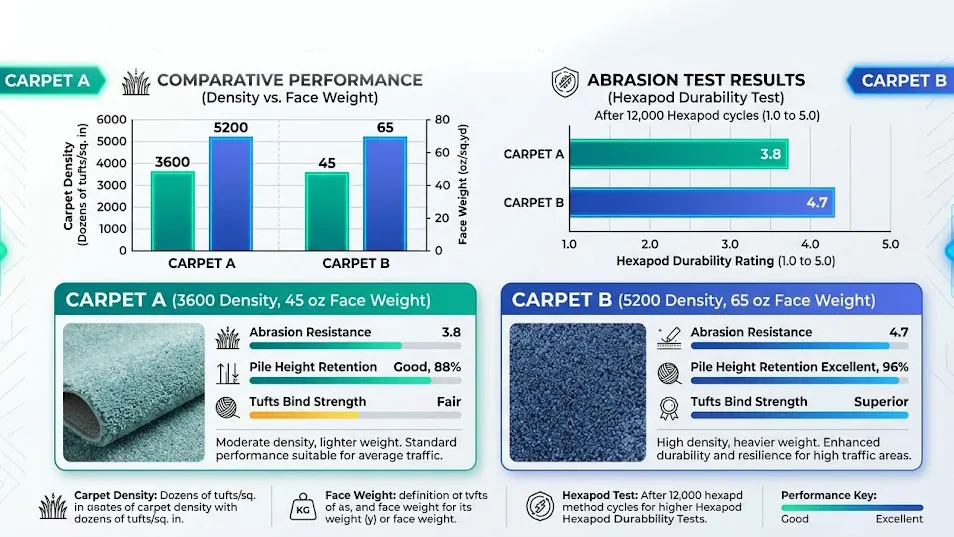
Specify density alongside face weight, or the number on the submittal is decorative.
Commercial Face Weight Benchmarks by Application
Residential ranges don’t transfer to contract work. Foot traffic, rolling loads, and cleaning frequency all push the numbers up.
Hotel Corridors and Lobbies
Corridors see wheeled luggage and daily housekeeping carts. Target 45-65 oz/sq yd with density above 4,500 oz/cu yd. Lobbies with lower dwell time can run slightly lighter if backing quality compensates.
High-Traffic Entertainment Areas and Hospitality Venues
Entertainment Venues and large hospitality floors run near-continuous foot traffic, sometimes 18 hours a day. Specify 60-80 oz/sq yd, dense construction, and a wear warranty tied to actual traffic counts rather than generic residential terms.
Airports, Conference Centers, and Office Lobbies
These spaces combine rolling luggage, chair casters, and constant pedestrian flow. A 55-70 oz/sq yd range with tight twist level holds pattern definition through repeated cleaning cycles.
Cruise Ships and Marine Interiors
Marine carpet answers to a different rulebook. Face weight still matters, but it sits behind IMO fire and smoke requirements. [IMO fire safety requirements for marine interiors]
Interactive Tool: Estimate your project’s recommended face weight and yardage
Fiber and Construction Change What “Good” Face Weight Means
Wool vs. Nylon vs. Wool-Blend
Premium New Zealand wool carries natural crimp, which gives it recovery after compression that synthetic fiber struggles to match at equal weight. A wool carpet at 40oz can outperform a synthetic at 50oz on resilience testing, because the fiber itself springs back rather than staying flattened.
Nylon still wins on raw abrasion resistance and price point. Wool-blend constructions split the difference — better recovery than pure nylon, lower cost than full wool.
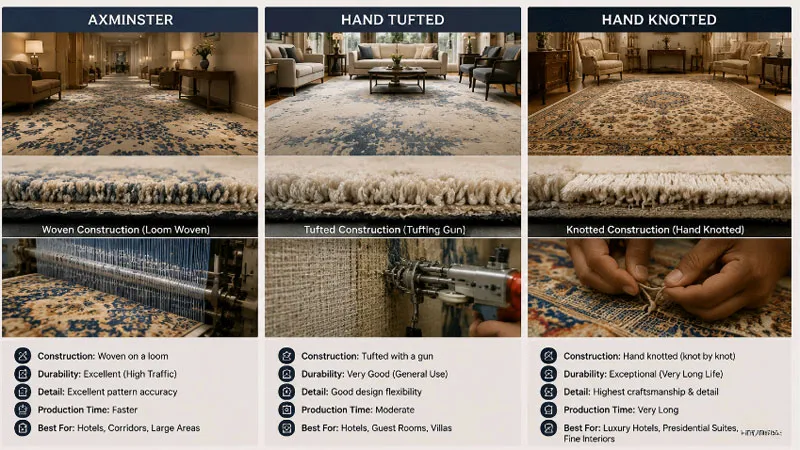
Axminster, Hand-Tufted, and Hand-Knotted — Same Weight, Different Outcomes
Construction method changes what a given face weight delivers:
- Axminster — machine-woven, supports intricate multi-color patterns at consistent density, standard for hotel corridors and function rooms
- Hand-Tufted — faster production, strong for custom pile height and sculpted design, moderate density control
- Hand-Knotted — highest density achievable per ounce, longest production lead time, reserved for feature areas and luxury suites
Fab Carpet runs all three methods from one facility, which lets a single project mix construction types — hand-knotted for a lobby feature, Axminster for corridors — without splitting the order across vendors.
The Compliance Layer Competitors Skip
Face weight means nothing if the carpet fails inspection.
Fire Rating: ASTM E648 and Bfl-s1
North American projects need Class I fire rating under ASTM E648. European projects reference Bfl-s1 under EN 13501-1. Fire performance connects to backing density and fiber type, not face weight alone — a heavy carpet with the wrong backing can still fail a radiant panel test.
Indoor Air Quality: CRI Green Label Plus
LEED-targeted projects require documentation, not just claims. CRI Green Label Plus certification (GLP9123 / GLP5308) confirms low VOC emissions. [CRI Green Label Plus certified product directory]
EN 14041, UKCA, and Marine Wheelmark
European contract work needs EN 14041 (CE marking). Post-Brexit UK projects require UKCA or UKMCA documentation separately — CE marking alone no longer clears customs in Great Britain. Marine interiors need MED Wheelmark certification tied to IMO standards, on top of everything above.
Fab Carpet holds CRI Green Label Plus, EN 14041, MED Wheelmark, UKCA/UKMCA, and ISO 9001/14001/45001 certification across its production lines, so a single order can satisfy multi-region compliance without re-testing between markets.
What Face Weight Really Costs Over 5-10 Years
Upfront price per yard tells half the story.
Face Weight vs. Replacement Cycle vs. Cleaning Cost
A lighter, lower-density carpet often needs replacement in 3-5 years in high-traffic zones. A properly specified heavier or denser carpet can run 7-10 years before replacement. Factor in the labor and downtime cost of replacement — closing a hotel corridor or a hospitality floor for reinstallation is rarely cheap.
| Metric | Light Spec (30oz) | Commercial Spec (55oz, high density) |
|---|---|---|
| Upfront Cost/sq yd | Lower | 20-30% higher |
| Replacement Cycle | 3-5 years | 7-10 years |
| Annual Cleaning Cost | Higher (faster soiling) | Lower |
| 10-Year Total Cost | Higher | Lower |
Run the ten-year number before approving the cheaper submittal.
How to Avoid Face Weight Misrepresentation
Spec sheets get inflated. It happens more than buyers expect.
Verify, Don’t Trust
Request third-party lab test reports rather than accepting a supplier’s printed spec sheet. [how to read a carpet lab test report] ISO-based testing protocols confirm actual fiber weight, not marketing weight.
Supplier Due-Diligence Checklist
Before signing a bulk order, confirm:
- Current ISO 9001/14001/45001 certification, not expired documentation
- A named quality standard the factory audits against — Fab Carpet runs internal QC against an AAAAA Quality Standard on every production batch
- Third-party fire and IAQ test reports dated within the last two years
- A factory that will ship physical swatches matching the actual production batch, not archived samples

MOQ, Lead Time, and Container Math
Face weight affects shipping cost directly. Heavier carpet takes up more container volume per square yard, which lowers the yardage a standard 40-foot container can carry. A 10-ounce increase in face weight can reduce loadable yardage per container by a meaningful margin — that math belongs in your freight budget before you finalize a spec, not after the container ships.
Sourcing direct from a factory that controls dyeing, weaving, and QC under one roof — rather than through a trading intermediary — typically removes 20-30% in markup and cuts the risk of lead-time slippage between subcontracted stages.
From Spec Sheet to Site
Custom Development Process
Getting from a design brief to an approved sample involves fiber selection, density testing, and color matching against approved standards — typically 2-3 rounds before a project sample is locked.
In-House QC and Testing
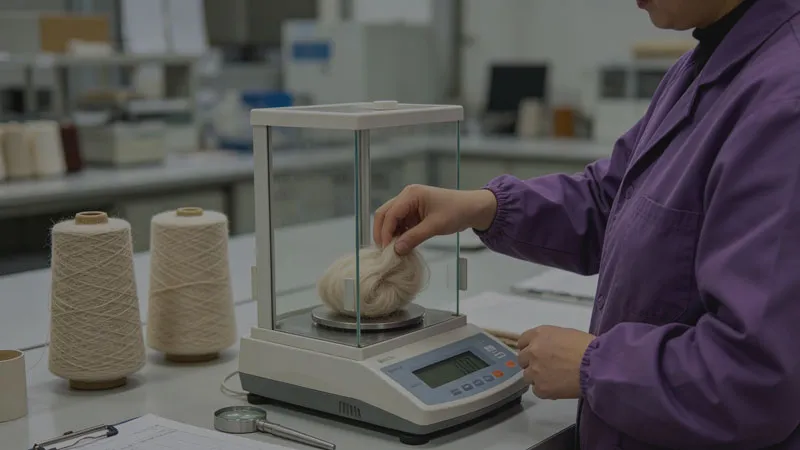
Every production batch gets weighed and density-tested before it leaves the facility, not sampled after the fact.
Hotel carpet project case study
FAQ
What is a good face weight for hotel corridor carpet?
45-65 oz/sq yd with density above 4,500 oz/cu yd, paired with a wear warranty matched to actual traffic volume.
What’s the typical MOQ for OEM/ODM wool carpet orders?
MOQs vary by construction method — hand-knotted runs higher minimums than machine-tufted. Request a project-specific quote for exact figures.
How long does sample production take?
Standard swatches ship within days. Custom-color or custom-density samples typically take 2-3 weeks depending on construction method.
Does higher face weight guarantee better fire rating?
No. Fire rating depends on backing composition and fiber chemistry, not face weight. Always request the ASTM E648 or Bfl-s1 test report directly.
Can I request a third-party test report before ordering?
Yes. Any reputable factory should provide current ISO-based lab reports on face weight, density, and fire performance before you commit to a bulk order.
How does face weight affect ocean freight cost?
Heavier carpet reduces loadable yardage per container, raising per-yard freight cost. Confirm container math during the spec stage, not after production.
Get Your Project-Specific Spec
Face weight is a starting point, not a full specification. Confirm density, fiber type, fire rating, and container economics before locking a submittal.