Call us now:

A wavy carpet in a hotel lobby is never just a maintenance issue. It’s a liability. It’s a warranty dispute waiting to happen. And if it trips a guest near a fire exit, it’s a code violation with your project’s name on it. This guide breaks down the real causes, the standards that apply, and the sourcing decisions that prevent it from happening on your next job.
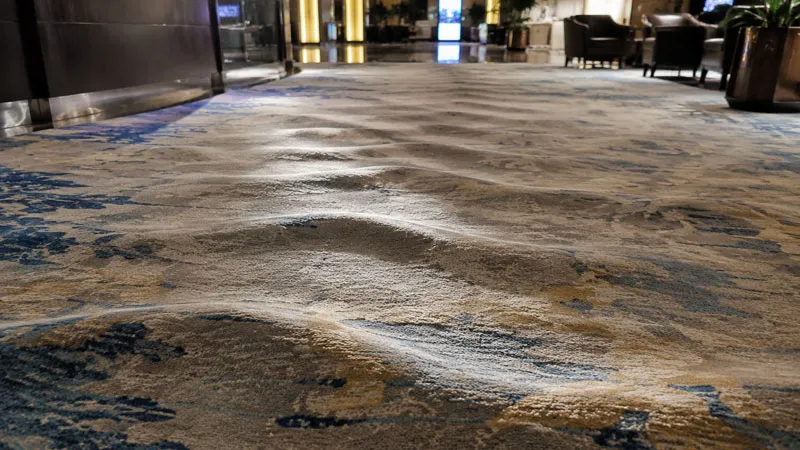
What “Wavy Carpet” Actually Means in Commercial Installations
“Wavy carpet” is the search term. In a spec document, the correct terms are wrinkling, buckling, and rippling — and they are not interchangeable.
Buckling happens when the backing loses tension and the carpet shifts off the tack strip. Rippling is a milder version, usually localized near seams or transitions. Wrinkling often points to a padding or moisture issue rather than the carpet itself.
This distinction matters because your warranty claim depends on it. A manufacturer’s warranty typically covers material defects. It does not cover installation errors. Knowing which term applies to your situation determines who pays for the fix.
Why This Problem Hits Harder in High-Traffic Commercial Spaces
A wavy area rug in a living room is an inconvenience. A wavy carpet runner in a hotel corridor, a convention hall, or a high-traffic entertainment area is a different category of problem. Foot traffic accelerates the failure. Guests notice. Facilities teams get calls. And in jurisdictions with strict accessibility codes, a raised ripple can become a documented trip hazard during an inspection.
Commercial carpet fire rating standards
Residential vs. Commercial Failure: Risk and Cost
| Factor | Residential Setting | Commercial Setting |
|---|---|---|
| Typical trigger | Humidity, furniture dragging | Foot traffic volume, poor stretching, HVAC cycling |
| Average repair cost | $150–$400 per room | $3–$8 per sq ft, plus labor and downtime |
| Compliance exposure | None | Fire code, ADA/accessibility, insurance liability |
| Responsible party | Homeowner or installer | Contractually defined — often disputed |
The Root Causes: A Materials Breakdown
Most articles on this topic stop at “humidity and bad installation.” That’s incomplete. The construction method of the carpet itself changes how it fails.
Backing Tension and Construction Type
Axminster carpet, hand-tufted carpet, and hand-knotted carpet all respond to tension loss differently. Axminster’s woven backing distributes stress across the weave, so buckling tends to appear gradually and evenly. Hand-tufted carpet relies on latex adhesive to hold the tufts in place — if that adhesive weakens under humidity swings, buckling can appear in patches rather than a uniform wave. Hand-knotted construction, with its warp and weft tension set by hand, can show unevenness the moment stiffening agents wash out during first cleaning.
Specifying the wrong construction for a high-moisture environment — a spa floor, a coastal property, a basement-level event space — is a design decision that shows up as a maintenance ticket eighteen months later.
Fiber Behavior: Wool vs. Synthetic
Wool fiber absorbs and releases moisture more readily than nylon or polypropylene. That sounds like a liability, but it’s actually a performance advantage when the wool is properly processed. Premium New Zealand wool has natural crimp and elasticity, which means it resists permanent deformation even after repeated humidity cycling. Lower-grade wool blends, or wool with inconsistent fiber length, lose that resilience faster.
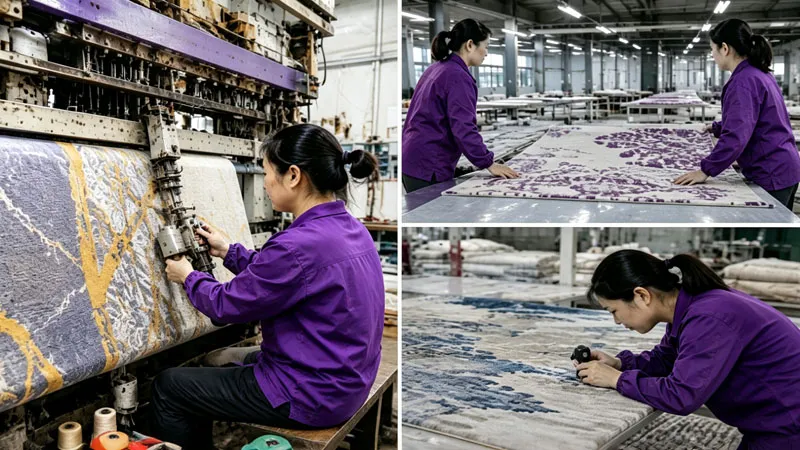
At Fab Carpet’s production line, wool batches are tested for moisture regain and crimp recovery before they’re approved for weaving. That single quality gate removes one of the most common root causes of post-installation buckling.
Installation Standards: Power-Stretching vs. Shortcuts
The Carpet and Rug Institute’s CRI 104 standard calls for power-stretching, not a knee kicker, on any commercial installation. Power-stretching applies consistent tension across the full width of the room. A knee kicker only stretches a few feet at a time, which leaves slack that shows up as waves within the first year.
Padding Density: The Overlooked Variable
Padding that’s too thick or too soft flexes under foot traffic and gradually loosens the carpet above it. CRI guidance recommends dense, low-profile padding for commercial applications — not the plush residential pads that feel comfortable in a showroom but fail under sustained traffic.

Compliance: The Blind Spot Most Guides Skip
This is where most content on wavy carpet stops short. For a B2B buyer, compliance isn’t optional reading — it’s the difference between a passed inspection and a failed one.
Fire Rating and Trip Hazard Risk
A buckled carpet near an exit corridor can fail an inspection on two fronts: the fire rating of the material itself, and the physical trip hazard the buckling creates. Commercial carpet destined for hospitality or public-access buildings should carry a Class I fire rating under ASTM E648, or the equivalent Bfl-s1 classification used in EU specifications. Fab Carpet’s product line is tested and certified to this standard before it leaves the factory, with test reports available per production batch.
EN 14041 and Cross-Border Specification
Projects specified for the EU market need CE marking under EN 14041, covering slip resistance, thermal properties, and reaction to fire. A carpet that passes US standards doesn’t automatically clear European requirements. Buyers sourcing for cross-border hospitality groups need documentation for both markets before the container ships, not after it lands.
Marine and Cross-Border Certification
For cruise line and marine interiors, IMO-compliant carpet needs MED Wheelmark certification. UK-bound projects need UKCA or UKMCA marking, separate from CE. These aren’t paperwork formalities — customs and project inspectors check them, and a shipment without the right marks can sit at port while the project timeline slips.
Full certification matrix for commercial carpet
Reading the Warranty Fine Print
Most disputes come down to one line: does the warranty cover material defects, or installation defects? Before signing, confirm the manufacturer’s testing documentation covers dye lot consistency, backing tension specs, and fiber-grade certification. Fab Carpet issues these as standard documentation with every commercial order — not as a premium add-on.
Total Cost of Ownership: Re-Stretch, Replace, or Renegotiate
Buckled carpet in a working hotel or retail space isn’t just a repair line item. It’s downtime.
Cost Breakdown
Re-stretching an existing carpet in good condition runs roughly $1–$3 per square foot in labor. Full replacement, once material, freight, and installation are factored in, typically runs $8–$18 per square foot depending on construction type. The gap between those numbers is why a fast, accurate diagnosis matters before a facilities team commits to either path.
The Hidden Multiplier: Downtime
A convention hall that closes a section for three days during re-stretching doesn’t just pay the labor bill. It loses bookable square footage. A hotel corridor under repair affects guest perception during the exact window reviews get written. Downtime cost, not material cost, is usually the larger number on the spreadsheet — and it’s the one procurement teams forget to model until it’s too late.
Interactive Tool: Estimate Your Project’s Carpet Cost — Carpet Calculator
Use the calculator to model material cost by area, construction type, and finish before you request a formal quote.
Supply Chain Due Diligence: Vetting a Manufacturer Before You Sign
A wavy carpet six months post-installation is often a sourcing decision, not a maintenance failure. Here’s what separates a reliable factory relationship from a risky one.
Factory Audit Checklist
Before placing a bulk order, ask for third-party QC reports, not just a certificate PDF. Ask whether the factory tests tension and moisture regain per batch, or per production run. Ask for the actual test lab name behind their ASTM or EN certifications — a legitimate factory will name it without hesitation.
Dye Lot Consistency
Color variance between batches is the single most common cause of post-installation disputes on large commercial orders. If a project needs 4,000 square yards delivered across two shipments, dye lot matching has to be locked before production starts, not checked after the second container arrives.
MOQ, Lead Time, and Pricing Logic
Tiered pricing on commercial carpet orders isn’t arbitrary — it reflects loom setup cost, yarn dyeing minimums, and QC batching. A transparent supplier will walk you through why a 500 sq yard order costs more per unit than a 5,000 sq yard order, rather than quoting a flat number and leaving the logic opaque.
Why Direct Factory Sourcing Changes the Math
Every layer between you and the loom adds margin and adds time. Sourcing through a trading company typically adds 20–30% in markup and extends lead time by two to four weeks, since your order queues behind the trading company’s own production slots. Buying direct from a factory like Fab Carpet means your project team gets the production schedule, the QC report, and the shipping timeline straight from the source — not filtered through a reseller who may not know the answer until they ask the factory themselves.
| Sourcing Route | Typical Markup | Lead Time | QC Transparency |
|---|---|---|---|
| Trading company | +20–30% | 8–14 weeks | Indirect, delayed |
| Direct factory (Fab Carpet) | Base cost | 6–10 weeks | Direct batch reports |
OEM and ODM carpet production process
OEM/ODM: Custom Carpet Without the Sourcing Guesswork
For architects and designers working on a custom colorway or pattern, the production path matters as much as the design file.
A properly run OEM/ODM process moves from design approval to a physical sample within two to three weeks, followed by tension and fire-rating testing before bulk weaving starts. Skipping the physical sample stage — approving from a digital rendering alone — is one of the most common reasons color and texture come back off-spec on the finished order.
Prevention Checklist for Architects and Procurement Teams
- Specify power-stretching (CRI 104) explicitly in the installation contract, not just “professional installation”
- Confirm padding density matches commercial-grade specs before ordering, not after delivery
- Request fire rating documentation (ASTM E648 or Bfl-s1) as part of the submittal package
- Lock dye lot matching in writing before production starts on multi-phase orders
- Build a re-stretching maintenance check into the facility’s annual schedule, not just reactive repair
This checklist covers supplier vetting questions, certification verification, and a diagnostic matrix for buckling symptoms — built for use in RFP documentation or on-site acceptance walkthroughs.
FAQ
What’s the MOQ for a custom Axminster or hand-tufted carpet order?
Minimum order quantities vary by construction type, typically starting around 300–500 square yards for hand-tufted and higher for woven Axminster due to loom setup requirements. Confirm exact figures per project.
How long does sample production take?
Standard color-matched swatches ship within 5–7 business days. Full pattern samples for custom OEM projects typically take 2–3 weeks.
What’s the typical ocean freight lead time?
From a Chinese production base to major US or EU ports, ocean freight generally runs 4–6 weeks, plus 2–3 weeks for customs clearance and inland delivery.
Does Fab Carpet provide fire rating test reports with each shipment?
Yes. ASTM E648 and EN 14041 documentation is issued per production batch, not as a one-time certificate.
Can hand-knotted carpet be re-stretched the same way as tufted carpet?
No. Hand-knotted rugs typically require rewetting and blocking rather than mechanical re-stretching, due to the warp and weft construction.
Is wavy carpet always a warranty issue?
Not automatically. Coverage depends on whether the cause is a material defect (fiber, backing) or an installation defect (stretching, padding) — which is why documentation from day one matters.
Next Step
If you’re specifying carpet for a hospitality, retail, or commercial project, get the compliance and cost details sorted before the RFP goes out.