Call us now:

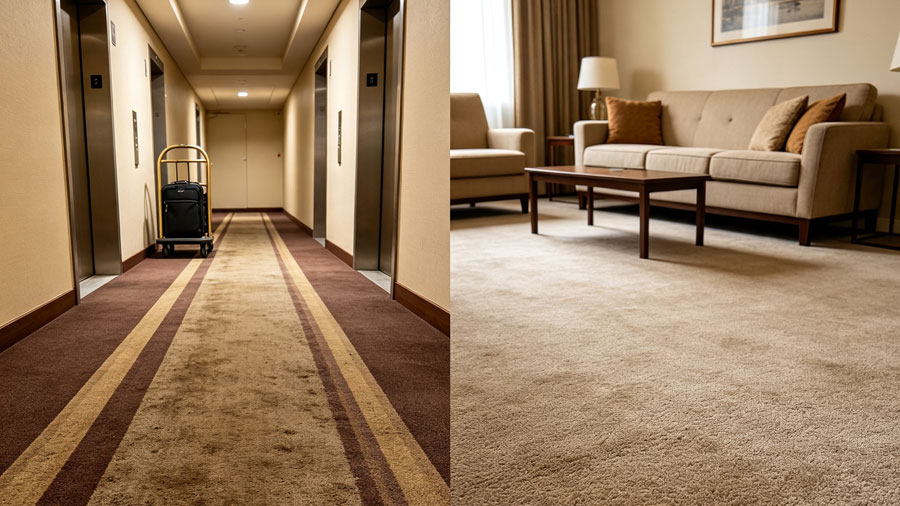
The life of carpet in a hotel corridor has nothing to do with the “5 to 15 years” figure you’ll find on residential blogs. A failed fire rating or a misjudged wear class can stall a project, blow a budget, or trigger a contract penalty. This guide breaks down how commercial carpet lifespan is actually calculated — and how to buy it right the first time.
Why “5 to 15 Years” Doesn’t Apply to Commercial Projects
Most published carpet lifespan figures come from home vacuum-cleaner blogs. A living room sees a handful of footsteps a day. A hotel lobby sees thousands.
Traffic load changes the math entirely. Residential carpet is rated for light or moderate use. Commercial carpet needs a Heavy or Extra Heavy traffic rating to survive daily wheeled luggage, room-service carts, and 24-hour foot flow.
Residential vs. Commercial Lifespan Benchmark
| Setting | Typical Traffic | Realistic Lifespan |
|---|---|---|
| Home living room | Light | 10–15 years |
| Home hallway/stairs | Moderate | 5–8 years |
| Hotel guest room | Moderate-Heavy | 5–7 years |
| Hotel corridor/lobby | Heavy-Extra Heavy | 3–6 years |
| High-traffic entertainment areas | Extra Heavy | 2–4 years |
A project spec written around residential numbers will underperform within two years. That gap is where most procurement budgets go wrong.
The Real Formula: How Carpet Lifespan Is Actually Calculated
Lifespan isn’t a guess. It’s a product of density, pile height, and twist level.
Density, Pile Height & Twist: The Core Durability Formula
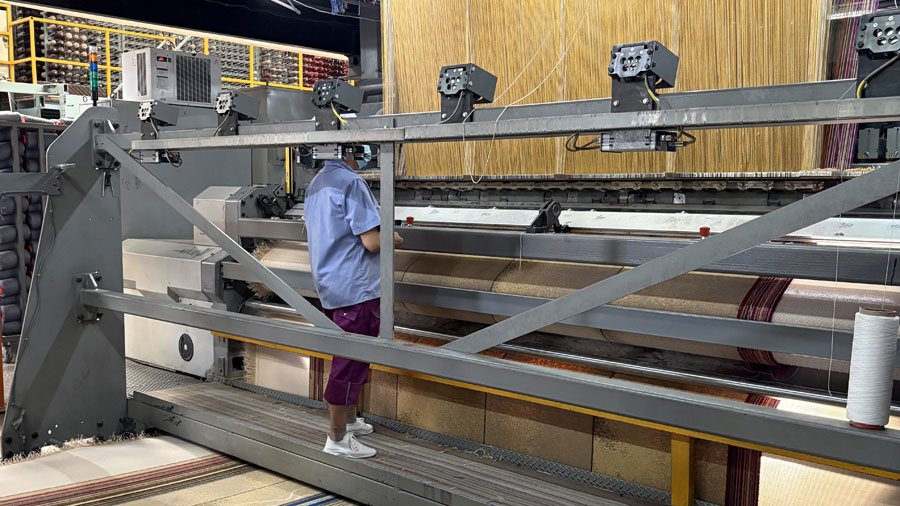
Density is calculated as (Pile Weight ÷ Pile Height) × 36. Higher density means tighter tufts, less crushing, and slower matting. A low-density carpet at 8,000 g/m² will flatten in a heavy-traffic corridor within 18 months, regardless of fiber quality.
Twist level matters just as much. Fibers with a tight twist and heat-set finish resist untwisting under repeated foot pressure — this is what keeps pile standing upright after year three, not just year one.
Construction Method Changes the Curve
- Axminster — woven construction, ideal for patterned, branded corridors and large-format hospitality layouts.
- Hand-Tufted — faster production, strong for guest rooms and mid-traffic zones.
- Hand-Knotted — the longest-cycle option, suited to suites and low-traffic luxury spaces.
On Fab Carpet’s production floor, density and twist are checked at three separate QC stages before a roll ever leaves the mill — not just at final inspection. That’s the difference between a spec sheet number and a delivered product.
Which Fiber Actually Lasts Longest in Commercial Use?
Fiber choice sets the ceiling on everything else.
Fiber Performance Matrix
| Fiber | Lifespan (Heavy Traffic) | Fire Performance | Best Use |
|---|---|---|---|
| Premium New Zealand Wool | 8–12 years | Naturally low flame spread | Lobbies, suites, corridors |
| Nylon | 6–9 years | Requires added treatment | Guest rooms, offices |
| Polyester blends | 4–6 years | Requires added treatment | Low-budget, low-traffic |
| Polypropylene | 2–4 years | Melts under heat | Not recommended for hospitality |
Wool holds its resilience because the fiber has natural crimp memory — it springs back after compression instead of staying flattened. That’s why Fab Carpet builds its premium lines on Premium New Zealand Wool: the fiber does the structural work before any finishing treatment is applied.
Premium New Zealand Wool carpet collection
Fire Safety: The Factor That Decides Project Approval Before Lifespan Even Matters
A carpet with a 10-year lifespan is worthless if it fails fire code and never gets installed.
Fire Rating Requirements for Hospitality Projects
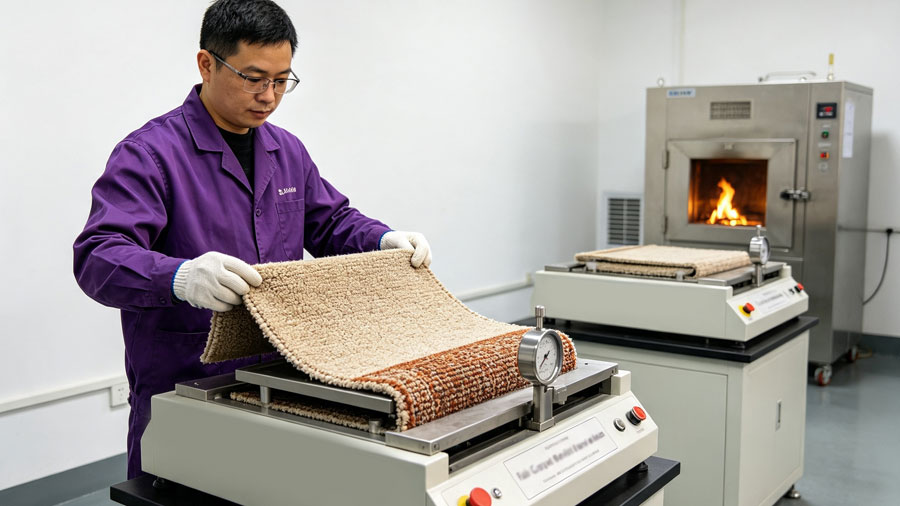
Commercial carpet in North America needs a Class I rating under ASTM E648. In the EU and UK, the equivalent benchmark is Bfl-s1 under EN 13501-1. Specifiers should request the actual test report — not a marketing claim — before approving material.
Fab Carpet’s wool and blended constructions are tested to Class I (ASTM E648) and Bfl-s1, with certificates issued per production batch, not per product line.
Compliance Checklist for International Buyers
| Certification | Market | What It Confirms |
|---|---|---|
| CRI Green Label Plus (GLP9123/GLP5308) | North America | Low VOC emissions |
| EN 14041 (CE) | European Union | Fire, slip, static performance |
| MED Wheelmark | Marine/IMO projects | Maritime fire & safety compliance |
| UKCA/UKMCA | United Kingdom | Post-Brexit market access |
| ISO 9001/14001/45001 | Global | Quality, environment, safety management |
CRI Green Label Plus certified products
Buyers sourcing for cruise or ferry interiors should confirm MED Wheelmark certification specifically — general fire ratings don’t satisfy IMO requirements.
High-Traffic Zones: A Zone-by-Zone Lifespan Breakdown
Not every square meter of a property wears the same way.
Lobby, Corridor & Entertainment Area Lifespan
| Zone | Recommended Density | Expected Lifespan |
|---|---|---|
| Guest rooms | 6,500–8,000 g/m² | 6–8 years |
| Corridors | 8,500–10,000 g/m² | 4–6 years |
| Lobbies | 9,000–11,000 g/m² | 3–5 years |
| High-traffic entertainment areas | 10,000+ g/m² | 2–4 years |
Acoustic Performance Is a Hidden Lifespan Marker
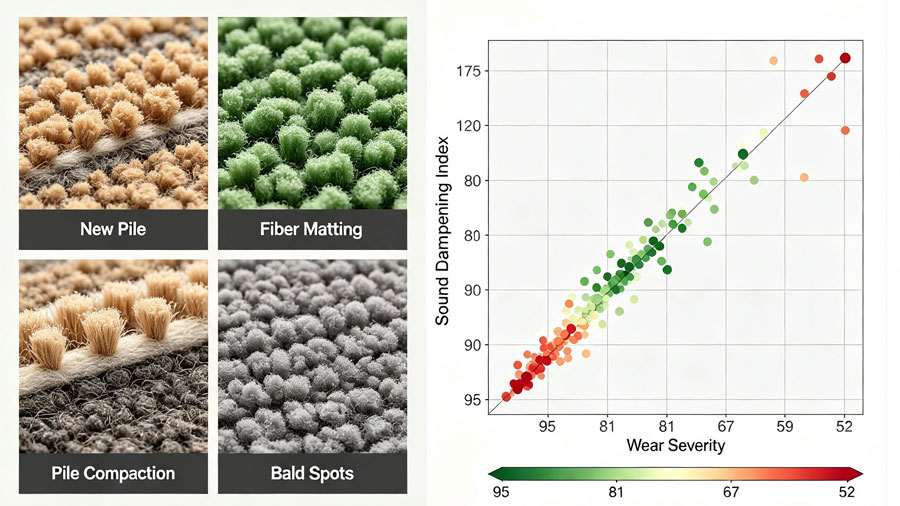
Sound absorption drops as pile crushes, long before visible wear appears. A carpet rated NRC 0.35 when new can fall below 0.20 after two years in a heavy-traffic zone. Guest complaints about noise often trace back to acoustic decay, not just visual wear — a factor most lifespan guides skip entirely.
Total Cost of Ownership: The Number That Actually Matters
Purchase price tells you almost nothing about long-term cost.
Why Cheaper Carpet Often Costs More Over 10 Years
A low-density carpet at $18/m² that needs replacing every 3 years costs more over a decade than a $32/m² commercial-grade product replaced once. Add labor, downtime, and disposal, and the gap widens further.
Interactive Tool: Calculate your project’s carpet lifespan and cost estimate
Where the 20–30% Markup Actually Goes
A typical import chain runs: mill → trading company → regional distributor → project buyer. Each link adds margin without adding value. Buying direct from a source factory like Fab Carpet in Qinghai, China, removes two of those links — the savings show up in the quote, not in a sales pitch.
Procurement Red Flags: Avoiding Supply Chain Failures Before Installation
Lifespan problems often start before the carpet ships.
Supplier Qualification Checklist
- Ask for batch-specific fire test reports, not generic certificates.
- Confirm ISO 9001/14001/45001 registration numbers directly with the issuing body.
- Request in-line QC photos from production, not just final inspection.
- Verify AAAAA quality standard compliance against actual factory audit records.
MOQ, Lead Time & Custom Development
Most source factories set MOQ by roll length rather than area, with tiered pricing at higher volumes. Custom Axminster patterns typically need 4–6 weeks for sampling and 8–12 weeks for bulk production, depending on yarn dyeing schedules. Buyers who skip the sampling stage to save time are the ones who end up with color-batch mismatches on site.
How to Extend Commercial Carpet Life
- Rotate high-traffic runners every 6 months to even out wear.
- Deep-clean corridors and lobbies every 3–4 months, guest rooms every 6–12 months.
- Match cleaning chemistry to fiber type — wool needs pH-neutral products, synthetics tolerate more aggressive treatment.
- Re-inspect fire and acoustic ratings at the 3-year mark, not just at replacement time.
Carpet maintenance guide for hospitality facilities
Frequently Asked Questions
What’s the minimum order quantity for custom hotel carpet?
MOQ varies by construction — hand-tufted runs typically start lower than Axminster. Most projects fall between 300–1,000 m² for a first custom order.
How long does it take to get carpet samples?
Stock swatches ship within days. Custom color-matched samples typically take 5–10 business days to produce.
What’s the standard sea freight lead time from China?
Ocean freight to North America or Europe runs 25–40 days depending on port and season, on top of production lead time.
Does Fab Carpet provide fire test reports for each order?
Yes — batch-specific ASTM E648 and Bfl-s1 reports are issued per production run, not per product catalog listing.
Is wool or nylon better for a hotel lobby?
Wool holds density and appearance longer under heavy traffic and carries stronger natural fire performance. Nylon costs less upfront but wears faster in extra-heavy zones.
Can Axminster carpet match a hotel’s existing brand pattern?
Yes — Axminster looms support custom jacquard patterns and color matching against a supplied design file or physical sample.
Ready to Spec Carpet That Actually Lasts?
Request free sample swatches, submit an RFQ, or download the technical data sheet for Fab Carpet’s commercial wool collections before your next project spec goes out for bid.