Call us now:

A wrong carpet color choice rarely fails on aesthetics alone. It fails on batch inconsistency, missed fire ratings, or a six-week delay that pushes back a hotel opening. Carpet colors 2026 trends look good in a mood board. They only work in a real project when the dye, the fiber, and the certification all hold up under a five-year lease. This guide breaks down what procurement teams and designers actually need to check before signing a purchase order.
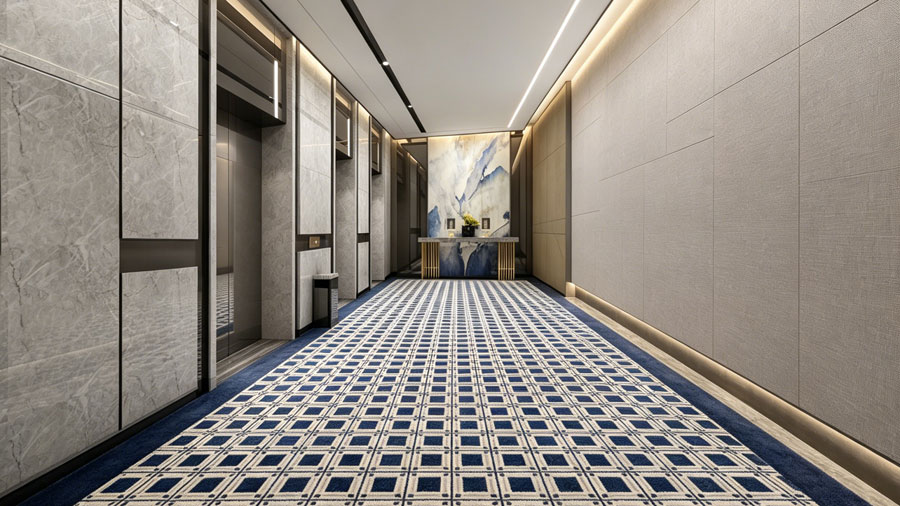
Why Commercial Carpet Color Decisions Differ From Residential Trends
A homeowner picks a color for a living room that sees light foot traffic and gets replaced in eight years. A hotel corridor sees thousands of footsteps a week, gets cleaned with commercial-grade chemicals, and needs to pass inspection under a completely different set of rules.
Color Fastness Under Commercial Wear
Fading isn’t cosmetic in a commercial setting — it’s a warranty issue. Wool fiber tested under ISO 105 light fastness standards holds pigment longer than most synthetic blends, particularly in lobbies with heavy glass exposure. [Light fastness testing methodology]
Batch Color Consistency: The Risk Nobody Flags Early
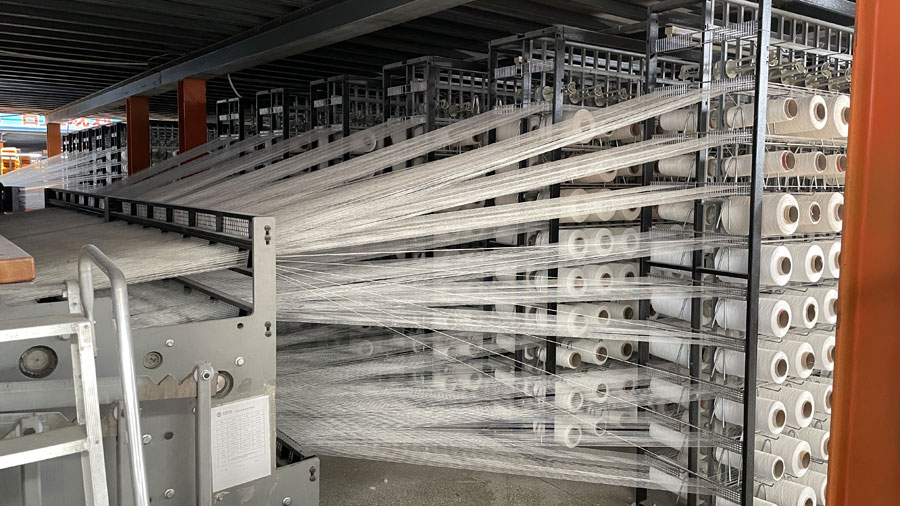
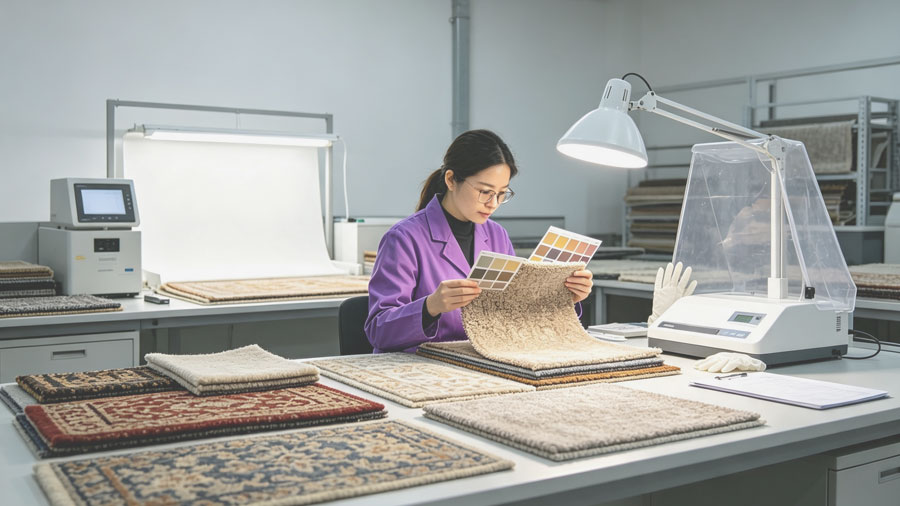
Order 3,000 square meters of the same SKU and you can still end up with visible shading between rolls if dye lots aren’t controlled. On Fab Carpet’s production line, every dye batch is measured against a ΔE tolerance under 1.0 before it clears QC — the difference between a corridor that reads as one continuous color and one that looks patched together at the seams.
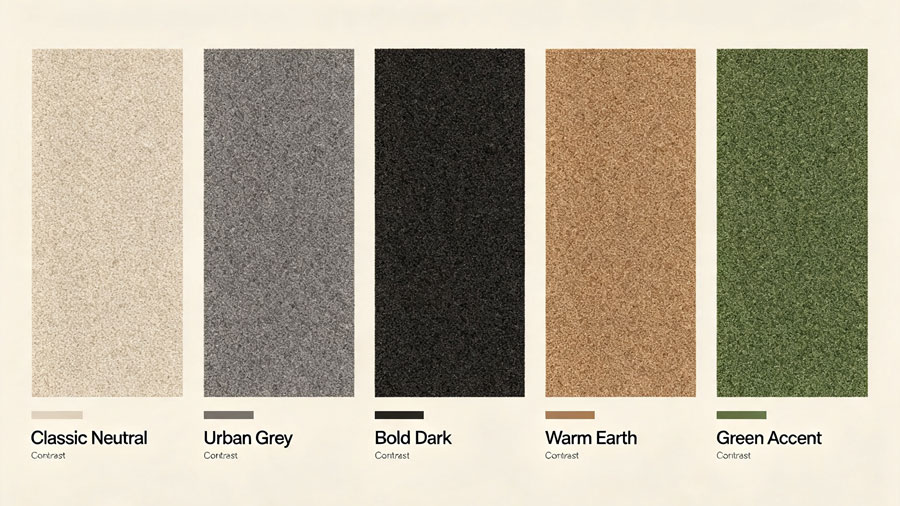
The 2026 Commercial Palette Buyers Are Specifying
Warm earth neutrals — dune, driftwood, and stone tones — dominate lobby and corridor specs this year, chosen as much for how well they hide soil as for their look.
Deep grounding tones — espresso, charcoal, midnight blue — are showing up in guest rooms and executive suites, paired with brass or matte black fixtures.
Botanical greens — moss, sage, olive — are standard now in wellness and spa areas, part of a broader biophilic design push.
Jewel tones — emerald, garnet, sapphire — are reserved for statement zones: ballrooms, F&B outlets, and other high-traffic commercial spaces where a bolder palette earns its place.
One color to reconsider: pale grey. It reads clean in a rendering, but under ASTM D3597 abrasion testing it shows wear and matting faster than warmer mid-tones, especially in corridors.
| Weave Type | Color Accuracy | Typical MOQ | Lead Time | Best Use Case |
|---|---|---|---|---|
| Axminster | Very high (multi-color pattern) | 300 sqm | 6–8 weeks | Branded corridors, logo carpets |
| Hand Tufted | High | 150 sqm | 4–6 weeks | Guest rooms, custom rugs |
| Hand Knotted | Highest, slowest | 100 sqm | 10–12 weeks | Luxury suites, statement pieces |
| Machine-Made | Consistent, limited pattern depth | 500 sqm | 3–4 weeks | Large-scale corridor rollouts |
Weave and Fiber: Why Construction Method Changes How Color Reads
Axminster looms allow up to eight colors woven into a single pattern with sharp edges, which is why hotel brands use it for logo carpets and complex borders. Hand-tufted construction gives more flexibility for custom color matching on shorter runs, since the tufting gun follows a hand-drawn pattern rather than a fixed loom setup.
Pile density and pile weight both affect how saturated a color appears. A heavier pile carries more dye per square inch, which is why the same Pantone reference can look flatter on a low-density sample and richer on a premium-weight one — a detail worth confirming before approving a strike-off.
Why Premium New Zealand Wool Holds Color Longer
Wool’s natural fiber structure absorbs dye into the core rather than just coating the surface, which is part of why it resists fading better than polypropylene under UV exposure. Fab Carpet sources graded New Zealand wool specifically for consistent dye uptake across production runs, which keeps a reorder six months later looking like the original delivery rather than a slightly different shade.
Compliance: The Layer That Overrides Every Color Preference
No color choice survives a failed fire test. Carpet specified for hospitality and marine projects needs to clear Class I fire ratings under ASTM E648 or Bfl-s1, and dye treatment can affect how vibrant a color reads post-treatment — something worth testing on a sample before a full order.
For indoor air quality, CRI Green Label Plus certification (GLP9123 / GLP5308) confirms low chemical emissions, which matters for LEED documentation and for guests with sensitivities. [CRI Green Label Plus certified product directory]
Regional requirements vary:
- EN 14041 (CE) — required across the EU
- MED Wheelmark — mandatory for marine and cruise ship interiors, following IMO standards
- UKCA / UKMCA — required for UK projects post-Brexit
- ISO 9001 / 14001 / 45001 — quality, environmental, and safety management benchmarks that reputable factories hold as standard, not as an upsell
Fab Carpet manufactures under the AAAAA quality standard and holds this full certification set, so a project spec that needs EN 14041 for a European hotel and MED Wheelmark for a cruise line refit can be produced on the same production standard without re-qualifying a supplier twice.
wool carpet fiber performance comparison
Sourcing 2026 Colors Without the Middleman Markup
A trading company adds a layer of cost and a layer of miscommunication. Every color revision, every sample request, and every production question routes through a third party before it reaches the factory floor. Buying direct from a source factory typically removes 20–30% of that markup, since there’s no intermediary margin stacked on top of production cost.
MOQ and pricing scale with weave complexity, not just square footage — an Axminster custom color run at 300 square meters costs differently per unit than the same design at 1,000 square meters, because loom setup is a fixed cost spread across the order.
Before signing with any supplier, verify:
- Recent third-party lab reports for fire rating and color fastness, not just marketing claims
- Sample consistency across at least two separate production runs
- In-house QC process, not outsourced inspection
- Actual client references from hospitality projects, not just residential dealers
commercial carpet procurement supplier vetting guide
[Downloadable Resource: Download Free B2B Carpet Procurement Checklist PDF]
Plan Your 2026 Project
Estimate material needs and get a preliminary cost range before submitting an RFQ.
Interactive Tool: Carpet Calculator
hospitality carpet acoustic and durability specifications
FAQ
What is the typical MOQ for custom-colored hand-tufted carpet?
Most factories set it around 150 square meters, though this varies by pattern complexity and pile height.
How long does sample production take before a full order?
Strike-off samples typically ship within 10–15 business days after color and spec confirmation.
Which fire certification applies to EU hospitality projects versus marine projects?
EU hotel projects require EN 14041 (CE); marine and cruise interiors require MED Wheelmark under IMO standards.
Does custom color matching add to Axminster lead time?
Yes, typically 1–2 weeks for loom setup and color calibration on top of standard production time.
How does wool compare to synthetic fiber for long-term color retention?
Wool generally resists UV fading better due to how dye binds within the fiber core, particularly relevant for sunlit lobbies.
Can a hotel brand’s exact Pantone color be matched for a large rollout?
Yes, with a physical dye lab match and an approved strike-off sample before bulk production begins.
Request Your Sample Swatches
Get physical color and material samples, a technical data sheet, and a project-specific quote before committing to a full order. Submit an RFQ or request free sample swatches directly from Fab Carpet’s production team.