Call us now:

Getting how to measure room for carpet wrong on a commercial project doesn’t just waste material — it triggers dye-lot mismatches, blows your fire-rating compliance window, and pushes install dates past the client’s opening date. This guide skips the homeowner tips and gives you the procurement-grade method architects and hotel developers actually need.
Why Commercial Carpet Measurement Is a Different Discipline Than Residential
A living room measurement error costs you a return trip to the store. A hotel corridor measurement error costs you a dye-lot mismatch across 40 floors, a missed opening date, and a very uncomfortable call with the general contractor.
Scale, Batch Consistency & Dye-Lot Risk Across Multiple Floors
Residential carpet guides assume one room, one purchase, one visit. Commercial projects run in phases — floor by floor, wing by wing — sometimes over several months. Every phase needs to pull from the same production batch, or you get visible color drift between sections that a lobby camera will catch on day one. Measurement isn’t just about area anymore. It’s about sequencing your orders so batch consistency survives a multi-phase rollout.
Why a 5% Waste Factor Rule Fails on Large-Format Projects
The standard “add 5% for waste” advice works fine for a 200 sq ft bedroom. It falls apart at 20,000 sq ft. At that scale, a 5% miscalculation isn’t a few extra dollars — it’s thousands of square feet of unaccounted material, or worse, a shortfall discovered mid-install. Waste factor on commercial jobs needs to account for roll width, pattern repeat, and seam count separately, not as one flat percentage.
The Hidden Cost of Under-Measuring: Reorder Delays, Dye-Lot Mismatch, Project Timeline Slippage
Wool carpet dye lots are batch-specific. Miss your quantity and the reorder won’t match — not in six weeks, not ever exactly. Developers who under-measure end up either replacing sections that don’t need replacing or accepting a visible seam of mismatched color in a five-star lobby. Neither option is cheap.
Step-by-Step: How to Measure a Room for Carpet (Procurement-Grade Method)
Tools of the Trade — From Laser Measuring Devices to CAD-Based Site Surveys
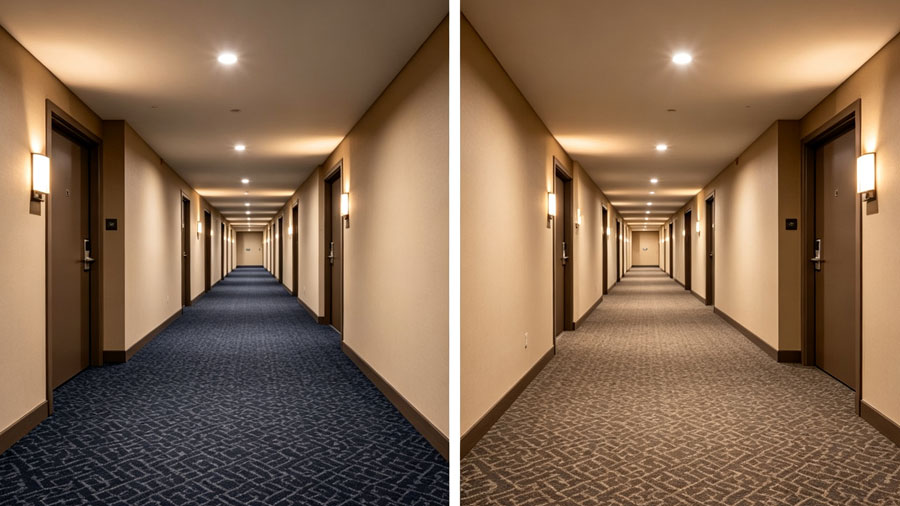
A tape measure works for a single office. For a 40-room floor plate, you need a laser distance meter and, ideally, the architect’s CAD floor plans as your baseline. Cross-check the CAD file against a physical site walk — as-built conditions rarely match the drawing set exactly.
Measuring Standard Rectangular Spaces (Formula + Worked Example)
Length × Width = base square footage. A 30 ft × 18 ft conference room needs 540 sq ft of base coverage. Simple math, but it’s only the starting point for a commercial order.
Measuring Irregular Layouts, Alcoves & Multi-Zone Commercial Floors
Break irregular floor plates into rectangles, measure each independently, then sum the totals. Reception desks, structural columns, and built-in millwork all cut into usable area — measure around them, not through them.
Measuring High-Traffic Corridors, Lobbies & Staircases in Hospitality Projects
Corridors and staircases carry the heaviest foot traffic in any hospitality build and need separate wear-rated specification, not just separate measurement. Measure stair treads and risers individually — total run length rarely matches a simple floor-to-floor calculation.
The Corrected Waste Factor Formula for Commercial Rolls & Custom Widths
For commercial rolls, factor pattern repeat, seam count, and roll width into your waste percentage — not a flat 5%. Run your own numbers with the Carpet Calculator, which adjusts waste percentage based on roll width and pattern repeat instead of applying one fixed number across every project type.
Seam Placement, Pattern Repeat & Directional Matching for Large-Format Projects
Why Pattern Repeat Calculations Change with Axminster vs Tufted Construction
Axminster carpet weaves pattern directly into the pile, which means pattern repeat has to align across every seam in a corridor run. Tufted carpet has more forgiving repeat tolerances but less design precision. Fab Carpet’s Axminster production line holds repeat tolerance tight enough for multi-floor corridor runs without visible pattern breaks at the seam.
Custom Widths & Bespoke Sizing — When Off-the-Shelf Rolls Don’t Fit Hotel Floor Plans
Standard 12-foot rolls don’t always fit a hotel floor plate cleanly. Custom-width production removes a seam entirely in some layouts, which matters more in a lobby than in a back office.
Beyond the Tape Measure — Technical Specs Every B2B Buyer Must Verify
Measurement gets your quantity right. It doesn’t confirm the carpet meets code — that’s a separate conversation your supplier should be having with you before production starts.
Fire Rating Standards Explained — ASTM E648 / Class I / Bfl-s1
Class I fire rating under ASTM E648 is the baseline for most U.S. commercial buildings. Ask for the actual test report, not a spec sheet claim. Fab Carpet ships Class I / Bfl-s1 certified product as standard on hospitality orders, with test documentation available before you sign off on production.
Acoustic Performance — Understanding NRC & STC Ratings for Hospitality Corridors
Corridors between guest rooms need sound absorption specs, not just aesthetics. NRC (Noise Reduction Coefficient) and STC (Sound Transmission Class) ratings determine how much footfall noise transfers between floors — a detail that shows up in guest reviews if it’s overlooked.
Wear & Durability Ratings for High-Traffic Commercial Zones
Martindale and Wyzenbeek ratings measure abrasion resistance under repeated foot traffic. High-traffic commercial spaces — lobbies, corridors, entertainment and hospitality venues — need wear ratings well above residential-grade product.
Environmental & Indoor Air Quality Compliance
CRI Green Label Plus certification (GLP9123 / GLP5308) confirms low chemical emissions, which matters for LEED-targeted projects and post-occupancy air quality requirements.
CRI Green Label Plus certification database
Marine & Transport-Grade Applications — MED Wheelmark (IMO) & UKCA/UKMCA
Cruise and marine hospitality projects need MED Wheelmark certification under IMO standards, plus UKCA/UKMCA compliance for UK-bound shipments. Few carpet guides address this because few writers work with factories that actually hold these certifications.
Comparison Table: Residential Carpet Specs vs Commercial-Grade Specs
| Attribute | Residential Standard | Commercial-Grade Fab Carpet |
|---|---|---|
| Fire Rating | Often untested | Class I / ASTM E648 / Bfl-s1 |
| IAQ Certification | Rare | CRI GLP9123 / GLP5308 |
| EU Building Code | N/A | EN 14041 (CE) |
| Marine Compliance | N/A | MED Wheelmark (IMO) |
| Wear Rating | Unspecified | Verified Martindale/Wyzenbeek |
Material Deep-Dive: Why Premium New Zealand Wool Changes Your Measurement Calculations
Wool vs Synthetic Fiber — Density, Pile Height & Weight Impact on Yardage Planning
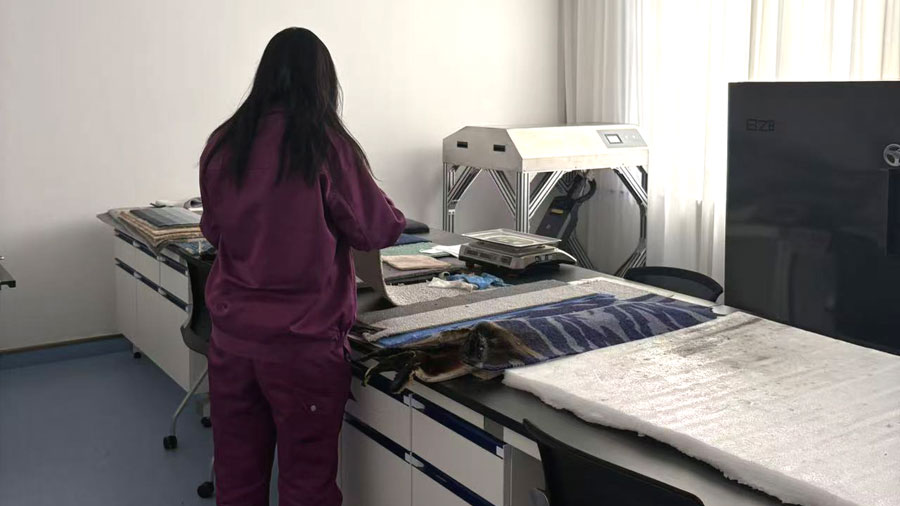
Wool pile height and density affect how much fiber a given area actually requires. Premium New Zealand wool holds shape and color longer under heavy foot traffic than synthetic blends, which changes your long-term replacement math even if the upfront yardage looks similar on paper.
Hand-Tufted vs Hand-Knotted vs Machine-Made — Lead Time & Tolerance Differences
Hand-knotted construction takes longer to produce and holds tighter custom tolerances. Machine-made runs faster but with less design flexibility. Fab Carpet runs all four methods — hand-tufted, hand-knotted, Axminster, and machine-made — on the same factory floor, so your production timeline gets built around the actual construction method, not a generic estimate.
Supply Chain Pitfalls — What Commercial Buyers Get Wrong When Sourcing After Measurement
The Middleman Markup Problem
A trading company between you and the factory typically adds 20-30% to your per-square-meter cost, with no added value to production quality or lead time. Sourcing factory-direct from a source-manufacturer removes that layer entirely.
Supplier Vetting Checklist — Questions to Ask Before Sending Your Measurements to a Factory
Ask for certification documents before quoting, not after. Request a physical sample before committing to a production run. Confirm the factory’s ISO 9001 quality management certification directly, not through a reseller’s claim.
MOQ & Tiered Pricing Logic
Minimum order quantities and per-square-meter pricing usually scale together — larger orders drop the unit cost, but the break points vary by construction method. Get the tiered pricing sheet before finalizing your measurement-based order quantity, not after.
Lead Time Reality Check
Custom production timelines run from sample approval to weaving to finishing to shipping. Fab Carpet’s Qinghai facility quotes lead time against actual order volume and construction method at RFQ stage, so your install schedule isn’t built on a guess.
Red Flags: Spotting Underqualified Suppliers
No physical factory address, no certification documents on request, and vague answers about production location are the three fastest disqualifiers before you send measurements anywhere.
commercial carpet supplier qualification process
From Measurement to Installation — Coordinating Site Survey, Production & Delivery
What to Include in a Site Survey Report for Your Supplier
CAD files, site photos, substrate condition notes, and access constraints all belong in the survey package sent to production — not just square footage.
How QC Cross-Checks Your Measurements Before Cutting
Fab Carpet’s AAAAA quality standard process re-verifies submitted measurements against the CAD file before a single roll gets cut, catching discrepancies before they become an on-site problem.
Shipping, Customs & On-Site Installation Coordination
International commercial orders need customs documentation prepared alongside the production schedule, not after the carpet ships.
custom hospitality carpet solutions
FAQ
What is the MOQ for OEM/ODM custom carpet orders?
MOQ varies by construction method — Axminster and hand-tufted orders typically require higher minimums than machine-made. Confirm current thresholds at RFQ stage.
How long does sample swatch delivery take?
Standard swatches ship within a few business days; custom color-matched samples take longer since they run through a mini production cycle first.
What is typical sea freight lead time for bulk commercial orders?
Ocean freight adds several weeks on top of production time, depending on destination port and customs processing.
Can I get a copy of the fire rating test report before ordering?
Yes — request the ASTM E648 or Bfl-s1 test documentation directly from the supplier before committing to production.
Does Fab Carpet support custom widths for hotel floor plans?
Yes, custom-width production is available to reduce or eliminate seams in non-standard floor layouts.
Is CRI Green Label Plus required for LEED projects?
It’s not universally mandatory, but it’s commonly required or heavily favored in LEED indoor air quality credit categories.
Get Your Project Measured Right — Talk to the Factory Directly
Submit your floor plans for a free RFQ, request physical sample swatches, or download the full TDS technical data sheet before you finalize your next commercial carpet order.