Call us now:

How to get smell out of carpet is rarely a cleaning question in commercial projects. It is a specification question. Most odor claims trace back to decisions made before installation. A musty corridor six months after handover means remediation costs, guest complaints, and arguments over who pays. Add a fire certificate that fails local rules, or a shipment that arrives late, and penalties follow. This guide shows you how to diagnose odor, remove it, and specify carpet that resists it from day one. You get a diagnostic table, a fiber comparison, a certification map, and a supplier checklist built from Fab Carpet’s factory and project experience.
Why Does Commercial Carpet Smell? Diagnose Before You Treat
Treating the wrong cause wastes budget. Name the smell first, then pick the fix.
The Five Sources of Carpet Odor
- Trapped moisture. Leaks, condensation, or extraction without full drying. Microbial growth starts within days.
- Organic contamination. Food, beverages, and bodily fluids in guest rooms, banquet halls, and Entertainment Venues.
- Smoke and airborne residue. Fibers and backing absorb it in lobbies and High-traffic Commercial Spaces.
- Degraded backing or underlay. A wet cushion holds odor long after the surface looks clean.
- New-carpet emissions. VOCs from adhesives and backings. They fade, but you should still check emission certification before you buy.
Diagnostic Table: Smell, Cause, First Action
| Odor character | Likely cause | How to confirm | First action |
|---|---|---|---|
| Musty, earthy | Moisture, mildew | Moisture meter, hygrometer, check edges and underlay | Dry, dehumidify, HEPA vacuum |
| Sour | Food or drink residue, leftover detergent | Spot inspection of damp areas | Extract with a fiber-appropriate cleaner |
| Ammonia | Urine | UV light inspection | Enzyme treatment, inspect underlay |
| Chemical | New-carpet VOCs, adhesive | Compare with install date, request emission certificate | Ventilate, verify certification |
| Stale smoke | Smoke absorption | Odor persists after routine cleaning | Hot-water extraction, air quality review |
When the Carpet Is Not the Problem
Check the HVAC system and the subfloor before you blame the carpet. A concrete slab with high moisture vapor emission feeds odor into any carpet laid on top. Test slab humidity before installation. In-situ relative humidity probing under ASTM F2170 is the common method.
How to Get Smell Out of Carpet: A Step-by-Step Protocol
Steps 1–2: Stop the Source, Then Dry Fast
Fix the leak. Extract standing water. Run fans and dehumidifiers. The EPA advises drying wet materials within 24–48 hours to prevent mold growth, and it recommends keeping indoor humidity below 60%, ideally between 30% and 50%.
EPA guidance on mold and moisture control in buildings
Steps 3–4: HEPA Vacuum, Then Match the Treatment to the Odor
Vacuum with a HEPA-filtered machine. It removes soil and loose spores before you add any liquid.
Then match treatment to cause:
- Organic odors: enzyme cleaner, applied per label.
- Smoke and soil: hot-water extraction.
- Ambient room odor: air filtration and ventilation.
Do not over-wet. Excess water creates the next odor problem.
Step 5: Re-Dry, Inspect the Backing, Verify
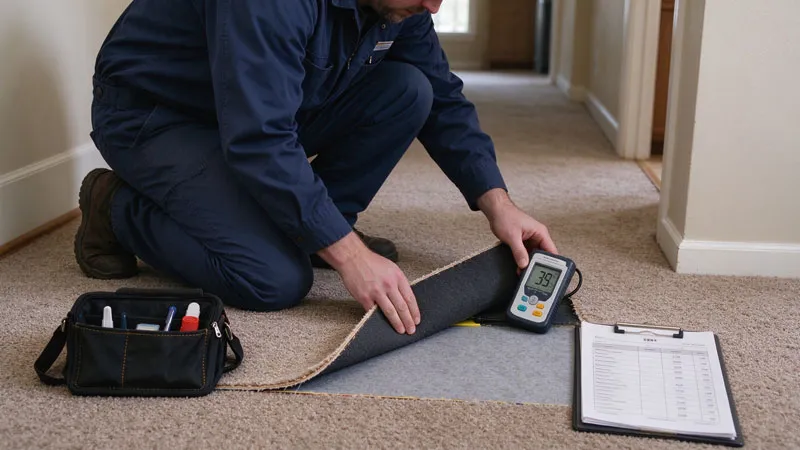
Lift a corner in the affected zone. Check the backing and underlay for staining, softness, or smell. Replace the section if it is contaminated. Cleaning the surface alone will not cure a damaged underlay. Re-measure moisture before the area returns to service.
DIY Hacks That Do Not Belong in Commercial Projects
Consumer blogs suggest vodka sprays, onion bowls, and vinegar-baking soda foam. These methods have no test data behind them. They do not scale across 2,000 m² of corridor. They can also conflict with warranty terms.
Wool needs extra care. It is sensitive to alkaline products, so avoid heavy baking soda layers and bleach-type cleaners. Use wool-approved products and follow the manufacturer’s care guide. Fab Carpet ships its wool carpets with care guidance and a list of unsuitable cleaning agents, because most warranty disputes we see start with the wrong cleaner.
Which Carpet Resists Odor Best? Fiber and Construction Compared
Specification decides how hard odor is to remove later. One point needs honesty: wool absorbs and releases moisture, which buffers humidity swings. That does not make a damp room safe. Any carpet will smell if it stays wet.
Fiber Comparison
| Fiber | Moisture uptake | Wear and resilience | Fire behavior | Odor note |
|---|---|---|---|---|
| Premium New Zealand Wool | High, releases slowly | Excellent recovery in dense pile | Naturally low flammability | Needs full drying and wool-safe cleaning |
| Nylon 6 / 6.6 | Moderate | Excellent wear | Depends on construction and backing | Can hold oily soils if untreated |
| Polyester (PET) | Very low | Good, lower resilience | Depends on construction and backing | Retains oily soils and the odor they carry |
| Polypropylene | Very low | Moderate | Depends on construction and backing | Resists moisture, attracts oily soils |
Confirm every figure against the supplier’s test report, not a brochure.
Construction Matters
- Axminster: tight weave, strong pattern control. Suits ballrooms, corridors, and large patterned areas.
- Hand tufted: fast custom work. Backing and adhesive choice drives moisture and emission performance.
- Hand knotted: premium, low-traffic zones such as suites and lobbies. Avoid frequent wet cleaning.
- Machine and hand-made combinations: custom detail with a shorter delivery path.
Pile Density: The Formula Specifiers Should Use
Density tells you how tightly the yarn is packed. Higher density resists crushing and keeps soil near the surface, where it is easier to extract.
Density (oz/yd³) = Pile weight (oz/yd²) × 36 ÷ Pile height (in)
Example (illustrative): 40 oz/yd² at 0.5 in gives 40 × 36 ÷ 0.5 = 2,880 oz/yd³. Ask each supplier for pile weight and height in writing, then compare on the same basis.
Before you request a quote, run your floor plan areas through the Carpet Calculator to estimate the area you need, including waste allowance.
Premium New Zealand wool carpet for hotels
Certifications That Protect Air Quality and Liability
CRI Green Label Plus: What It Covers
Green Label Plus is a third-party program that tests carpet for VOC emissions. It speaks directly to new-carpet smell and indoor air quality. Fab Carpet holds GLP9123 and GLP5308. Check each certificate’s product scope in the directory. A certificate for one product line does not cover another.
CRI Green Label Plus certified products directory
Fire Performance: ASTM E648 Class I and Bfl-s1
ASTM E648 is the radiant panel test. Class I is the highest class, requiring a critical radiant flux of 0.45 W/cm² or more. Bfl-s1 is the EN 13501-1 reaction-to-fire class for floorings, with limited smoke production. Fab Carpet products carry a Class I rating (ASTM E648 / Bfl-s1). Always request the report that matches your exact construction, pile, and backing.
Regional Compliance Map
| Market | Typical requirement | Fab Carpet documentation |
|---|---|---|
| North America | CRI Green Label Plus, ASTM E648 | GLP9123 / GLP5308, Class I |
| European Union | EN 14041 (CE), EN 13501-1 | EN 14041 (CE), Bfl-s1 |
| United Kingdom | UKCA / UKMCA | UKCA / UKMCA |
| Marine and cruise | IMO marine standard | MED Wheelmark |
Our factory also runs under ISO 9001, ISO 14001, and ISO 45001, and meets the AAAAA Quality Standard. Final requirements always follow local code and your project specification.
Fab Carpet certifications and test reports
How to Buy Odor-Resistant Commercial Carpet Without Costly Mistakes
Supplier Qualification Checklist
Ask every supplier these questions:
- Is the certificate current, and does its scope cover this exact product?
- Are test reports from a third-party lab, and do they match the ordered construction?
- Who controls backing and adhesive selection?
- Can the supplier prove capacity for your volume and date?
- Will they hold a sealed reference sample for bulk comparison?
- Do they support OEM/ODM changes without re-quoting the whole job?
Supply Chain Pitfalls That Create Odor and Disputes
- Moisture in transit. Container condensation can wet rolls. Insist on moisture-barrier packing.
- Sample-to-bulk mismatch. Lock the approved sample and compare every batch against it.
- Backing or adhesive substitution. Ask for written confirmation of materials per batch.
- Color variation between batches. Agree tolerances before production.
- Missing documents. Certificates and test reports should ship with the order, not after it.
MOQ, Sampling, and Lead Time
Plan around these Fab Carpet numbers:
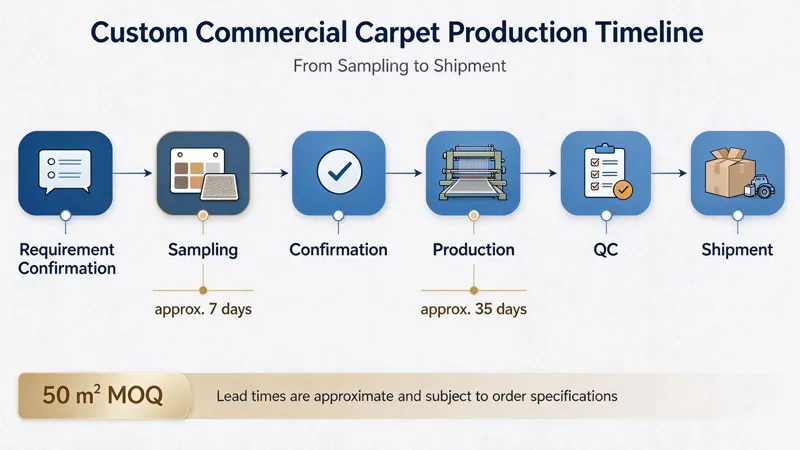
- MOQ: 50 m².
- Sampling: about 7 days. Samples are paid, and the fee is fully credited against your bulk order.
- Production: about 35 days after approval.
That is roughly six weeks from brief to ex-factory, before shipping to your port. Build that into your handover schedule, not around it.
Factory-Direct Pricing: Where the 20%–30% Goes
A trading company, an importer, and a regional distributor each add margin, storage, and handling. Buyers who source direct typically save 20%–30% of that intermediary premium, depending on specification, volume, and market. Fab Carpet ships direct from its Qinghai plant and supports OEM/ODM.
The price is only part of the gain. When one party makes the carpet, one party answers for the specification and the delay. That shortens dispute chains.
OEM/ODM custom carpet manufacturing service
What Gets Checked Before a Roll Ships
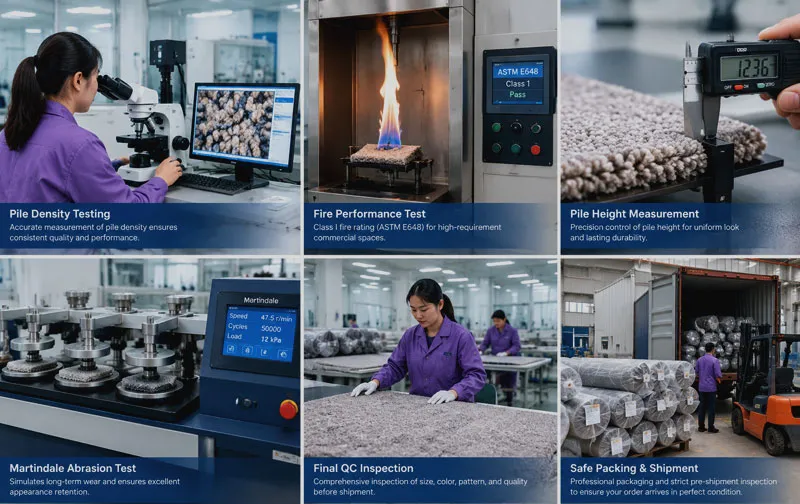
Our quality control follows four stages:
- Incoming raw material inspection.
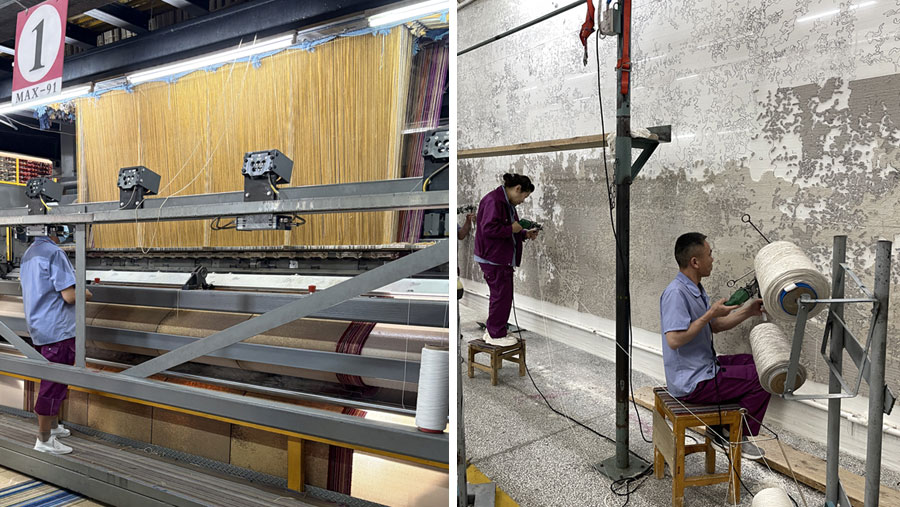
- In-process checks on pile height, weight, and density.
- Finished goods inspection against the approved sample.
- Pre-shipment verification of labeling, packing, and documents.
Maintenance and Total Cost of Ownership
Odor prevention continues after handover. A basic schedule for hotels and commercial venues:
- Daily: vacuum entrances and corridors, spot-treat spills at once.
- Weekly: full HEPA vacuum of high-traffic zones.
- Quarterly: check humidity and inspect edges and thresholds.
- Annually: professional hot-water extraction following IICRC S100 practice.
Compare life-cycle cost, not unit price. A cheaper carpet that needs early replacement, extra extraction, or closed rooms costs more. Cleaning products outside the manufacturer’s guidance can also void coverage.
FAQ: Commercial Carpet Smell and Sourcing
What is the MOQ for custom OEM/ODM commercial carpet?
Fab Carpet’s MOQ is 50 m² per design. That covers Axminster, hand tufted, hand knotted, and machine and hand-made combinations. For pilot rooms or show suites, tell us the area and we will confirm what is feasible.
How long does sampling take, and how is it charged?
Sampling takes about 7 days. Samples are paid up front. The full sample fee is credited against your bulk order once you confirm. Courier transit to your address is additional, so add it to your approval timeline.
How long does bulk carpet production take?
Production takes about 35 days after sample approval. Ocean freight and port clearance come on top. Work backward from your handover date and keep a shipping buffer.
Can you provide fire rating test reports for hotel carpet?
Yes. Our products carry a Class I rating (ASTM E648 / Bfl-s1). Request the report that matches your exact construction, pile, and backing, then check it against your local code before ordering.
How to get smell out of carpet in a hotel or commercial building?
Find the source first. Fix any leak, extract standing water, and dry the carpet within 24-48 hours. HEPA vacuum, then match the treatment to the odor: enzyme cleaner for organic residue, hot-water extraction for smoke and soil. If the smell returns, lift a corner and inspect the backing and underlay.
How to get musty smell out of carpet after water damage or high humidity?
Dry first, clean second. Run fans and a dehumidifier, and keep indoor humidity below 60%. Check moisture with a meter, not by touch. Musty odor that survives cleaning usually means a wet underlay or a damp subfloor, so replace the contaminated section rather than treating the surface again.
How to get smell out of wool carpet without damaging the fibers?
Use wool-approved products only. Wool is sensitive to alkaline cleaners and bleach-type agents, so avoid heavy baking soda layers. Extract with controlled water and dry fully. Premium New Zealand wool recovers well when it is cleaned and dried correctly. Fab Carpet ships care guidance with every wool order.
How to get new carpet smell out of a commercial space?
New-carpet smell comes from VOCs in adhesives and backings. Ventilate the space and let the area air out before occupancy. To avoid the problem at source, specify carpet certified under CRI Green Label Plus. Fab Carpet holds GLP9123 and GLP5308. Check each certificate’s product scope in the CRI directory.
Request Samples, an RFQ, or Technical Data
Ready to specify odor-resistant carpet with documentation behind it?
- Request free sample swatches to check pile, color, and hand feel.
- Submit an RFQ with your area, market, and timeline.