Call us now:

Knowing how to buy commercial carpet decides whether your project lands on budget or bleeds money. A missed fire certificate blocks customs. A shade mismatch between sample and bulk forces a re-run. A late container triggers contract penalties. This guide walks through nine steps, from specification to delivery. It draws on Fab Carpet’s factory test data and hotel project deliveries across Asia, the Middle East, Oceania and the United States. Every number below comes from our Axminster and hand-tufted spec sheets, not from a brochure.
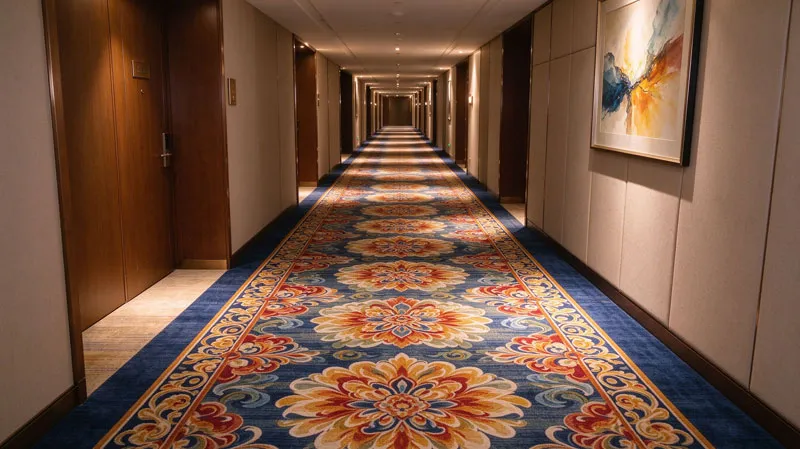
What Counts as Commercial Carpet in a Specification?
Commercial carpet is carpet sold against test data. A product page that says “heavy-duty” tells you nothing. A spec sheet with abrasion cycles, load recovery and fire results tells you everything.
Commercial vs. Residential: Measure Performance, Not Softness
Residential carpet is judged by feel. Commercial carpet is judged by how it looks after years of luggage carts, housekeeping trolleys and daily vacuuming. Compare thickness loss, recovery and abrasion values. Ignore adjectives.
Who Specifies and Who Buys
Architects and designers set the performance and pattern brief. Procurement teams compare price, lead time and compliance paperwork. Both need the same document: a full spec sheet with test references. Ask for it before you ask for a quote.
Step 1: How Do You Define the Application Before Choosing a Product?
Start with a zone-by-zone brief. One carpet rarely suits every area of a building.
- Guest corridors: continuous traffic, rolling loads, pattern must hide soiling.
- Guest rooms: lower traffic, comfort and acoustics matter more.
- Lobbies and gyms: higher wear, frequent cleaning.
- High-traffic commercial spaces and Entertainment Venues: long corridors, heavy cart use, strict fire requirements.
- Cruise cabins: marine certification and moth control.
Rolling Loads and Acoustics
Wheeled loads crush pile faster than footsteps. Pile weight and underlay also drive acoustic performance. Request impact and airborne noise data (NRC, STC) for the full build-up, not only the face yarn. Define these needs in the brief, then let the specification follow.
Step 2: Which Construction Fits Your Project?
Construction sets durability, design freedom and capacity. Match it to the zone and the volume.
| Construction | Best fit | Design freedom | Volume suitability |
|---|---|---|---|
| Axminster (woven) | Corridors, guest rooms, large hotels | High, multi-colour patterns | Very high |
| Hand-tufted | Lobbies, suites, feature areas | Very high, sculpted textures | Limited |
| Hand-knotted | Statement pieces, ultra-premium | Highest | Low |
| Machine & hand-made | Mixed-detail areas, custom logos | High | High |
Capacity Decides Phasing
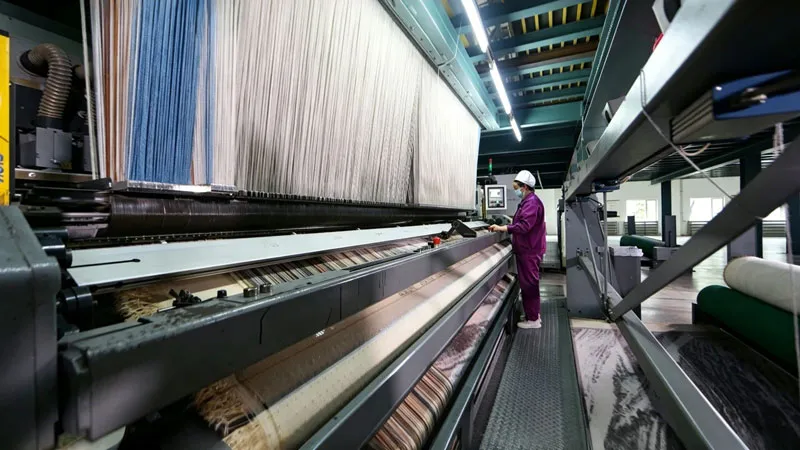
Capacity matters when you buy 20,000 sqm or more. Fab Carpet runs Axminster at 1,800,000 sqm per year, machine & hand-made at 100,000 sqm per year, and hand-tufted at 36,000 sqm per year. That means a large hotel order can often be scheduled in one run instead of split across batches. Split batches raise shade-variation risk.
Step 3: What Fiber Blend Performs in High-Traffic Commercial Spaces?
The hospitality benchmark is 80% wool and 20% nylon 6.6. Wool brings resilience, soil-hiding and natural flame resistance. Nylon adds abrasion resistance and recovery.
| Fiber | Strength | Limit | Typical zone |
|---|---|---|---|
| 80/20 wool-nylon | Balanced wear, appearance retention, fire behavior | Higher cost tier | Hotel corridors, guest rooms |
| 100% wool | Premium hand, strong resilience | Lower abrasion margin in heavy use | Suites, lobbies |
| Nylon 6.6 | High abrasion resistance | Less natural hand | Heavy-traffic areas |
| Polypropylene / PET | Lower cost | Weaker recovery, stain behavior varies | Budget or low-traffic zones |
Yarn, Dye and Moth Control
Fab Carpet Axminster uses 660/2 tex yarn (2/47s Dewsbury). Hand-tufted uses 1/80s Dewsbury wool, with optional bamboo silk. Both are skein-dyed with Huntsman dyestuff. Light fastness reaches Class 5 (ISO 105-B02). Dry rubbing fastness is a minimum Class 4 (ISO 105-X12). Mystox CMP moth-proofing protects wool through ocean freight and humid storage. Ask any supplier which dye and moth treatment they use, and for the test result.
Step 4: How Do You Read Pile Weight, Density and Backing?
Most price gaps hide in these numbers. Two quotes with the same pattern can differ by 30% in yarn content.
Pile Height, Weight and Density
Our Axminster range runs 7.0–12.0 mm effective pile height (±0.5 mm). Pile weight is 36.1–72.6 oz/sq.yd (1,225–2,493 g/sq.m, ±10%). Pile density is 4,344–6,263, with pitch 7 and 9–12 rows. Hand-tufted runs 8–13.5 mm pile height, with 21–23 stitches and 20–22 rows per dm.
Compare quotes on the same unit. Convert everything to g/sq.m. Check whether “weight” means pile weight or total weight. Total Axminster weight is 61.0–96.4 oz/sq.yd.
Backing Decides Stability
Backing holds the tufts and controls dimensional stability. Our Axminster uses a polypropylene weft, cotton and polyester chain, and about 360 g/sq.m of BASF SBR fray-resistant latex. Hand-tufted uses a cotton-polyester basket-weave primary, a leno-weave secondary and Celanese VAE latex. A thin latex coat saves cost and costs you later in edge fray and seam failure.
Step 5: Which Test Data Should You Request Before Approving a Specification?
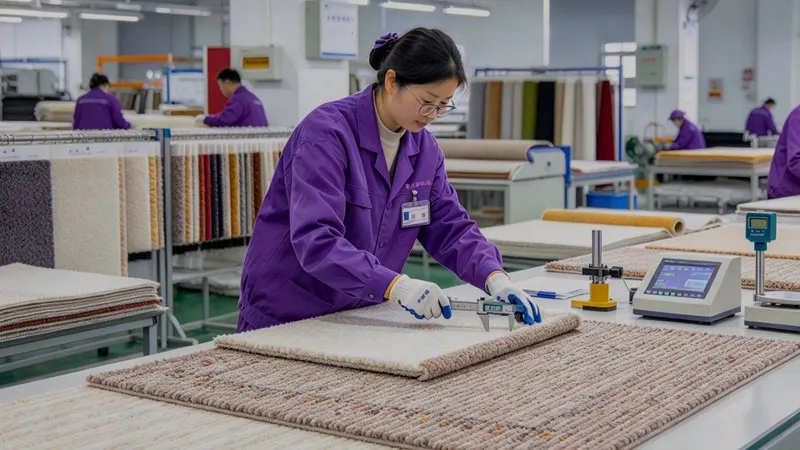
Ask for lab reports with test date, standard and sample ID. Our Axminster production-line standards include:
- WIRA abrasion: more than 12,000 rubs to end point.
- Hexapod: minimum Class 3 after 12,000 turns.
- Static loading: 85% recovery after 24 hours.
- Dynamic loading: under 15% thickness loss after 1,000 impacts.
- Tuft bind: above 10 Newton.
- Static resistance: below 3.5 kV.
- Durability and fiber integrity: average weight loss under 42.5 mg per 1,000 cycles.
These tests predict what happens at year three, not day one. A supplier who cannot produce them is guessing.
Step 6: Which Certifications and Fire Ratings Does Your Market Require?
Fire and indoor-air documents are the most common reason a shipment stalls. Request them at the quotation stage.
| Certificate | What it covers | Market |
|---|---|---|
| ASTM E648 Class I | Critical radiant flux, flooring fire behavior | North America |
| EN 13501-1 Bfl-s1 | Reaction-to-fire classification | Europe |
| EN 14041 (CE) | Essential characteristics of resilient, textile and laminate floor coverings | EU |
| UKCA / UKMCA | UK conformity marking | United Kingdom |
| CRI Green Label Plus (GLP9123, GLP5308) | Low VOC emissions, indoor air quality | North America, global specs |
| MED Wheelmark (IMO marine standard) | Marine equipment compliance | Cruise and marine projects |
| ISO 9001 / 14001 / 45001 | Quality, environmental and safety management systems | All |
Product Test vs. Installed System
A product passing a fire test does not guarantee the installed floor passes. Check the test setup in the report: substrate, underlay and adhesive. Match it to your build-up.
Our Axminster also reports hot metal nut (BS 4790), methenamine tablet (BS 6307) and smoke density (DM under 327) results. Verify CRI certificates directly. CRI Green Label Plus certified products directory You should be able to trace each certificate number to the issuing body.
Step 7: Where Do Commercial Carpet Supply Chains Break?
Problems appear between sample approval and installation. Four failure points repeat across projects.
Sample-to-Bulk Mismatch
Colour, pattern repeat and pile weight (±10% tolerance) can all drift. Lock tolerances in the PO. Use a three-stage check: lab dip, sealed sample, bulk inspection. Fab Carpet runs design, R&D, production and testing in-house, so the sample and the bulk come from the same line and the same team.
Dye Lot Control
Multi-phase projects need one dye plan. Order attic stock with the main run. Reordering later risks a visible shade break.
Lead Time and Freight
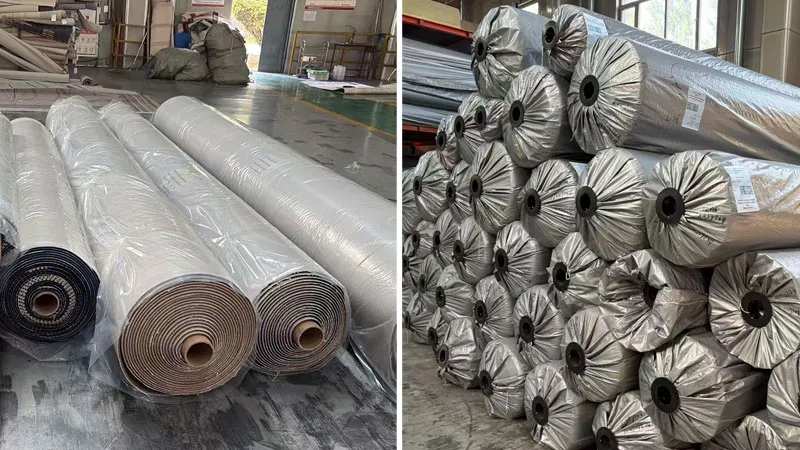
Typical production is 35–60 days, depending on schedule. Book the slot before the design freeze. Add buffer for sea freight and customs. Roll packing with moisture-proof wrapping and a container loading plan prevents damp and crushed pile in transit.
Traders vs. Direct Factory
Each middle layer adds margin and delay. It also filters information: your CAD changes, test requests and tolerance notes pass through people who do not run the loom. Direct factory supply removes those hand-offs. You deal with the people who set the machine.
Axminster carpet manufacturer for hotels
Step 8: What Drives Commercial Carpet Cost per Square Meter?
Six factors set the unit price: fiber blend, pile weight, construction, design complexity, backing and certification scope. Wool content and pile weight usually move price most.
MOQ and Tiered Pricing
Our MOQ starts at 50 sqm, adjusted by project. Volume breaks follow loom set-up efficiency. Larger runs spread set-up cost across more area. Quotes are issued per project, so use your drawings, not a price list.
Costs Beyond the Unit Price
Add these before you compare suppliers:
- Freight terms (FOB, CIF, DDP) and import duty
- Wastage allowance for pattern repeat and cuts
- Underlay and adhesive
- Installation labour and subfloor preparation
- Attic stock (typically a small percentage of total area)
Total Cost of Ownership
A cheaper carpet that is replaced early costs more than a heavier one that lasts. Estimate lifespan, cleaning cycle and replacement downtime in your hotel or venue before you decide.
Use the calculator to estimate area, wastage and ordering quantity: Carpet Calculator
Step 9: What Should Your Supplier Qualification Checklist Include?
Audit before you place the PO. Check these items:
- Factory capability: loom type, annual capacity, in-house R&D and QC.
- Document package: test reports, certificates, material declarations.
- Comparable projects: similar scale, region and application.
- Sample policy: about 7 days, free of charge, client pays freight, cost deducted from the first order.
- Third-party inspection: SGS or BV, agreed scope and timing.
- Warranty: 5 years, with covered and excluded items stated on the warranty card.
- Red flags: no test reports, vague specs, unclear production ownership, refusal of factory audit.
What Does the Direct-Factory Procurement Workflow Look Like?
- Brief and drawings: share zones, CAD files and target certifications.
- Design and sampling: colour matching and pattern development, with samples in about 7 days.
- Approval and production: sealed sample sign-off, then 35–60 days of production with in-line QC.
- Pre-shipment inspection: in-house test plus optional third-party check.
- Packing and shipping: moisture-protected rolls, loaded to plan.
- Installation support: subfloor flatness and moisture check, layout and seam planning, attic stock.
Where Do These Specifications Perform? Project References
Fab Carpet has delivered 80% wool, 20% nylon Axminster to five-star hotels in Japan, the United States, Singapore, New Zealand, Macao, Bahrain, the UAE and Korea. Three examples:
- Five-star hotel, Houston, USA (2,100 sqm): hallways, guest rooms and gym. Axminster, 80/20 wool-nylon.
- Five-star hotel, Singapore (12,600 sqm): guest rooms. Axminster with over-tufted detail.
- Entertainment Venues, Macao (24,600 sqm): corridors. Axminster, 80/20 wool-nylon, chosen for traffic and fire performance.
Hospitality carpet project case studies
FAQ
What is the minimum order quantity for custom commercial carpet?
Our MOQ starts at 50 sqm. The final minimum depends on construction, colour count and project scope. Send your drawings and we confirm the exact figure in the quotation.
How long does a custom commercial carpet order take from sample to delivery?
Samples take about 7 days. Bulk production takes 35–60 days, depending on schedule and volume. Sea freight is additional. Book capacity early for large hotel programs.
What fire rating and certifications should a hotel carpet supplier provide?
For North America, ask for ASTM E648 Class I. For Europe, ask for Bfl-s1 under EN 13501-1 and CE under EN 14041. UK projects need UKCA/UKMCA. Marine projects need MED Wheelmark. We also hold CRI Green Label Plus (GLP9123, GLP5308) and ISO 9001/14001/45001.
What specifications should I compare between commercial carpet quotes?
Compare pile content, yarn count, pile height, pile weight in g/sq.m, density, backing and latex weight, and test results. Our Axminster example: 80/20 wool-nylon, 660/2 tex, 7–12 mm pile, 12,000+ WIRA rubs.
Do you provide free samples and CAD-based customization?
Yes. Samples are free; you pay freight, and the cost is deducted from your first order. We work from your CAD files and support OEM/ODM, including custom colour, size and pattern.
What does the 5-year warranty cover?
The warranty card lists covered and excluded items. Coverage depends on correct installation and maintenance. Request the card with your quotation so legal and procurement can review it first.
Request Samples and a Project Quote
Send us your drawings, target zones and certification list. Our team will return a specification proposal, sample plan and lead-time schedule. Request Free Samples or use the Carpet Calculator to estimate quantity before you contact us. Download the procurement checklist above and bring it to your next supplier call.