Call us now:

Commercial carpet patterns decide more than the look of a hotel corridor. A wrong repeat inflates wastage, a missing fire certificate blocks entry at customs, and a late shipment can trigger opening-date penalties. This guide shows how to choose patterns by zone, match construction to traffic, verify ASTM E648 and Bfl-s1 documents, and estimate orders with a calculator. It draws on Fab Carpet’s factory production data and delivery experience. Written for architects, designers, developers and procurement teams buying for North America and Europe. Sections are short; skip to the one you need.
Why Commercial Carpet Patterns Are an Engineering Decision
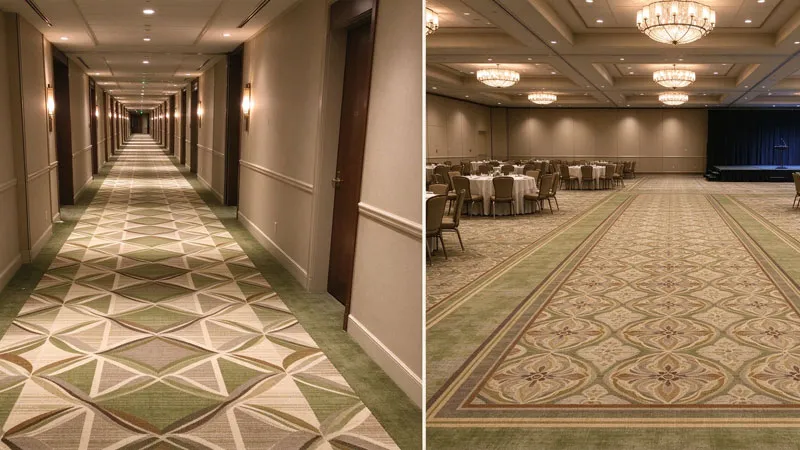
A pattern is a performance tool. It hides soil, marks zones and sets how much material you must order. Pick it on looks alone and you pay later in cleaning, replacement and wasted roll length.
Soil Concealment in High-traffic Commercial Spaces
Mid-tone, multi-color patterns hide dirt and vacuum marks better than plain solids. Dark solids show lint. Light solids show footprints. A busy pattern with 3–5 close tones forgives both.
Pattern works with construction, not against it. Cut-and-loop texture adds shadow variation. A flat, tightly packed surface keeps the motif sharp. Ask suppliers for appearance-retention test results on the exact construction you plan to buy, not on a similar one.
Zoning and Wayfinding
Patterns guide people without signage. A directional stripe pulls guests along a corridor. A bordered medallion marks a lobby center. A change in scale separates a lounge from a walkway, with no threshold strip required.
The Hidden Cost of a Wrong Pattern
A large repeat can add 10–15% to your order in matching waste on narrow rooms. A reorder after a color mismatch costs more than the original price difference. Both problems start at specification stage, so fix them there.
Which Commercial Carpet Patterns Work in Each Zone
Match pattern type to the traffic, light and function of each space.
| Zone | Recommended Pattern | Why It Works |
|---|---|---|
| Hotel corridor | Organic or tone-on-tone linear | Hides wear, stretches sightlines |
| Guest room | Small repeat, soft contrast | Keeps the room calm, cuts matching waste |
| Ballroom / meeting | Large geometric, 2–3 colors | Holds up under furniture and event traffic |
| Lobby | Medallion, border or custom motif | Sets brand tone, tolerates scale |
| Lounge / bar | Dark base, deep contrast | Masks spills and wear |
| Entertainment Venues and High-traffic Entertainment Areas | Dense multi-color pattern, high-density pile | Conceals soil under constant movement |
| Cruise and marine cabins | Small-scale pattern, certified construction | Meets IMO rules, limits waste |
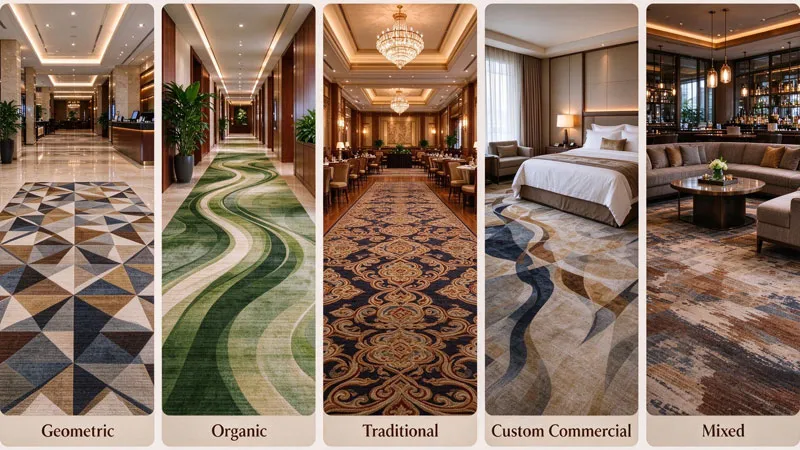
Five pattern families cover most briefs:
- Geometric. Grids, hexagons and tone-on-tone blocks. Strong in meeting spaces and modular layouts.
- Organic. Stone, wave and grain motifs. Best for corridors.
- Traditional. Florals, damask and medallions. A natural fit for heritage hotels and resorts.
- Biophilic and textural. Foliage, terrain and sculpted cut-and-loop surfaces.
- Custom and branded. Logos, monograms and project-specific artwork.
Keep logos restrained. A repeated crest across a lobby reads as signage, not design. Fab Carpet supports OEM and ODM development, so designers can send artwork, CAD files or physical color references, and the factory matches them against yarn dyeing records before any strike-off is approved.
Axminster, Hand Tufted, Hand Knotted or Machine & Hand-Made?
Construction sets how finely a pattern can be drawn, how many colors it can carry and how fast it ships. Choose it before you finalize artwork.
| Method | Pattern Detail | Best For | Fab Carpet Annual Capacity |
|---|---|---|---|
| Axminster | Crisp, multi-color, wide color capacity | Corridors, ballrooms, full-property programs | 1,800,000 sqm |
| Hand Tufted | High design freedom, sculpting | Suites, lobbies, mid-size custom runs | 36,000 sqm |
| Hand Knotted | Finest detail | Flagship spaces, feature pieces | Project-based |
| Machine & Hand-Made | Machine base with hand-finished detail | Cost-balanced custom designs | 100,000 sqm |
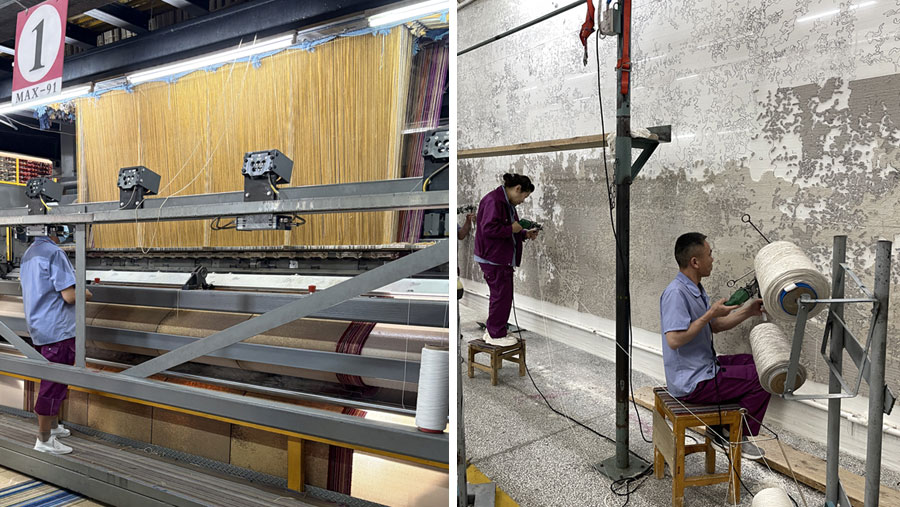
Axminster remains the volume standard for hotels. It weaves each tuft into the pattern, which keeps edges sharp and allows large color counts. Axminster hotel carpet manufacturer
Hand tufted suits shaped logos, sculpted relief and irregular layouts that a loom handles poorly. Output is smaller, so plan lead time with it in mind. custom hand tufted carpet for hospitality
Hand knotted costs the most and takes the longest. Reserve it for rooms guests photograph.
Machine & Hand-Made combines a machine-built field with hand-carved edges or motifs. It gives custom detail at a lower cost than full hand work.
A common split on large projects: Axminster for corridors and guest floors, hand tufted for the lobby and suites. Capacity at Fab Carpet allows both to run in parallel, so one project does not wait on another line.
Fiber, Pile Weight and Density: The Specs That Set Durability
Fiber Choice
Premium New Zealand Wool gives resilience, natural flame resistance and low smoke behavior. Nylon adds abrasion resistance and stain performance. An 80/20 wool-nylon blend is the hospitality benchmark because it balances both. Solution-dyed nylon suits areas that face frequent cleaning or strong light.
Use pure wool for luxury suites and lobbies. Use higher nylon content for corridors and Entertainment Venues where traffic is constant.
Key Terms
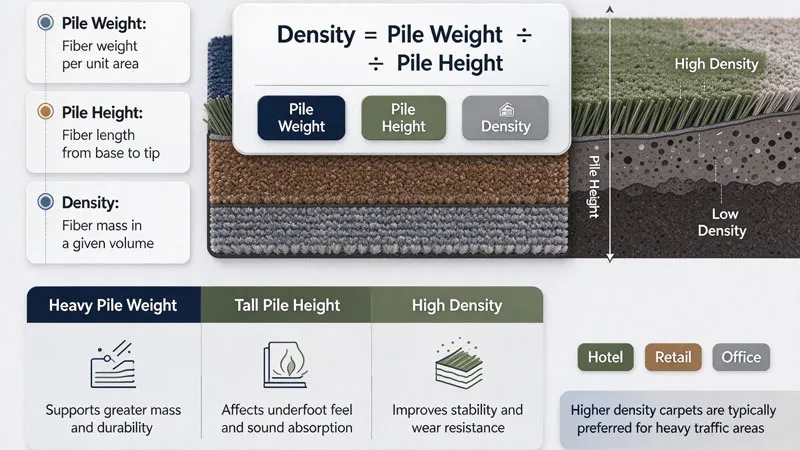
- Pile height: the length of the yarn above the backing.
- Pile weight: yarn mass per unit area, in oz/yd² or g/m².
- Density: how tightly the yarn is packed.
The Density Formula
Pile Density = (Pile Weight in oz/yd² × 36) ÷ Pile Height in inches
Worked example. A carpet has a 0.5 in pile height:
- At 40 oz/yd²: (40 × 36) ÷ 0.5 = 2,880
- At 50 oz/yd²: (50 × 36) ÷ 0.5 = 3,600
Same height, 25% more density. The denser version resists crushing and shows the pattern longer. Pile weight alone can mislead, since a tall, loose pile can weigh the same as a short, dense one. Ask for both numbers on every quote.
Tests to Request
Ask for appearance retention, tuft bind, colorfastness to light and rubbing, and dimensional stability. Write the required results into the purchase contract. Fab Carpet runs in-house checks on each production lot and keeps retained samples, so a later dispute can be compared against the original lot.
Fire, Emissions and Marine Certifications Buyers Should Verify
Certificates open or close markets. Check the scope, not just the logo.
| Requirement | Standard | Fab Carpet Status |
|---|---|---|
| US fire performance | ASTM E648 | Class I |
| European fire classification | EN 13501-1 | Bfl-s1 |
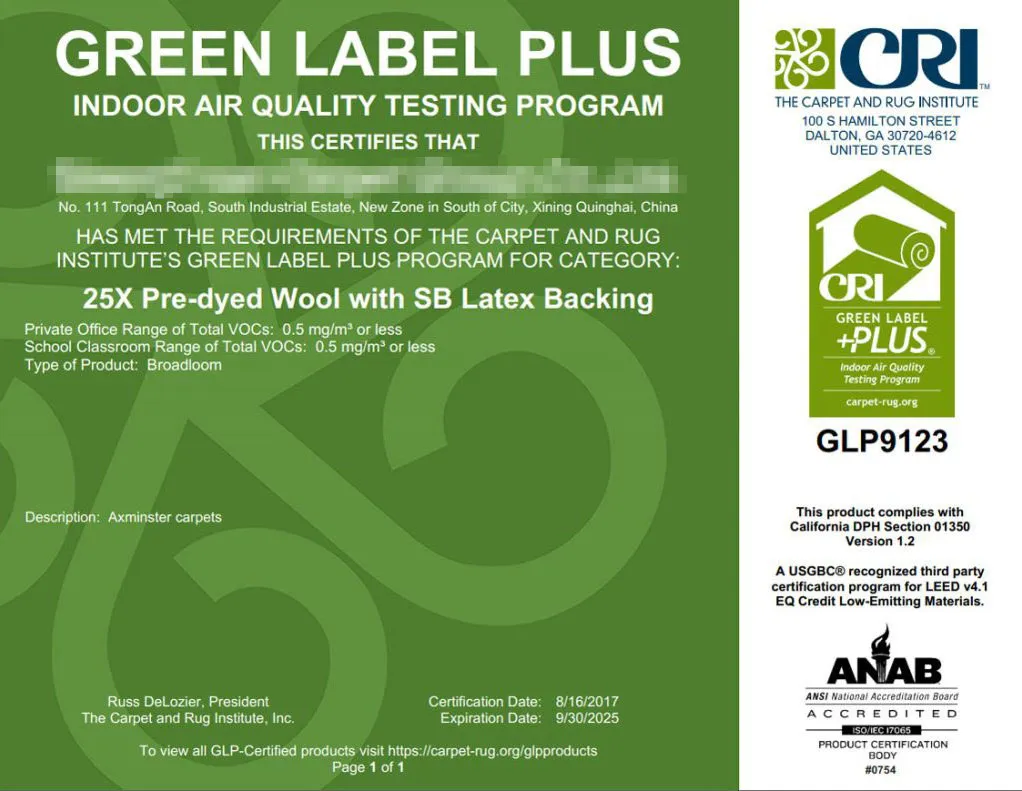
| Indoor air quality | CRI Green Label Plus | GLP9123 and GLP5308 |
| EU market access | EN 14041 (CE) | Held |
| UK market access | UKCA / UKMCA | Held |
| Marine | MED Wheelmark (IMO) | Held |
| Management systems | ISO 9001 / 14001 / 45001 | Held |
| Quality grading | AAAAA Quality Standard | Held |
CRI Green Label Plus product directory
Verification steps:
- Match the certificate holder to the supplier name.
- Confirm the certificate covers your construction and fiber.
- Check the validity dates.
- For CRI, look up the certificate number in the public directory.
- Request full test reports, not a summary page.
For cruise and yacht work, marine carpet with MED Wheelmark certification saves a late-stage requalification. Ask suppliers which exact products carry the Wheelmark, and get that in writing.
ASTM E648 radiant panel flooring test method
Acoustic Performance: What Carpet Actually Contributes
Specifiers often mix up acoustic metrics. Keep them apart:
- NRC measures sound absorption inside a room.
- IIC / ΔLw measure impact sound reduction through a floor.
- STC rates airborne sound through walls and floors as assemblies. Carpet alone does not carry an STC rating.
Heavier pile, higher density and a quality underlay all lower impact noise and room reverberation. Corridors and guest floors benefit most. For event spaces, ask the supplier for test data on the full carpet-and-underlay build. Fab Carpet can arrange project-specific testing when the acoustic target is part of the contract.
Pattern Repeat and Wastage: Order the Right Quantity
Every cut on a patterned roll must land on a repeat. The offcut is waste.
Worst-case example. A floor needs 12 drops from a 4 m wide roll. The pattern repeat is 0.69 m. Each drop can lose up to one repeat length:
12 × 0.69 m = 8.28 m of extra roll length, or about 33 sqm at 4 m width.
On a small project that is a real cost. Fixes:
- Choose a smaller repeat for narrow rooms.
- Use a half-drop repeat when layouts allow.
- Send the floor plan early so the factory can plan cuts and number rolls to match.
Use the calculator to add pattern-repeat allowance before you request a quote:
Net Carpet Area 0.00 sq.ft
Total Carpet Required (With Waste Factor) 0.00 sq.ft
Square Yardage Equivalent 0.00 sq.yd
Waste & Cutting Allowance
Estimates generated are approximate calculations for preliminary planning. Actual roll layouts and seam placements may vary. Professional measurement recommended before ordering.
Fab Carpet marks and numbers each roll against the installation plan. Rolls ship in moisture-protective wrapping, which limits damp damage in transit.
What Factory-Direct Sourcing Changes for Your Project
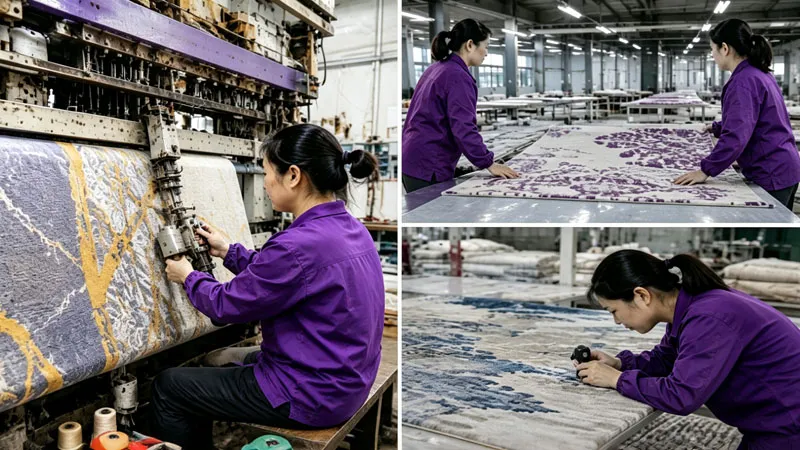
Each middle layer in a distributor chain adds margin, delay and one more handoff where specs get lost. Buying from the factory removes layers, not quality checks. Fab Carpet produces in Qinghai, China, and sells directly to project buyers.
MOQ and Costing
Minimum order is 50 sqm. That allows a pilot floor or a single suite before a full rollout. Price depends on fiber, construction, pile weight, design development and freight. Ask for a line-by-line breakdown. A supplier who cannot split the quote into these items is hiding something.
Sampling Process
Samples take about 7 days. Sampling is paid at the start, and the full fee is credited against your bulk order once you confirm it. That protects both sides from casual requests and keeps strike-offs serious.
Lead Time
Bulk production takes about 35 days after sample and artwork approval. Capacity sits behind that number: 1,800,000 sqm a year on Axminster lines means one large order does not push another into a queue.
Inspection
Third-party inspection by SGS or BV can be arranged before shipment. Agree on the inspection standard and sampling plan in the contract.
Warranty
Fab Carpet gives a 5-year warranty. Covered and excluded items are listed on the warranty card. Read it before you sign, and ask for it with the quote.
| Factor | Distributor Chain | Factory Direct |
|---|---|---|
| Price transparency | Layered margins | Line-item quote |
| Custom response | Relayed through agents | Direct to production team |
| Lead time control | Dependent on stock and agent | Set by the factory schedule |
| Traceability | Often lost | Lot records and retained samples |
| After-sales path | Multiple parties | Single contact |
Supplier Checklist: Ten Questions Before You Approve
- Are you the manufacturer or a trader?
- Do certificates cover my exact construction and fiber?
- What are the pile weight and height, stated separately?
- How are strike-offs approved, and what color tolerance applies?
- What is the MOQ, and how does price step down by volume?
- How long do samples and bulk production take?
- How are rolls packed and labeled?
- Is third-party inspection allowed?
- What does the warranty exclude?
- Who handles claims, and how fast?
Red flags: certificates without a number, a quote with one lump price, samples that look better than the stated spec, and refusal to name the production site.
FAQ
What is your MOQ, and which patterns and constructions are available?
The MOQ is 50 sqm. Axminster, hand tufted, hand knotted and machine-and-hand-made constructions are all available, with custom pattern, color and size development under OEM and ODM terms.
Which materials can I specify?
Premium New Zealand Wool, wool-nylon blends and nylon are standard for hospitality. Confirm fiber options for your construction at the quoting stage, since not every fiber suits every weave.
Which fire and environmental certifications apply?
Fab Carpet products are tested to Class I under ASTM E648 and Bfl-s1 under EN 13501-1. Certification also includes CRI Green Label Plus (GLP9123, GLP5308) and EN 14041 (CE). Request the certificate that matches your construction before you order.
How does sampling work, and what does it cost?
Samples are paid. The fee is credited in full against your bulk order after you confirm it.
How long do samples take to arrive?
Production takes about 7 days. Courier time depends on destination.
What is the lead time for bulk orders?
About 35 days after sample and artwork approval. Complex custom designs may need extra time at the design stage.
Which trade terms do you offer, and how is the carpet protected in transit?
FOB and CIF are standard; DDP can be quoted for selected destinations by project. Rolls are wrapped against moisture and impact, then labeled by installation zone.
What are the payment terms?
50% deposit, 50% balance. Confirm the balance trigger (before shipment or against shipping documents) in the contract.
Can we use SGS or BV inspection?
Yes. Third-party inspection can be arranged before shipment.
What happens if there is a quality problem?
Report it with photos, lot numbers and installation details. Claims are reviewed against the 5-year warranty card, which defines covered and excluded items.
Request Samples and a Project Quote
Pattern selection, construction, certification and ordering quantity are one decision, not four. Get them aligned before you place an order.
- Request free sample swatches of Axminster, hand tufted and wool-blend options.
- Submit an RFQ with your floor plan, pile spec and target market.
Contact Fab Carpet’s engineering team with your drawings. We reply with a line-item quote, a sampling plan and a production schedule.