Call us now:

Getting the carpet or paint first decision wrong on a hotel renovation costs more than touch-up paint. It costs room nights, missed inspection windows, and rework budget nobody planned for. This guide breaks the sequencing question down the way a project engineer would — with compliance deadlines, acoustic ratings, and supply chain math included.
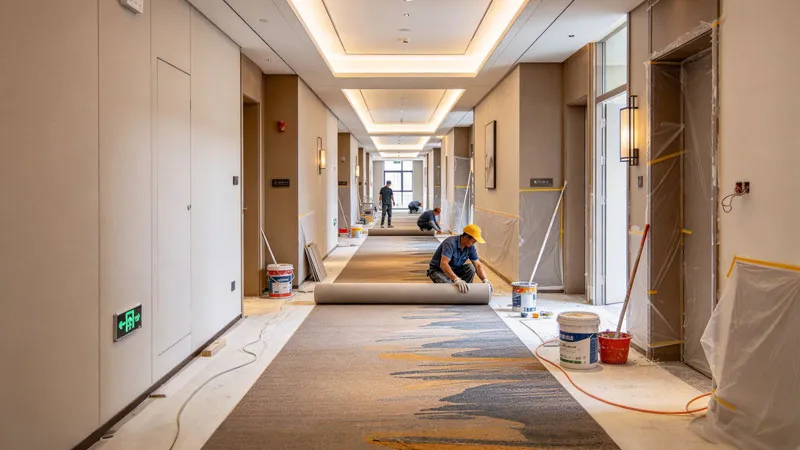
Why Sequencing Is Different at Commercial Scale
A homeowner picking paint and carpet colors has weeks to decide. A hotel developer coordinating three trades across 200 rooms has days, and every day of delay carries a dollar figure attached to it.
At residential scale, the worst outcome of getting the order wrong is a scuffed baseboard. At commercial scale, the worst outcome is a failed fire inspection because carpet certification documents arrived after the paint crew already left the building. The stakes shift from cosmetic to contractual.
| Factor | Residential Decision | Commercial/Hospitality Decision |
|---|---|---|
| Timeline pressure | Flexible, weeks | Fixed opening date, penalty clauses |
| Compliance requirement | None | Fire rating, EN/CE, IMO documentation |
| Crew coordination | Single trade at a time | Multiple trades on tight overlap |
| Cost of rework | Hundreds of dollars | Thousands per room, per day |
Fab Carpet’s project team has coordinated installation sequencing across more than 200 hotel and commercial fit-outs. The pattern repeats: projects that plan sequencing around compliance sign-off, not around trade convenience, finish on schedule.
Paint Before Carpet: The Commercial Case
Painting first gives crews open access to a bare subfloor. No taping edges around carpet, no risk of paint bleeding into pile fiber, no protective sheeting across thousands of square feet.
The upside:
- Faster wall finish with no floor protection cost
- VOC off-gassing happens before flooring traps odor against the subfloor
- Cleaner baseboard lines, especially useful for LEED or WELL Building air-quality documentation
The risk:
Carpet installation involves knee kickers, power stretchers, and heavy rolls moving through corridors. Fresh paint on baseboards and lower walls takes scuff damage from this equipment. Budget touch-up time into the schedule, not as an afterthought.
VOC curing windows matter more here than most procurement checklists mention. Paint needs 24-48 hours minimum before flooring crews move in. On a compressed opening timeline, that curing window becomes a scheduling constraint, not a suggestion.
Carpet Before Paint: When It Makes Sense
Installing carpet first solves a different problem: color certainty. Painters can hold swatches directly against the finished floor and confirm the palette before a single wall gets rolled.
The upside:
- Paint color matched against actual flooring, not a sample chip under showroom lighting
- No carpet protection cost across large floor areas
- Baseboard height gaps get caught and corrected during painting, not after
The risk:
Protecting finished carpet from paint drips across a full hotel floor is expensive and rarely airtight. Plastic sheeting shifts. Canvas drop cloths get expensive at scale. One knocked-over paint can on wool pile is a full section replacement, not a spot clean.
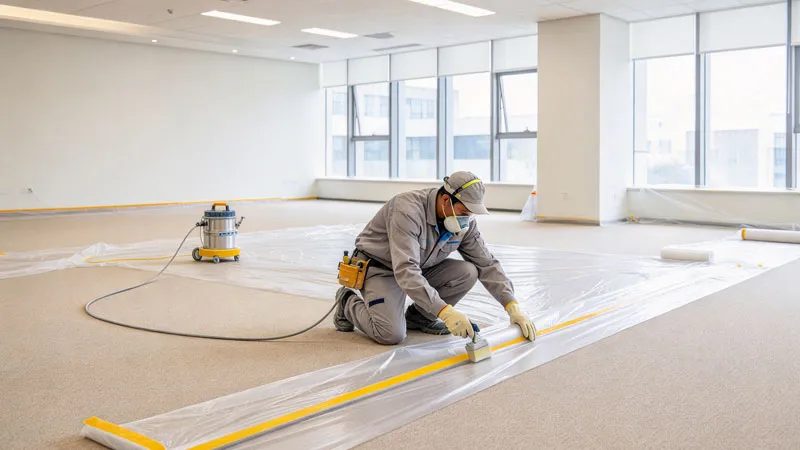
The Hybrid Protocol We Recommend
Most experienced general contractors don’t pick one order. They split the paint job into two passes: base coat before flooring, final coat and touch-up after.
This protects walls from installation equipment while still letting the crew finish with fresh, undamaged paint as the last visible step before handover.
| Project Type | Recommended Sequence | Buffer to Add |
|---|---|---|
| New-build hotel | Base coat → Carpet install → Final coat | 3-5 days |
| Renovation while occupied | Carpet install → Base coat → Final coat (phased by floor) | 5-7 days |
| Retrofit / rebrand | Base coat → Carpet install → Touch-up | 2-4 days |
Estimate your project’s material needs and timeline buffer with the Carpet Calculator
Fire Rating and Compliance: The Step Nobody Sequences For
Paint schedules get built around drying time. Carpet schedules should get built around certification sign-off, and few procurement guides mention this at all.
Fire marshals require documented fire rating compliance before final occupancy inspection, independent of whether painting is finished. If your carpet supplier can’t produce a Class I Fire Rating certificate (ASTM E648 / Bfl-s1) on request, your opening date is at risk regardless of paint sequencing.
Certifications to verify from any supplier, before you sign a purchase order:
- CRI Green Label Plus (GLP9123 / GLP5308) — indoor air quality
- EN 14041 (CE marking) — required for European commercial projects
- MED Wheelmark — IMO marine standard for cruise and marine hospitality
- UKCA / UKMCA — post-Brexit UK compliance
- ISO 9001 / 14001 / 45001 — manufacturing quality and environmental management
Fab Carpet ships every commercial order with this full certification set as standard documentation, not as a paid add-on. Ask any supplier for the certificate numbers directly and check them against the issuing body’s public directory before accepting the paperwork at face value.
Verify CRI Green Label Plus certification
Acoustic Performance and Wear Rating: What Sequencing Won’t Fix
Getting the paint order right doesn’t matter if the carpet itself fails an acoustic or durability spec six months into operation. Corridor noise complaints and worn pile in high-traffic entertainment areas trace back to fiber choice, not installation order.
| Construction Type | Density | Abrasion Resistance | Acoustic NRC | Best Fit |
|---|---|---|---|---|
| Wool Axminster | High | Excellent | 0.30-0.40 | Guest corridors, lobbies |
| Hand-Tufted | Medium-High | Good | 0.25-0.35 | Guest rooms, function rooms |
| Hand-Knotted | Very High | Excellent | 0.30-0.35 | Executive suites, statement areas |
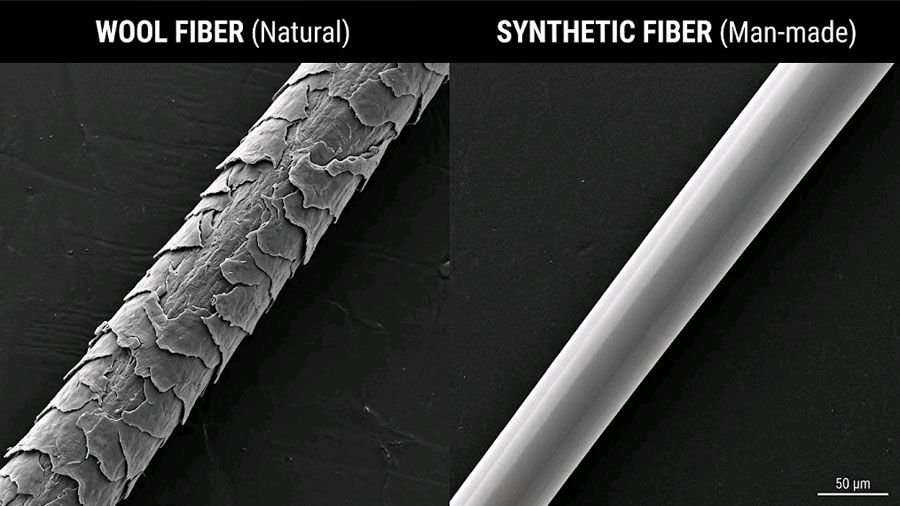
Premium New Zealand Wool holds a natural resilience recovery rate that synthetic fiber struggles to match after repeated foot traffic in corridors and high-traffic entertainment areas. That recovery rate is why wool stays the default fiber spec for four- and five-star hospitality projects.
Supply Chain: Where Procurement Teams Actually Lose Money
Sequencing gets attention because it’s visible on the job site. Supply chain risk gets less attention because it happens before the crew ever shows up, and it costs more.
Vendor vetting checklist:
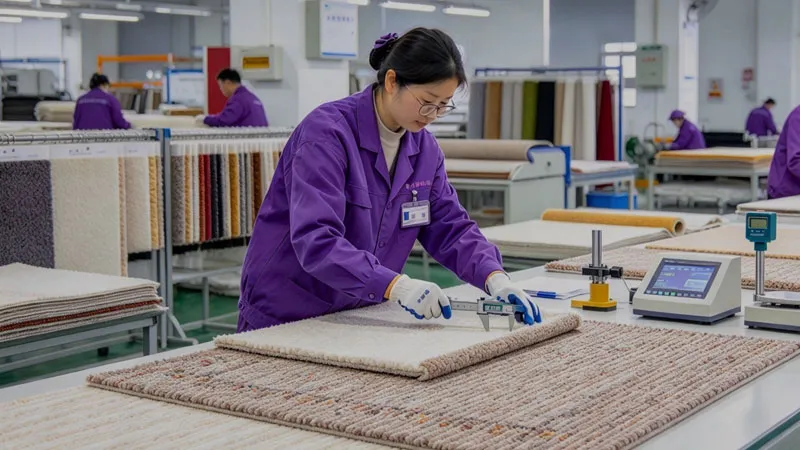
- Request factory audit access or third-party audit reports
- Confirm sample lead time in writing (not verbally)
- Ask who performs on-site QC before shipment, and request inspection photos
- Confirm dye-lot matching process for multi-phase orders
MOQ and pricing:
Trading companies add a layer between the mill and your project. That layer typically adds 20-30% to unit cost, and it adds a communication delay when specs change mid-project. Sourcing directly from a manufacturing source — Fab Carpet’s Qinghai facility, for example — removes that layer. OEM/ODM capability means custom pile height, colorway, and border matching happen against your architectural drawings directly, without a redesign cycle through a middleman.
Shipping and lead time should sync with your paint schedule, not fight it. Confirm production lead time, ocean freight transit, and customs clearance windows before locking your paint contractor’s start date.
7-Point Decision Checklist
- Confirm your fire inspection deadline before setting any paint schedule
- Get carpet fire rating and CE/IMO documentation in writing before ordering
- Confirm sample and production lead time against your opening date
- Decide sequence by project type: new-build, occupied renovation, or retrofit
- Budget touch-up paint time regardless of which trade goes first
- Verify acoustic and abrasion ratings match the space’s actual traffic level
- Source samples directly from the mill to confirm dye lot before full order
FAQ: Common Procurement Questions
Should carpet be installed before or after painting in a hotel renovation?
Use a hybrid approach: base coat before carpet installation, final coat and touch-up after. This protects walls from installation equipment while keeping the final paint finish undamaged.
What fire rating is required for commercial carpet in the US versus the EU?
US projects typically require Class I per ASTM E648. EU projects require Bfl-s1 classification under EN 14041 with CE marking.
How much lead time should I budget for custom Axminster or hand-tufted carpet?
Custom production typically runs 6-10 weeks depending on order volume and design complexity, plus ocean freight transit time. Confirm this in writing before setting your opening date.
What’s the difference between CRI Green Label Plus and EN 14041 certification?
CRI Green Label Plus certifies indoor air quality and VOC emissions, primarily referenced in North America. EN 14041 is the CE marking standard covering fire, slip resistance, and performance requirements for European commercial flooring.
Does factory-direct sourcing actually reduce MOQ requirements?
Yes, in most cases. Trading companies often impose higher MOQs to cover their own margin requirements. Direct mill sourcing typically offers more flexible order volumes for hospitality-scale projects.
How long does sample dispatch take from a source-factory supplier?
Standard swatch samples typically ship within 3-5 business days. Custom colorway samples take longer and should be confirmed against your project timeline before requesting them.