Call us now:

Ask ten property managers how often to replace carpet and you’ll get ten different answers — most of them guesswork. For architects and hotel developers, guesswork means blown budgets, failed fire inspections, or a lobby that looks dated two years after opening. This guide replaces guesswork with engineering data: wear ratings, compliance benchmarks, and real lifecycle cost math.
Why Residential Replacement Timelines Don’t Apply to Your Project
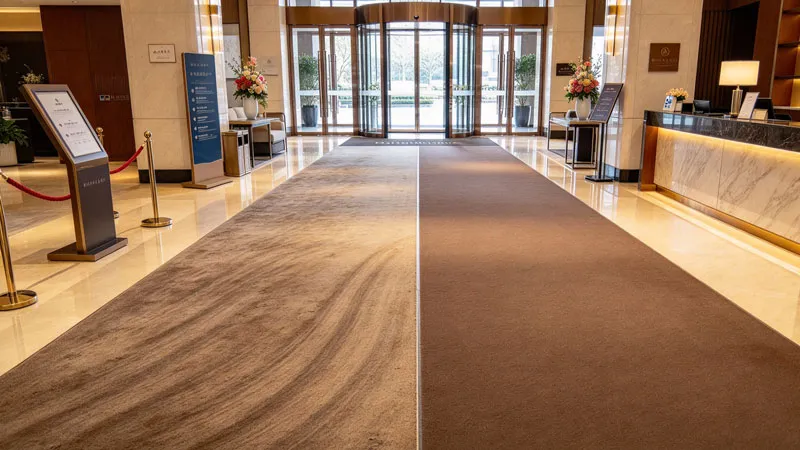
Most articles ranking for “how often to replace carpet” quote a 5-to-15-year window. That number comes from single-family homes with a handful of daily footsteps. A hotel corridor sees thousands. A conference center floor sees tens of thousands during peak season.
Traffic volume, not age, drives commercial carpet failure. A carpet in a guest room might hold up for eight years. The same product in a ballroom entrance can fail in eighteen months if it’s the wrong construction or fiber for that load. That’s why B2B buyers need a different unit of measurement than “years” — they need traffic cycles per fiber type, backing system, and pile density.
This distinction matters even more in high-traffic commercial spaces such as convention centers, airport lounges, and entertainment venues, where flooring failure isn’t cosmetic — it’s a liability and a guest-experience problem.
Carpet Lifespan by the Numbers: Pile Weight, Density, and Fiber Type
Two carpets can look identical on a sample board and perform completely differently on-site. The difference sits in three specs procurement teams should request before signing anything: pile weight (oz/yd² or g/m²), pile density, and fiber composition.
Higher density resists crushing. Higher pile weight resists matting. Fiber type determines how the carpet recovers after repeated compression — this is where Premium New Zealand Wool consistently outperforms synthetic fibers, because wool fiber has natural crimp memory that lets it spring back after heavy foot traffic, cycle after cycle.
| Fiber Type | Abrasion Resistance | Resilience (Recovery) | Typical Use Case |
|---|---|---|---|
| New Zealand Wool | High | Excellent | Hotel lobbies, corridors, boardrooms |
| Solution-Dyed Nylon | High | Good | High-traffic corridors, transit hubs |
| Standard Nylon | Medium-High | Moderate | Guest rooms, offices |
| Polypropylene | Medium | Lower | Budget-tier, low-traffic zones |
Construction method adds another layer. Axminster weaving handles complex, multi-color patterns without pattern distortion — the standard for branded hotel corridors. Hand-tufted production offers faster turnaround for custom logo carpets. Hand-knotted construction is reserved for luxury suites and heritage properties where longevity and craftsmanship matter more than lead time. On a Fab Carpet production line, the construction method is selected based on the traffic zone the client specifies — not the other way around.
Explore Axminster vs hand-tufted construction options
Testing Standards Every Buyer Should Ask For
Specifications on paper mean nothing without third-party test data behind them. Two tests matter most for commercial procurement:
Martindale and Wyzenbeek abrasion testing measures how many rub cycles a carpet withstands before visible wear. Ask your supplier for the actual test report, not a marketing claim.
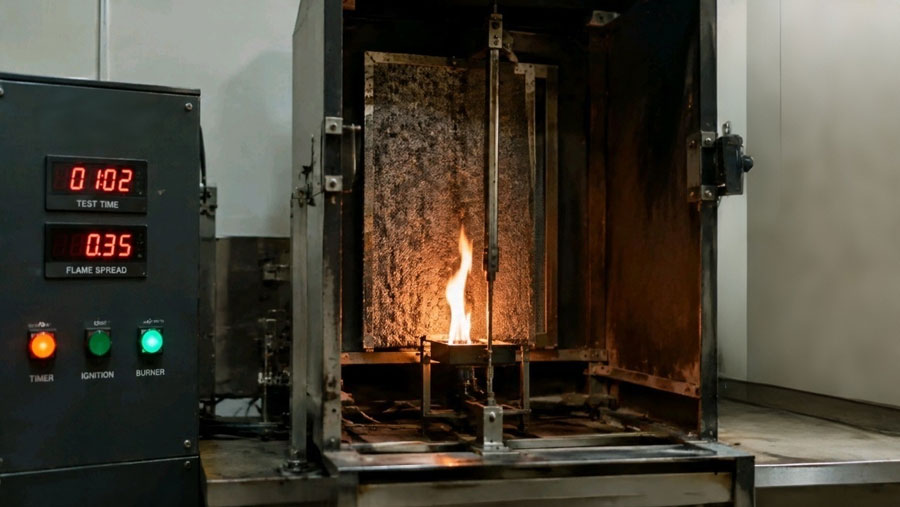
Fire rating certification determines whether your carpet can legally be installed in a commercial building at all. In the US, that’s ASTM E648. In the EU and UK, the equivalent is Bfl-s1. Fab Carpet’s full commercial range is manufactured to meet Class I Fire Rating under ASTM E648 / Bfl-s1, with test documentation available before shipment — not after a fire marshal asks for it during final inspection.
Review official fire safety classification criteria
The Compliance Checklist That Prevents Rejected Shipments
Compliance failures are the single most preventable cause of project delays. A container held at customs because certification paperwork doesn’t match the destination market’s requirements can push a project back by months.
Here’s what to verify before you place a deposit:
- North America: CRI Green Label Plus certification (indoor air quality) — Fab Carpet products carry GLP9123 and GLP5308 registration numbers
- Europe / UK: EN 14041 (CE marking), plus UKCA and UKMCA for post-Brexit UK imports
- Marine and cruise projects: IMO MED Wheelmark — frequently overlooked until the shipyard rejects the order
- Factory quality system: ISO 9001 (quality management), ISO 14001 (environmental), ISO 45001 (occupational safety)
Marine projects catch the most buyers off guard. A carpet fully compliant for a hotel installation will not automatically clear IMO requirements for a vessel. Confirm this before, not after, production starts.
Signs Your Commercial Carpet Needs Replacing — Beyond the Obvious
Visible fraying and flat pile are the last-stage warning signs, not the first. Three earlier indicators get missed:
Acoustic performance drop. Carpet contributes to a room’s Noise Reduction Coefficient (NRC) and impact sound rating (STC/IIC). As fiber crushes and backing compresses, that sound-dampening effect degrades — noticeable in open-plan lobbies and conference floors well before the carpet looks worn.
Seam and backing delamination. In high-moisture zones — spa areas, poolside corridors, coastal properties — backing can separate from the face fiber long before surface wear is visible. This is a safety issue as much as an aesthetic one.
VOC off-gassing in aging carpet. Older adhesives and backings can release compounds that affect indoor air quality, particularly in enclosed HVAC systems common in hotel corridors.
For hospitality operators, there’s a fourth factor that isn’t physical at all: guest perception. Carpet condition shows up in online reviews before maintenance logs ever flag it.
Total Lifecycle Cost: Why the Cheapest Bid Rarely Wins
The purchase price on a quote is the least useful number for comparing two carpet options. What matters is Total Lifecycle Cost (LCC):
LCC = Purchase Price + Installation + Maintenance Costs − Extended Lifespan Value, divided by expected traffic cycles.
Run that formula across a 10-year hotel renovation cycle and the math flips. A budget synthetic carpet at a lower unit price often requires two full replacements plus more frequent deep cleaning. Premium New Zealand Wool, despite a higher entry cost, typically needs one replacement cycle over the same period, with lower cleaning frequency due to wool’s natural soil resistance.
| Cost Factor | Budget Synthetic | Premium Wool (Fab Carpet spec) |
|---|---|---|
| Replacements over 10 years | 2 | 1 |
| Deep cleaning frequency | Every 6–8 months | Every 12–14 months |
| Estimated 10-year total cost | Higher | Lower |
Run your own numbers before deciding on paper specs alone.
Estimate your project’s replacement cycle and 10-year cost
Procurement Pitfalls: Sourcing Carpet Without the Middleman Markup
Most commercial carpet buyers never speak directly with the factory producing their order. That gap is where cost, quality control, and lead-time risk all pile up.
Vet suppliers with direct questions. Can they provide third-party test reports on request? Will they allow a factory audit or video walkthrough? What’s the penalty clause for missed delivery dates? A supplier who hesitates on any of these is a red flag.
Understand MOQ and tiered pricing. Custom carpet manufacturing — especially patterned Axminster or logo carpets — runs on tiered pricing tied to order volume and design complexity. Factory-direct manufacturers like Fab Carpet can offer more flexible OEM/ODM minimums than trading companies, because there’s no reseller margin built into the quote.
Know where the markup lives. A typical import chain runs factory → trading company → distributor → your invoice, with each layer adding 8–12%. Buying direct from a source-factory in Qinghai, China, with OEM/ODM capability, commonly removes 20–30% of that stacked markup without touching product specification.
Watch lead-time red flags. Vague delivery windows, no production schedule shared, or no sample lead time quoted upfront are signs a supplier is managing your expectations, not your order. Confirmed production slots and shipment tracking should be standard, not a premium ask.
Compare OEM and ODM carpet manufacturing options
From Design to Installation: What Actually Happens After You Order
A custom order moves through three checkpoints. First, design and sampling — pattern matching for Axminster or logo work happens here, and this is the stage to catch color or scale issues, not after full production runs.
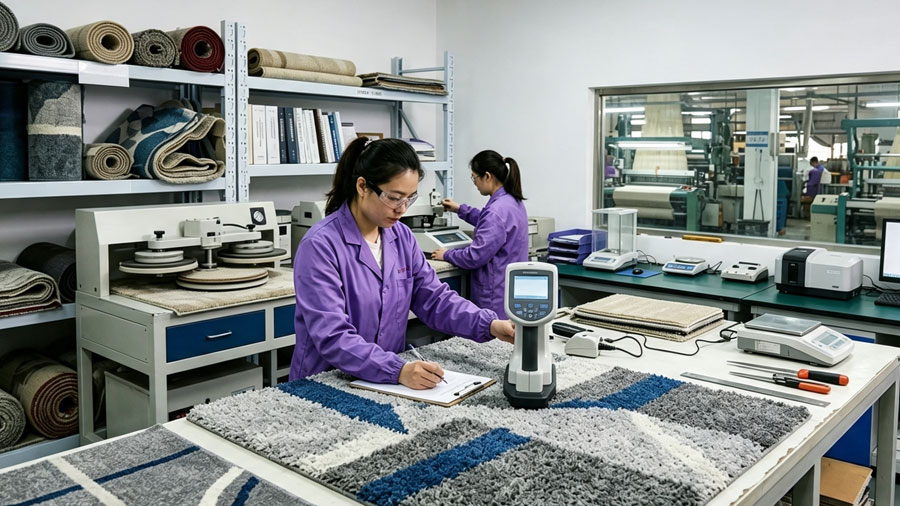
Second, factory QC. Reputable manufacturers inspect raw material on arrival, mid-production, and again before packing. On a Fab Carpet production line, this three-stage check is standard practice, not an add-on service.
Third, shipment coordination. The carpet arriving before the site is ready to receive it — or after the installation crew has already been scheduled — is one of the most common and avoidable project delays. Confirm shipment timelines against your construction schedule, not just against the factory’s production calendar.
Maintenance That Extends Replacement Cycles
Cleaning frequency should match traffic zone, not a blanket schedule. Lobbies and entrances need professional cleaning more often than guest rooms or low-traffic offices. Entrance matting systems reduce the soil load carried into carpeted areas by a measurable margin — a low-cost addition that meaningfully extends replacement cycles. Once cleaning stops restoring pile bounce or removing embedded soil, that’s the signal maintenance can no longer substitute for replacement.
FAQ: Commercial Carpet Replacement
What is the average MOQ for custom OEM/ODM commercial carpet?
MOQs vary by construction method and pattern complexity. Hand-tufted and machine-made carpets generally have lower minimums than Axminster weaving. Request a project-specific quote for exact figures.
How long does sample swatch shipping take?
Standard sample swatches typically ship within a few business days of request; custom color-matched samples take longer due to production time.
What is a realistic sea freight lead time for bulk hotel carpet orders?
Ocean freight timelines depend on production volume and destination port, and should be confirmed with a production and shipping schedule before deposit — not estimated after the order is placed.
Can I get a fire rating test report before placing an order?
Yes. Any commercial supplier should provide ASTM E648 or Bfl-s1 test documentation on request prior to purchase, not only after installation.
Does wool carpet cost more than synthetic in the long run?
Upfront price is higher, but lifecycle cost — factoring in replacement frequency and cleaning costs — is often lower over a 10-year period. Use the LCC formula above to model your specific project.
Is New Zealand Wool suitable for high-traffic commercial areas?
Yes, when specified with appropriate pile density and backing for the traffic level. It’s a standard choice for hotel corridors and lobbies precisely because of its recovery performance under repeated compression.
Request Your Project Quote
Carpet replacement decisions get expensive when they’re based on guesswork instead of specifications. Request free sample swatches, ask for a Technical Data Sheet (TDS), or submit an RFQ directly to a source factory — no trading company markup, no guessing on lead times.