Call us now:

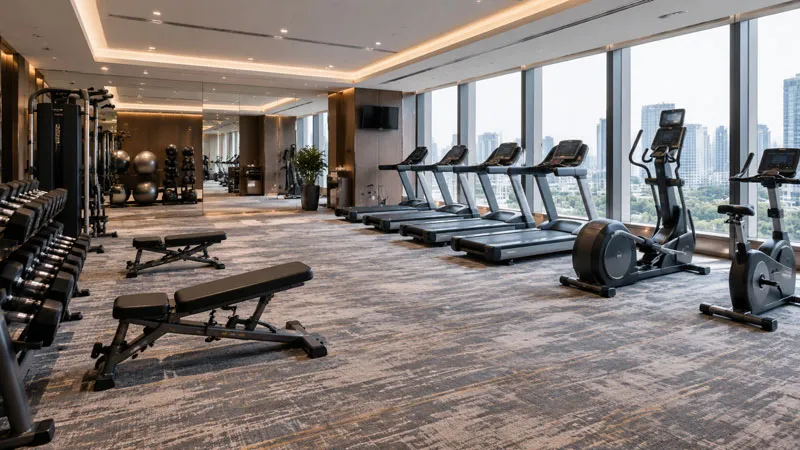
Finding the best carpet for exercise room projects in a hotel or commercial building is not a color decision. It’s a compliance decision. One wrong fire rating on a submittal, and your project stalls at inspection. This guide covers the specs, certifications, and sourcing steps that actually protect your timeline and budget.
What “Best Carpet for Exercise Room” Means in a Commercial Context
Residential buyers pick carpet by hand feel and price per square foot. Commercial specifiers work under different pressure. A hotel fitness center sits next to guest rooms. A corporate gym runs 16 hours a day under foot traffic that never stops. Insurance underwriters and fire marshals check the paperwork before anyone checks the pile height.
The carpet has to pass three tests before it passes the design review: fire code, wear performance, and supply chain reliability. Miss any one, and the “best” carpet on paper becomes a liability on site.
Core Performance Criteria for Commercial Gym Carpet Flooring
Abrasion Resistance and Wear Rating
Fitness center floors take repetitive point-load stress from equipment, plus constant foot traffic in athletic shoes. Martindale abrasion testing gives you a number to specify against — not a marketing claim. Ask any supplier for the test report, not the summary sentence.
Acoustic Performance for Shared-Wall Hotel Layouts
Fitness centers in hotels almost always share a wall or a floor plate with guest rooms. Dropped weights and treadmill impact transmit through hard flooring fast. Carpet with the right backing construction absorbs impact noise and cuts airborne sound transmission — this is where NRC (Noise Reduction Coefficient) and STC (Sound Transmission Class) data belong in your spec sheet, not as an afterthought.
Fire Safety: Class I Rating, ASTM E648, and Bfl-s1
This is the section that stops projects cold when it’s wrong. ASTM E648 measures critical radiant flux — how far flame spreads across the carpet surface. A Class I rating means the carpet meets the highest flux threshold under US code, required in corridors and many commercial common areas. Bfl-s1 is the equivalent EU classification under EN 13501-1, confirming low smoke production alongside flame resistance.
On Fab Carpet production lines, every wool construction is tested to Class I (ASTM E648) and Bfl-s1 before it ships — not sampled occasionally, tested as a batch standard. That’s the level of documentation a fire marshal or a hotel brand compliance team expects to see attached to the PO, not promised verbally.
ASTM E648 critical radiant flux test method
Moisture and Odor Control in Sweat-Heavy Spaces
Gym carpet absorbs sweat, spills, and humidity from HVAC cycling. Non-breathable backing traps moisture and grows mold inside the pad — a problem three popular home-gym guides never mention, because residential installs rarely deal with continuous 200+ daily users. Commercial-grade backing with moisture-resistant treatment, paired with a maintenance schedule, solves this before it becomes a health complaint.
Indoor Air Quality: CRI Green Label Plus
CRI Green Label Plus certifies low VOC emissions from carpet and adhesive systems — critical for enclosed fitness rooms with limited fresh-air exchange. Fab Carpet holds GLP9123 and GLP5308 certification across its wool product lines, which means the paperwork is ready when your LEED or WELL documentation team asks for it.
CRI Green Label Plus certified product directory
Comparison Table: Construction Method Matrix
| Construction Method | Cost Tier | Lead Time | Design Flexibility | Best Use Case |
|---|---|---|---|---|
| Axminster | Mid-High | Fast (once tooling/design is set) | High — strong for pattern-heavy, branded designs | Large-scale branded designs requiring repeatable patterns |
| Hand-Tufted | Mid | Shorter than hand-knotted | High — custom logos, mixed pile heights | Custom hospitality projects needing logo work or varied pile textures |
| Hand-Knotted | Premium | Longest | Highest — greatest design precision | Premium projects prioritizing durability and design detail over speed |
| Machine-Made | Most cost-efficient | Fastest | Lower — best for uniform, repeatable designs | Large uniform areas where turnaround and cost efficiency matter most |
Material Deep-Dive: Wool vs. Synthetic for Commercial Fitness Spaces
Why Premium New Zealand Wool Outperforms Synthetic
Wool fiber has natural crimp, which means it resists crushing under repeated point-load stress better than nylon or polyester over a 5-10 year lifecycle. It’s also naturally flame-resistant at the fiber level — synthetic fibers need chemical treatment to reach the same fire performance. Fab Carpet sources Premium New Zealand Wool specifically for its resilience under commercial traffic, not for the marketing story.
Construction Methods: Axminster, Hand-Tufted, Hand-Knotted, Machine-Made
Each construction method solves a different project problem:
- Axminster — best for pattern-heavy branded designs at commercial scale, fast production once tooling is set
- Hand-Tufted — flexible for custom logos and mixed pile heights, shorter lead time than hand-knotted
- Hand-Knotted — highest durability and design precision, longer lead time, premium tier
- Machine-Made — fastest turnaround, most cost-efficient for large uniform areas
Fab Carpet runs all four methods in-house, which means the construction choice gets made on project fit, not on what one factory happens to offer.
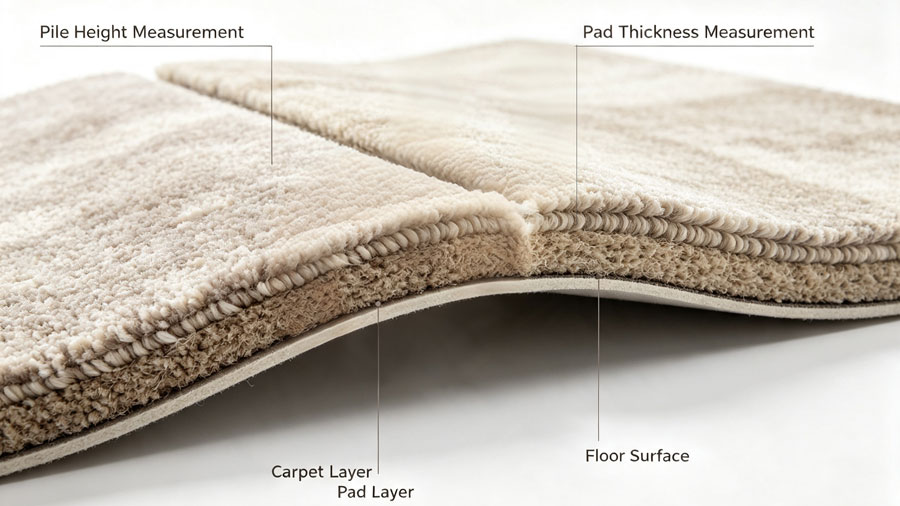
Pile Height, Pile Weight, and Density — The Formula That Predicts Durability
Density is what actually determines how long a commercial carpet holds up — not pile height alone. The working formula:
Density = (Pile Weight ÷ Pile Height) × Constant
Higher density means more fiber packed per square inch, which resists crushing and matting under repeated load. A thick, low-density carpet will flatten faster than a shorter, high-density one. Ask for the density figure, not just the pile height, on every commercial submittal.
Comparison Table: Performance Snapshot by Construction Type
| Construction Type | Wear Rating | Fire Class | NRC Range | IAQ Certification |
|---|---|---|---|---|
| Axminster | High — dense pile resists point-load stress | Class I (ASTM E648) / Bfl-s1 | Mid-range — depends on backing construction | CRI Green Label Plus (GLP9123 / GLP5308) |
| Hand-Tufted | Mid-High — durable with proper density | Class I (ASTM E648) / Bfl-s1 | Mid to high — backing often engineered for sound absorption | CRI Green Label Plus (GLP9123 / GLP5308) |
| Hand-Knotted | Highest — premium density and fiber resilience | Class I (ASTM E648) / Bfl-s1 | Mid-range — varies by pile height and density | CRI Green Label Plus (GLP9123 / GLP5308) |
| Machine-Made | Moderate — consistent but lower density than custom builds | Class I (ASTM E648) / Bfl-s1 | Lower to mid — typically thinner backing | CRI Green Label Plus (GLP9123 / GLP5308) |
International Compliance Checklist for Cross-Border Carpet Procurement
Every export market has its own required paperwork. Missing one certificate can hold your shipment at customs or fail your project’s compliance audit:
- CRI Green Label Plus (GLP9123 / GLP5308) — IAQ verification for North American projects
- EN 14041 (CE Marking) — mandatory for flooring products placed on the EU market
- MED Wheelmark (IMO Marine Standard) — required for marine, yacht, and cruise fitness facilities
- UKCA / UKMCA — post-Brexit conformity marking for UK-based projects
- ISO 9001 / 14001 / 45001 — factory-level quality, environmental, and safety management certification
A supplier holding all five isn’t unusual on paper. Verify it against the certificate registry directly — don’t take a PDF screenshot at face value.
Sourcing Strategy: Avoiding Supply Chain Pitfalls
Supplier Vetting — What to Verify Before You Sign
Request the factory’s certification numbers and check them against the issuing body’s public registry. Ask for a pre-shipment sample from current production, not an archived showroom sample. Confirm the factory owns its looms rather than subcontracting to a third party mid-order — subcontracted orders are where quality and timeline control break down.
The Hidden Cost of Trading Company Middlemen
Most commercial carpet quoted through a trading company carries a 20-30% markup before it reaches the factory floor. That markup pays for a sales layer that adds no manufacturing value — it doesn’t improve fire rating, wool grade, or delivery reliability. Sourcing directly from a factory like Fab Carpet removes that layer. The savings come from cutting a step, not cutting quality.
MOQ, Tiered Pricing, and Realistic Lead Times
Minimum order quantities and lead times shift based on construction method and customization level. Machine-made runs typically move faster and scale down in MOQ more easily than hand-knotted custom orders. Get tiered pricing in writing before committing to volume — a 500 sqm order and a 2,000 sqm order should never sit on the same per-unit rate without justification.
Custom OEM/ODM Development
Fab Carpet runs full OEM/ODM development from design brief through sample approval, giving hospitality brands and design firms control over pattern, colorway, and construction without managing multiple vendors across the process.
Use the calculator below to get a working estimate before you request a formal quote:
Interactive Tool: Carpet Calculator
Explore commercial carpet construction options
From Factory to Installation: QC and Delivery Workflow
Design, Sampling, and Approval
Every custom order moves through a strike-off sample stage before bulk production starts — this is the checkpoint to catch color and construction issues before they scale into a full production run.
In-Factory Quality Control: The AAAAA Standard
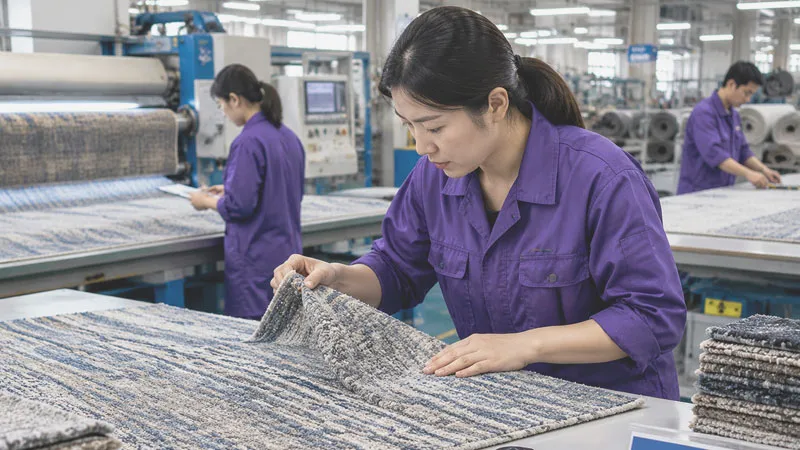
Fab Carpet applies an AAAAA quality inspection framework across production — checking pile density consistency, backing adhesion, dye lot uniformity, and edge finishing at multiple stages, not just at final packing. That’s the difference between catching a defect on the factory floor and catching it after installation on a hotel project.
Shipping, Logistics, and On-Site Coordination
Ocean freight lead time, customs documentation, and on-site installation scheduling need to be locked before production starts — not negotiated after the carpet is already on a container ship. A factory with in-house export experience handles this coordination directly instead of routing it through a third party.
Comparison Table: Fab Carpet Wool Construction vs. Standard Market Options
| Criteria | Fab Carpet Wool Construction | Standard Market Options |
|---|---|---|
| Fire Rating | Class I (ASTM E648), tested as a batch standard on every production run | Often tested only occasionally/on sample basis; rating may not be guaranteed batch-to-batch |
| Certifications | Bfl-s1 (EN 13501-1), CRI Green Label Plus (GLP9123 / GLP5308), plus ISO 9001 / 14001 / 45001 | Certification coverage varies; often incomplete or unverified against issuing registries |
| Wear Rating | High — wool’s natural crimp resists crushing under point-load stress over a 5-10 year lifecycle | Lower — synthetic fibers typically flatten/mat faster under the same traffic conditions |
| NRC (Acoustic Performance) | Backing construction engineered for impact and airborne sound absorption — relevant for shared-wall hotel layouts | Varies widely; acoustic backing often not specified or documented |
| Lead Time | Structured workflow: strike-off sample → AAAAA QC → production, with freight/customs planned pre-production | Timelines less predictable when routed through trading company middlemen |
| MOQ | Tiered by construction method (machine-made lower, hand-knotted higher), quoted directly from factory | Often bundled with trading company markup (20-30%), with less transparent tiering |
Maintenance and Total Cost of Ownership
Upfront price per square meter tells you almost nothing about what a commercial carpet actually costs over its service life.
| Factor | Standard Synthetic | Fab Carpet Wool |
|---|---|---|
| Upfront cost | Lower | Higher |
| Expected lifespan | 4-6 years | 8-12 years |
| Cleaning frequency | Higher (odor retention) | Lower (natural fiber resilience) |
| Replacement cycles (10-yr) | 2x | 1x |
Wool’s higher upfront cost typically offsets against fewer replacement cycles and lower cleaning frequency over a 10-year hold period — the math that matters to a facilities budget, not just a procurement PO.
Frequently Asked Questions
What is the minimum order quantity for custom commercial gym carpet?
MOQ varies by construction method — machine-made runs generally start lower than hand-tufted or hand-knotted custom orders. Confirm current MOQ tiers directly with the factory for your specific design.
How long does sample delivery take for a commercial project?
Standard strike-off samples typically ship within 7-10 business days of design confirmation, depending on construction complexity.
What fire rating do I need for a hotel fitness center in the US?
Class I rating under ASTM E648 is the standard requirement for most commercial common areas, including hotel fitness centers — confirm the specific local code with your project’s fire marshal.
Can I get a fire test report before placing a bulk order?
Yes. A compliant factory should provide third-party test reports (ASTM E648, Bfl-s1) for the specific construction and colorway before production, not after.
What’s the typical ocean freight lead time for bulk carpet orders?
Ocean freight generally runs 25-40 days depending on destination port, on top of production lead time — build this into your project schedule early.
Does wool carpet cost more to maintain than synthetic?
No — wool’s natural soil and odor resistance typically means lower cleaning frequency over time, despite a higher upfront material cost.
Ready to Move Forward?
Request free sample swatches, submit an RFQ for your project specs, or download the technical data sheet (TDS) with full certification documentation. Fab Carpet’s engineering team reviews project requirements directly — no trading company layer in between.