Call us now:

How thick is a carpet supposed to be for a hotel corridor, and who checks it before the container ships? Get this spec wrong and you inherit a fire-rating failure, a stalled customs clearance, or a reorder six months into a 200-room rollout. This guide breaks down thickness, weight, and compliance the way a factory engineer reads a spec sheet — not the way a showroom brochure sells one.
What Does “Carpet Thickness” Actually Mean in a Commercial Spec Sheet?
Most product pages use “thickness” loosely. In a procurement contract, that looseness costs money.
Pile Height vs. Total Thickness vs. Gauge
Pile height is the yarn length from the primary backing to the tip of the fiber. Total thickness adds the backing and any underlay bonded to it. Gauge measures the spacing between tufted rows and affects density more than it affects height. A spec that says “12mm pile” without stating total thickness leaves installers guessing at transition strip height and door clearance — a common source of change orders on hotel renovation projects.
The Metric Competitors Ignore: Pile Weight
Height alone tells you almost nothing about performance. Pile weight — measured in ounces per square yard (oz/yd²) or grams per square meter (g/m²) — tells you how much fiber is actually packed into that height. Two carpets at 10mm pile height can differ by 30% in weight, and the heavier one will outlast the other by years in a lobby or corridor.
A simplified way to think about it:
Pile Weight ≈ Pile Height × Tuft Density × Fiber Yield Factor
Buyers who specify height only, and skip weight, are the ones who reorder early.
[Factory Embed] At Fab Carpet’s Qinghai facility, every roll is measured against both pile height and pile weight tolerances before it leaves the production line, under our AAAAA internal quality standard. Deviation outside spec triggers a hold, not a shipment.
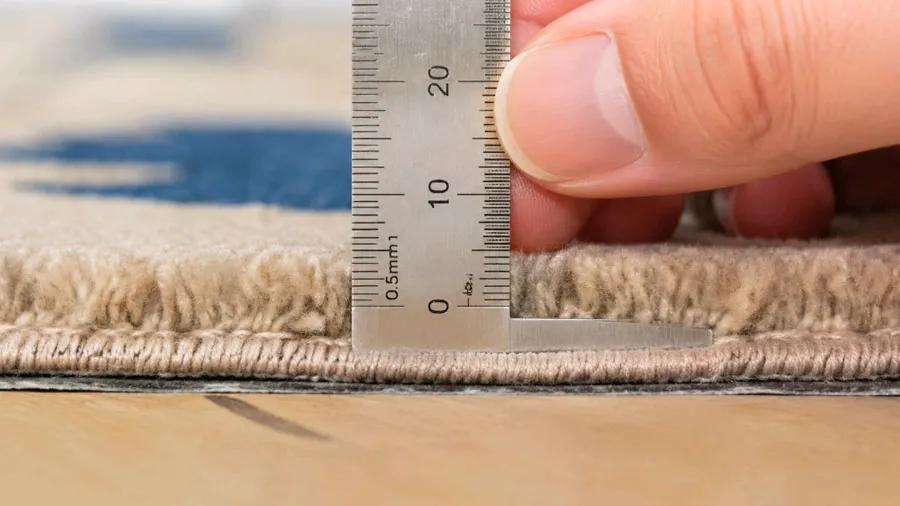
Standard Carpet Thickness Chart by Construction Type
Construction method changes what “standard thickness” even means. Here’s how the four main commercial constructions compare.
| Construction | Typical Total Thickness | Thickness Tolerance | Best-Fit Application |
|---|---|---|---|
| Axminster | 8–14mm | Tight (±0.5mm) | Hotel corridors, patterned lobbies |
| Hand-Tufted | 10–20mm | Moderate (±1mm) | Guest rooms, custom logo mats |
| Hand-Knotted | 12–25mm+ | Wide (varies by weaver) | High-end lounges, executive suites |
| Machine-Made Loop/Cut Pile | 6–12mm | Tight (±0.5mm) | Offices, high-traffic retail |
Axminster construction locks pile into a woven backing, which keeps thickness consistent roll to roll — a reason it dominates hotel corridor specs where 500+ linear meters need to match exactly. Hand-tufted work allows more design flexibility but needs tighter QC to avoid batch variance. Hand-knotted carpet, especially in wool, carries the widest thickness range because density is set by hand, not machine.
[Factory Embed] Fab Carpet runs Axminster, hand-tufted, and hand-knotted lines under one roof in Qinghai. That means a hotel group can source patterned corridor Axminster and custom hand-tufted suite rugs from a single supplier, with matched dye lots and one QC framework — instead of reconciling two factories’ tolerance standards.
Axminster carpet manufacturing process
How Thick Should Commercial Carpet Be? An Application Matrix
Thickness has to match traffic load and acoustic need, not aesthetic preference alone.
Guest Rooms and Suites
10–18mm total thickness. Comfort underfoot matters here, and traffic is lighter than public areas, so higher pile weight is affordable.
Corridors and Circulation Areas
8–12mm, denser construction. Thinner but denser resists matting from wheeled luggage and housekeeping carts far better than plush pile.
Lobbies, Ballrooms and Function Spaces
Varies by zone. Reception areas near entrances need low-pile, high-density carpet for durability. Seating zones can run thicker for acoustic comfort.
High-Traffic Entertainment and Hospitality Leisure Venues
These spaces see continuous foot traffic for extended hours. Specify dense, low-to-mid pile construction with reinforced backing — thickness under 10mm, weight well above residential standard, to resist crushing under sustained use.
Marine and Cruise Interiors
Thickness is only part of the spec here. Marine projects require IMO-compliant materials regardless of pile height, which we cover in the compliance section below.
Interactive Tool: Estimate the right pile thickness and material cost for your project
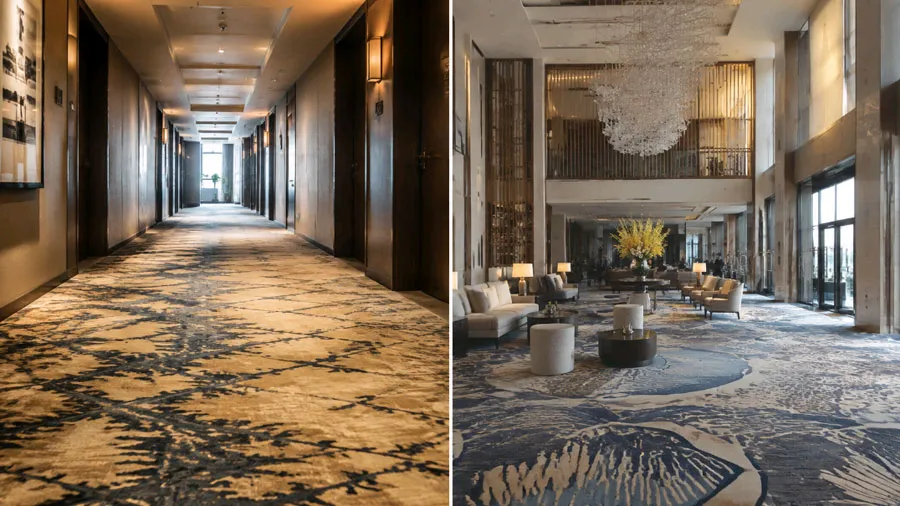
Beyond Thickness: The Performance Metrics B2B Buyers Actually Need
A thickness number without compliance data is not a usable spec.
Fire Safety Compliance
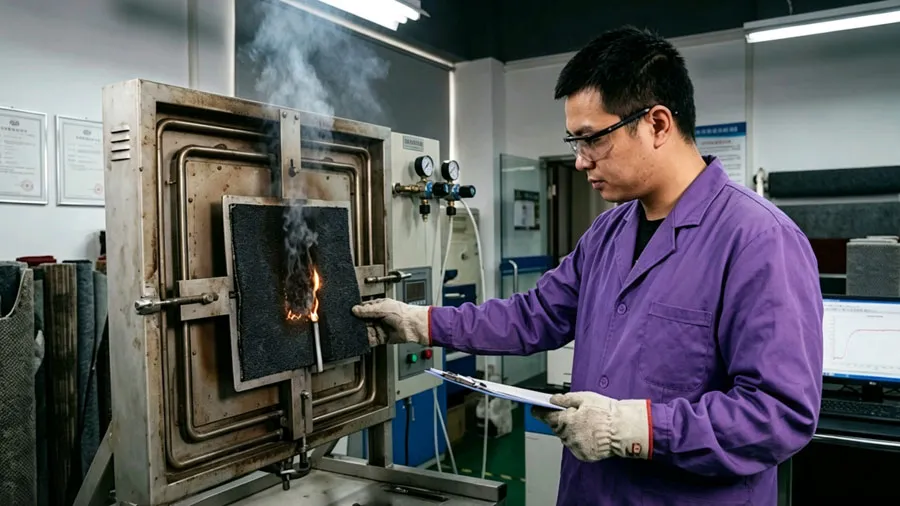
Commercial carpet in North America needs to pass ASTM E648 (Critical Radiant Flux) for a Class I fire rating. European projects reference EN 13501 and Bfl-s1 classification. Skipping this step is the single most common reason shipments get rejected at customs on hospitality projects.
Acoustic Performance
Denser, thicker pile absorbs more sound. For corridors above guest rooms or below function spaces, Noise Reduction Coefficient (NRC) and Impact Insulation Class (IIC) ratings matter as much as thickness itself. A thin, dense Axminster will outperform a thick, loose-pile carpet acoustically if the underlay isn’t matched correctly.
Abrasion and Wear Resistance
Martindale and Wyzenbeek tests simulate foot traffic cycles. Ask for test reports, not marketing claims — a carpet rated for 50,000 Martindale cycles behaves very differently in a lobby than one rated for 15,000.
Rolling Load Compliance
Offices and healthcare facilities with wheeled chairs and carts need carpet tested for rolling load resistance. This is frequently missed in general hospitality specs and causes premature wear at reception desks.
ASTM E648 flooring radiant panel test method
[Factory Embed] Every Fab Carpet product line carries Class I Fire Rating documentation (ASTM E648 / Bfl-s1) as standard, not as an optional add-on. We issue test reports per production batch, not per product launch — which matters when a hotel’s fire marshal asks for lot-specific documentation during final inspection.
Why Premium New Zealand Wool Changes the Thickness Equation
Fiber type determines how thickness holds up over time — not just how it feels on day one.
Fiber Density vs Synthetic Alternatives
Wool fiber is naturally more resilient than nylon or polyester at the same pile height. It springs back after compression instead of flattening permanently, which means a 12mm wool pile retains more of its original thickness after five years of hotel traffic than a 12mm synthetic pile.
Thickness Retention Over Time
| Fiber | Crush Resistance | Pile Recovery Rate | Typical Lifespan (Commercial Use) |
|---|---|---|---|
| Premium New Zealand Wool | High | Fast | 12–15 years |
| Nylon | Moderate–High | Moderate | 8–10 years |
| Polyester | Low–Moderate | Slow | 5–7 years |
Acoustic and Underfoot Feel
Wool’s natural crimp traps more air per fiber, which improves both sound absorption and thermal insulation compared to synthetic fibers at equal thickness.
[Factory Embed] Fab Carpet sources Premium New Zealand Wool directly for our Axminster and hand-tufted lines, tested against pile recovery benchmarks before a design goes into bulk production — not after a client complains about matting eighteen months post-installation.
Premium New Zealand Wool carpet collection
The Hidden Cost of Getting Thickness Wrong
Spec teams often price carpet per yard and stop there. That’s an incomplete number.
Maintenance Cost by Density
Low-density, thick pile needs more frequent deep cleaning and specialized equipment. Dense, correctly-specified pile in corridors cuts cleaning labor hours meaningfully over a multi-year contract.
Replacement Cycle Reality
Underspecifying thickness in high-traffic zones to save 10% upfront often forces a full corridor replacement two to three years early. That replacement includes freight, installation labor, and guest-room downtime — costs that dwarf the original material saving.
Total Cost of Ownership
Hotel developers who model carpet cost over a 10-year hold, not just the initial invoice, consistently land on higher-density, mid-thickness specifications over plush, thick alternatives.
Sourcing Guide: How to Specify and Procure the Right Thickness Without Overpaying
Getting the spec right on paper means nothing if the supply chain can’t deliver it consistently.
Supplier Qualification Checklist
Before signing a purchase order, confirm the supplier holds ISO 9001 (quality management), ISO 14001 (environmental management), and ISO 45001 (occupational health and safety). Ask for CRI Green Label Plus certification numbers directly, and verify them against the public directory rather than accepting a PDF at face value.
MOQ and Tiered Pricing Logic
Thickness and density directly affect cost-per-yard breakpoints. A thicker, higher-density Axminster carries a higher minimum order quantity because loom setup costs are fixed regardless of order size — spreading that cost over more yardage is what makes tiered pricing work in the buyer’s favor.
Avoiding Middleman Markup
Trading companies typically add 20–30% margin between factory price and quoted price, without adding QC value. Sourcing factory-direct removes that layer — the tradeoff is that the buyer needs to do more upfront diligence on the factory itself, which is exactly what the checklist above is for.
Lead Time and Custom Production
A realistic OEM/ODM timeline runs: design confirmation (1–2 weeks) → sampling (2–3 weeks) → bulk production (4–8 weeks depending on volume) → QC and packing (1 week) → shipping. Any supplier quoting a bulk hospitality order in under six weeks total is cutting a corner somewhere in that sequence.
[Factory Embed] Fab Carpet’s Qinghai facility runs OEM/ODM production with published lead times at each stage, and clients get sample approval before bulk weaving starts — not after. Direct factory sourcing here typically saves clients the 20–30% trading-company margin without compromising on documentation or QC transparency.
Compliance and Certification Snapshot
| Certification | Verifies | Required For |
|---|---|---|
| CRI Green Label Plus (GLP9123/GLP5308) | Low VOC emissions | US commercial/hospitality projects |
| EN 14041 (CE Marking) | Flooring performance for EU market | European projects |
| MED Wheelmark (IMO Marine Standard) | Marine fire and safety compliance | Cruise and marine interiors |
| UKCA / UKMCA | UK post-Brexit market access | UK-based hospitality projects |
| ISO 9001 / 14001 / 45001 | Quality, environmental, safety management | General supplier due diligence |
Few factories hold this full certification stack simultaneously, which is precisely why buyers should ask for certificate numbers before, not after, placing a deposit.
CRI Green Label Plus certified product directory
FAQ: What B2B Buyers Ask Before Placing an Order
What’s the difference between pile height and carpet weight?
Pile height measures fiber length. Weight (oz/yd² or g/m²) measures how much fiber is packed into that length. Weight predicts durability better than height alone.
What is a typical MOQ for OEM/ODM commercial carpet?
MOQs vary by construction — hand-tufted custom orders often start lower than Axminster, which needs full loom setup. Request project-specific MOQ during the RFQ stage.
How long does it take to receive sample swatches?
Standard swatches usually ship within a few business days. Custom color-matched samples take longer, since they require a small production run first.
What sea freight lead time should I plan for?
Container shipping from a Chinese factory typically adds 25–40 days transit time depending on destination port, on top of production lead time.
Does thicker carpet automatically mean better fire rating?
No. Fire rating depends on fiber composition and backing treatment, not thickness. A thin carpet can outperform a thick one on ASTM E648 if the fiber and backing are engineered correctly.
Can I request a Technical Data Sheet before ordering?
Yes — any legitimate commercial supplier should provide a TDS with pile height, weight, fire rating, and certification numbers before you commit to a purchase order.
Ready to Specify With Confidence?
Get the exact thickness, weight, and compliance data behind your next project. Request free sample swatches, submit an RFQ for your project specifications, or download the Technical Data Sheet for Fab Carpet’s Axminster, hand-tufted, and hand-knotted wool lines.