Call us now:

The pros and cons of wool rugs look different once fire codes, budgets, and delivery deadlines enter the picture. A wrong spec can mean a failed inspection, a blown timeline, or a supplier who ships fibers you never approved. This guide breaks down the real performance data, the compliance paperwork, and the sourcing decisions that determine whether wool works for your project.
1. Wool Rugs in Commercial and Hospitality Applications
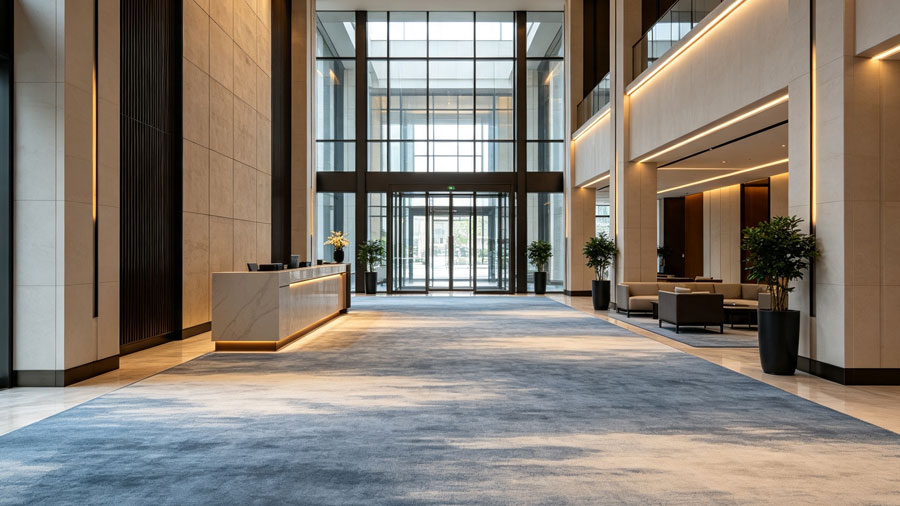
Wool shows up in guestrooms, lobbies, boardrooms, corridors, and cruise cabins for a reason: it holds color, resists crushing under rolling carts, and reads as premium the moment a guest steps off the elevator. High-traffic corridors and lobby zones typically call for a denser, tighter-woven construction than a guestroom, where foot traffic and cart wheels are lighter. Specifiers working across hospitality, marine, and commercial office projects generally price wool against nylon early, then narrow the decision once fire and durability requirements are on the table.
2. The Performance Case for Wool: Pros Backed by Test Data
Generic adjectives don’t help a procurement team compare bids. Here’s what the numbers actually show.
Softness and underfoot feel trace back to pile weight and yarn twist, not marketing copy. Higher ounce-per-square-yard wool with a tighter twist holds its texture longer under foot traffic.
Durability is measured through Wyzenbeek or Martindale abrasion cycles. Wool typically outperforms polypropylene at the 50,000-rub mark and holds pile height better than most synthetics past 100,000 rubs, largely due to its natural crimp memory.
Fire resistance is where wool earns its place in code-driven specs. Wool fiber has a naturally high ignition point, and properly constructed wool carpet can achieve a Class I fire rating under ASTM E648, or a Bfl-s1 classification under EN 13501 — both standard requirements for hotel corridors and public assembly spaces. [Class I flooring radiant panel test methodology]
Stain resistance comes from the lanolin coating on raw wool fiber, which repels water-based spills long enough for cleanup before they set.
Acoustic performance rarely gets mentioned in consumer content, but it matters in open-plan offices and hotel corridors stacked above guestrooms. Wool’s fiber structure absorbs airborne sound and reduces impact noise transfer between floors, which is why it’s specified over hard flooring in sound-sensitive zones.
Indoor air quality benefits come from wool’s natural resistance to dust mites and its low off-gassing profile, which matters for projects targeting LEED or WELL certification. [Green Label Plus certified product requirements]
Sustainability is straightforward: wool is a renewable, biodegradable fiber, and manufacturing under an ISO 14001 environmental management system keeps processing impact documented and auditable.
| Attribute | Wool | Nylon | Polypropylene |
|---|---|---|---|
| Abrasion resistance (50k rubs) | Excellent | Good | Fair |
| Natural fire resistance | High | Requires treatment | Low, melts under heat |
| Stain resistance (untreated) | Good, short window | Fair | Excellent |
| Acoustic absorption | High | Moderate | Low |
| Biodegradable | Yes | No | No |
Interactive Tool: Compare Wool vs Synthetic Performance and Estimate Your Project Cost
3. Where Wool Requires Planning, Not Just Awareness
Every material has trade-offs. Wool’s are manageable with the right spec.
Upfront cost versus lifecycle cost is the real comparison, not sticker price alone. Wool typically costs more per square meter than polypropylene at purchase, but a 10-year lifecycle model — replacement cycle, cleaning frequency, and appearance retention — often narrows or reverses that gap in high-visibility areas where synthetic carpet gets replaced twice as often.
Moisture sensitivity needs engineering around, not avoidance. In marine and coastal projects, this means specifying wool constructions tested against IMO marine standards rather than assuming any wool product qualifies.
Fiber shedding in the first weeks of use is normal for new wool carpet. What isn’t normal is continued heavy shedding past the initial break-in period — that’s usually a sign of low twist density or substandard yarn processing at the mill. On Fab Carpet’s production line, yarn twist and pile density are checked against an internal AAAAA quality benchmark before a batch ever ships, specifically to catch this failure mode before it reaches a job site.
Maintenance requirements are real but predictable: professional hot-water extraction on a set schedule, paired with routine vacuuming, keeps commercial wool carpet performing for its full rated lifespan.
4. Manufacturing Method Changes the Pros and Cons Equation
Wool carpet isn’t one product — construction method changes cost, lead time, and where it should go.
Axminster handles complex patterns and heavy traffic, making it the standard choice for branded hotel corridors and casino-adjacent circulation paths — now more commonly specified for high-traffic commercial spaces and entertainment venue public areas where pattern-matching and durability both matter.
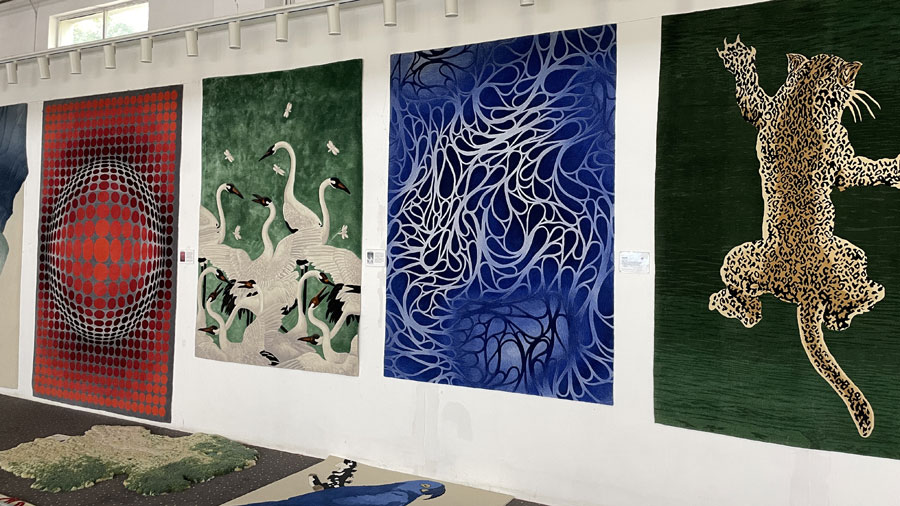
Hand-tufted wool rugs deliver custom design at a mid-range cost and shorter lead time, useful for boutique properties working within a defined budget.
Hand-knotted construction is the premium tier — slower to produce, but built for statement lobby pieces meant to last decades.
Machine-made versus hand-made ultimately comes down to timeline and design flexibility. Machine production moves faster for large, repeatable orders; hand-made work suits one-off or highly custom specs. Running Axminster, hand-tufted, hand-knotted, and machine-made capacity under one roof lets a buyer match construction method to budget and deadline without switching suppliers mid-project.
5. Wool Grade Isn’t a Single Spec
“Wool carpet” on a quote sheet tells you almost nothing. Ask for pile weight, pile height, and density — density is roughly pile weight multiplied by 36, divided by pile height. Low density at a low price usually signals a thinner, less durable product regardless of what the yarn label says.
Premium New Zealand wool is prized in commercial specs for its longer staple length and stronger crimp recovery, which translates directly to better resilience under repeated foot traffic compared to shorter, blended fibers. [Explore Premium New Zealand Wool carpet options]
6. Compliance Checklist: The Certifications Your Project Actually Needs
This is the section most buyer’s guides skip, and it’s where projects stall during permitting.
- Fire safety: ASTM E648 Class I for North American commercial interiors; EN 13501 Bfl-s1 for European projects.
- Environmental and health: EN 14041 for CE marking; CRI Green Label Plus (GLP9123 / GLP5308) for indoor air quality on LEED and WELL-targeted builds.
- Marine and cruise: MED Wheelmark certification, confirming compliance with IMO fire and safety standards for vessel interiors.
- UK market access: UKCA and UKMCA marking, required post-Brexit for products entering the UK market.
- Manufacturing systems: ISO 9001 for quality management, ISO 14001 for environmental management, ISO 45001 for occupational health and safety — three certifications worth requesting from any supplier before signing.
Fab Carpet’s production carries this full certification set — CRI Green Label Plus, EN 14041, MED Wheelmark, UKCA/UKMCA, ISO 9001/14001/45001, and ASTM E648 Class I fire rating — because hospitality and marine buyers can’t afford to discover a gap after the container has shipped.
[Downloadable Resource: Download Free B2B Wool Carpet Compliance & Spec Checklist PDF]
7. Factory-Direct Sourcing and What It Actually Changes
Multi-layer distribution adds cost at every handoff: importer margin, distributor margin, sometimes a second distributor margin before a quote reaches your desk. Buying factory-direct removes those layers, which is typically where the 20-30% cost reduction comes from — not from cheaper materials.
What factory-direct sourcing should also give you is control: direct line to the QC team, visibility into yarn testing before weaving starts, and a single point of accountability for lead time. Before signing with any supplier, ask for their raw material inspection process, in-line QC checkpoints, and pre-shipment inspection reports with color deltaE tolerance data — not just a finished-product photo.

Request OEM/ODM manufacturing details
8. Is Wool the Right Spec for Your Project?
Match the material to the zone: wool for guestrooms, executive corridors, and lobby feature areas where appearance retention and acoustic performance matter most; a wool-synthetic blend or high-performance nylon for back-of-house or extreme-moisture zones. Budget tier and certification requirements should drive the final call, not preference alone.
Interactive Tool: Estimate Your Project’s Wool Carpet Cost and Lead Time
FAQ: Commercial Wool Carpet Procurement
What’s the typical MOQ for custom wool carpet from a factory-direct supplier?
MOQs vary by construction method — hand-tufted orders generally start lower than Axminster, which requires minimum loom run lengths. Request project-specific MOQ during RFQ.
How long does sample dispatch take?
Standard swatches usually ship within 3-5 business days; custom color-matched samples take longer, depending on dye lot scheduling.
What’s a realistic sea freight lead time?
Ocean freight from a Chinese production facility to North American or European ports typically runs 25-40 days, separate from production time.
Can I get fire rating test reports before placing an order?
Yes — ASTM E648 and EN 13501 test reports should be provided as standard documentation, not on request only.
Does wool carpet meet LEED or WELL indoor air quality requirements?
CRI Green Label Plus certified wool products are commonly accepted documentation for LEED and WELL indoor air quality credits.
Can Fab Carpet match an existing hotel brand’s carpet design?
Yes, through OEM/ODM development — pattern replication and custom colorways are handled through the design-to-sample process.
Ready to Spec Wool With Confidence?
Request free sample swatches, submit an RFQ for project-specific pricing, or download the technical data sheet before your next bid deadline.