Call us now:

High traffic carpet decisions get made twice: once at the design table, and again during punch-list week when a corridor fails fire inspection. This guide walks architects, developers, and procurement teams through the fiber data, compliance requirements, and sourcing checks that prevent the second conversation from happening at all.
1. What “High Traffic” Actually Means on a Spec Sheet
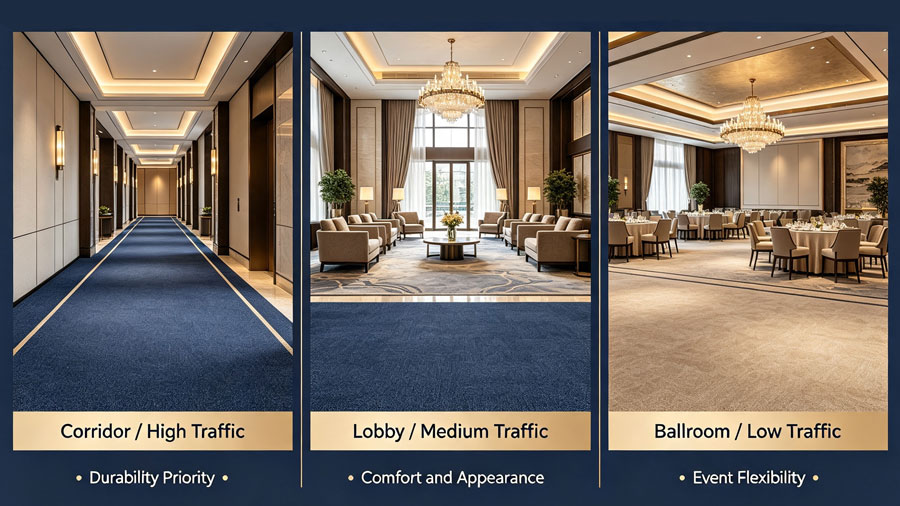
Residential blogs use “high traffic” loosely. Commercial specifications don’t have that luxury. ISO 10874 and EN 1685 classify flooring into use categories — from Moderate to Severe — based on measured foot traffic and mechanical stress, not guesswork.
A hotel corridor sits in a different category than a guest room. A hotel lobby sits in a different category than a corridor. Ballrooms and high-traffic commercial and entertainment areas — spaces with continuous foot flow and furniture movement — typically require Severe-duty classification, the top rating in most international schemes.
Get the classification wrong and the carpet wears out in 18 months instead of the 10 years the budget assumed.
2. Fiber Performance: What the Data Actually Shows
Marketing copy calls every fiber “durable.” Test data doesn’t lie the same way.
Nylon recovers well from compression and holds color under solution-dyeing. It’s the default choice for budget-driven commercial rollouts.
Premium New Zealand Wool performs differently than commodity wool. Long-staple fiber gives it natural resilience, inherent flame resistance, and acoustic absorption that synthetic fibers can’t match without added backing. It costs more per square meter. It also outlasts nylon by several years in comparable traffic zones, which changes the lifecycle math entirely.
Wool blends split the difference — synthetic fiber for cost control, wool for surface performance.
Face weight and pile density matter more than fiber type alone. A simple check: divide face weight (oz/sq yd) by pile height, then multiply by 36. Higher density numbers correlate directly with wear resistance, regardless of fiber.
Fab Carpet sources Premium New Zealand Wool directly rather than through blended-fiber intermediaries, which keeps fiber consistency traceable from raw material to finished roll — a detail that shows up in abrasion test results, not in a brochure.
2a. Construction Method Changes the Outcome
Fiber choice is half the specification. Construction method is the other half.
Axminster handles multi-color patterned designs at scale — the standard for branded corridor carpet and ballroom floors.
Hand-tufted construction suits custom logos and feature areas where turnaround matters more than volume.
Hand-knotted carpet belongs in suites and lobbies where longevity and craftsmanship justify the investment.
Machine-made broadloom or tile covers large rollouts on tighter budgets.
Fab Carpet runs Axminster, hand-tufted, hand-knotted, and machine production under one factory roof, which lets a single project specify different constructions for different zones without switching suppliers mid-build.
commercial carpet construction methods explained
3. Fire Safety and Compliance — Where Projects Get Rejected
This is the section most guides skip, and it’s the one that stops installation on-site.
Class I Fire Rating (ASTM E648 / Bfl-s1) is required for corridors and means of egress in most jurisdictions. Carpet without this rating fails inspection regardless of how it looks or performs otherwise.
CRI Green Label Plus (GLP9123 / GLP5308) certifies indoor air quality — required documentation for LEED and WELL-certified projects.
EN 14041 (CE marking) governs market entry for flooring products sold in the EU.
MED Wheelmark (IMO Marine Standard) applies to marine and cruise applications — a narrower certification that few land-based factories hold.
UKCA/UKMCA covers post-Brexit UK compliance separately from CE marking.
ISO 9001, 14001, and 45001 confirm quality, environmental, and safety management systems at the factory level, not just the product level.
Fab Carpet holds hospitality-grade certification (CRI, EN 14041) alongside marine-grade certification (IMO/MED Wheelmark) — a combination that lets one factory supply both land-based hospitality projects and marine interiors without a secondary vendor.
Class I fire rating requirements
CRI Green Label Plus certified product directory
4. Acoustic Performance — The Overlooked Line Item
Corridors, ballrooms, and lobbies generate noise most spec sheets never address. NRC (Noise Reduction Coefficient) and STC (Sound Transmission Class) ratings quantify how much sound a carpet absorbs versus transmits.
Wool fiber structure absorbs sound more naturally than synthetic fiber at equivalent density. In multi-floor hotel construction, that difference affects guest complaints more than any other single spec.
5. Sourcing Without Getting Burned
Most cost overruns trace back to one decision: choosing a trading company that presents itself as a factory.
Red flags to check before signing an RFQ:
- Certificates that can’t be verified against the issuing body’s database
- No factory audit available, virtual or on-site
- Vague answers about production location or subcontracting
A working due-diligence checklist:
- Request third-party test reports (SGS, Intertek) independent of the supplier’s own claims
- Verify certification numbers directly with CRI, ISO, or the relevant issuing authority
- Confirm MOQ and tiered pricing structure before committing to a sample run
MOQ and pricing typically scale in three tiers: sample development, pilot-floor order, and full project rollout. Unit cost drops meaningfully between tiers, but only if the factory controls production directly.
Buying through a source factory — rather than a trading company layered between buyer and production line — typically removes 20–30% in intermediary markup, while giving procurement teams direct accountability for QC and lead time. Fab Carpet’s Qinghai-based production operates on this direct model: one point of contact from raw wool sourcing through finished roll.
Interactive Tool: Estimate your project cost and area requirements
how to audit a carpet manufacturer
6. From Design to Installation
A typical commercial order moves through five stages: custom design and pattern development, sampling and lab-dip color approval, in-line production QC checkpoints, freight planning (sea freight for volume, air for urgent sampling), and on-site installation coordination that accounts for subfloor moisture and acclimation time.
Skipping QC checkpoints at the production stage — not at final inspection — is where most color and density inconsistencies originate.
7. Maintenance for Lifecycle Value
Entrance matting sized to the traffic zone, not the doorway, catches the majority of soil before it reaches interior carpet. Professional cleaning cadence should follow the traffic classification assigned in Section 1 — Severe-duty zones need cleaning cycles roughly twice as frequent as Moderate zones. A manufacturer warranty that specifies wear tolerance by traffic class, rather than a flat number of years, is the stronger document to request.
FAQ
What’s a typical MOQ for custom hospitality carpet?
MOQs vary by construction method — machine-made broadloom generally starts lower than hand-tufted or hand-knotted custom orders. Confirm the exact figure per project during RFQ.
How long does sample development take?
Standard color-matched samples typically ship within 1–2 weeks of design approval; custom pattern development takes longer.
What’s the typical sea freight lead time for a full project order?
Ocean freight timelines depend on origin port and destination, generally running several weeks; factor this into installation scheduling early.
Is wool or nylon better for hospitality corridors?
Wool offers longer wear life and better acoustic absorption; nylon offers lower upfront cost. The right choice depends on project budget and lifecycle priorities.
Do I need both CRI and EN 14041 certification?
Only if the project spans both US and EU markets, or if LEED/WELL documentation is required alongside EU market entry.
Can one factory produce both fire-rated and marine-certified carpet?
Few can. Confirm dual certification (Class I fire rating plus IMO/MED Wheelmark) before assuming a single supplier covers both use cases.
Next Step
Specification decisions made now determine maintenance cost for the next decade. Request free sample swatches, submit an RFQ for project-specific pricing, or download the technical data sheet (TDS) before finalizing your carpet spec.