Call us now:

Carpet life expectancy determines your renovation budget years before the invoice arrives. Specify the wrong construction and a “10-year” hotel corridor carpet fails in four. This guide breaks down the engineering variables — density, fiber, fire rating, compliance — that actually decide how long your carpet lasts, based on production data from our own mills.
What Determines Carpet Life Expectancy? The Variables That Actually Matter
Generic advice says carpet lasts 5 to 15 years. That range is useless for a procurement decision. Life expectancy is a function of three measurable inputs: face weight, pile density, and twist level. Get these numbers before you get a price quote.
Density and Pitch: The Formula Behind Durability
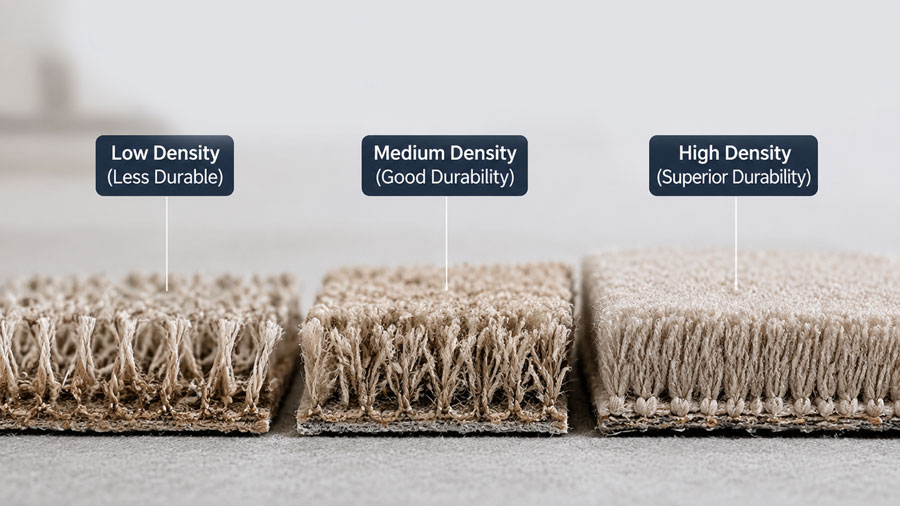
Face weight (oz/yd²) multiplied by pile density gives you the real durability signal. A carpet with 40 oz/yd² face weight and tight pitch outlasts a 60 oz/yd² carpet with loose, open tufts. Density resists crushing. Weight alone does not.
| Density Level | Face Weight | Recommended Traffic Zone | Expected Lifespan |
|---|---|---|---|
| Standard | 20–30 oz/yd² | Offices, low-traffic rooms | 5–8 years |
| Commercial | 30–45 oz/yd² | Hotel corridors, retail | 8–12 years |
| Heavy Commercial | 45–60+ oz/yd² | Lobbies, High-Traffic Commercial Spaces | 12–20 years |
Fiber Choice: Wool vs. Nylon vs. Wool-Blend
Nylon resists staining and costs less upfront. Wool recovers its shape after compression and keeps that recovery for decades — this is the reason museums, government buildings, and five-star hotels still specify wool. Our mills work almost exclusively with Premium New Zealand Wool because of its fiber diameter and natural crimp, both of which drive resilience under repeated foot traffic. Blended wool-nylon constructions split the difference: better stain resistance than pure wool, better resilience than pure nylon.
Construction Method: Axminster, Hand-Tufted, Hand-Knotted
| Construction | Density | Relative Cost | Typical Lifespan | Best Use Case |
|---|---|---|---|---|
| Axminster | High | Mid | 15–20 years | Hospitality corridors, banquet halls |
| Hand-Tufted | Medium-High | Mid-Low | 8–12 years | Custom rugs, feature areas |
| Hand-Knotted | Very High | High | 20–30 years | Executive suites, heritage properties |
| Machine-Made Broadloom | Medium | Low-Mid | 6–10 years | Offices, budget projects |
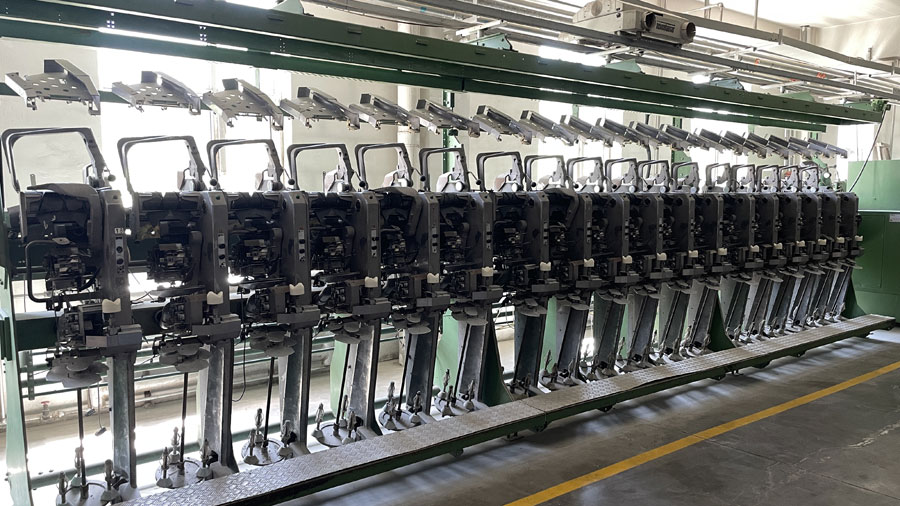
Each construction method runs on a different production line with a different quality-control checkpoint. Axminster weaving, for instance, requires yarn tension checks every 500 meters to prevent the uneven pile height that shortens usable life.
Carpet Abrasion Resistance: The Test Home Blogs Never Mention
Wear rating, not warranty period, predicts real-world performance. Two industry-standard tests measure it.
Martindale and Wyzenbeek Double-Rub Testing
Wyzenbeek testing counts how many double rubs a fabric or pile withstands before visible wear appears. Heavy commercial carpet should clear 30,000+ double rubs. Anything below 15,000 belongs in residential settings only. Martindale testing, common in European specs, follows a similar logic with a different rub count scale.
High-Traffic Zone Performance Requirements
Hotel lobbies, casino-adjacent corridors reclassified as High-Traffic Entertainment Areas, and airport concourses need the top tier of abrasion resistance plus a tight loop or cut-pile construction that resists matting. Specify below this threshold and you’re budgeting for a mid-lease replacement.
commercial carpet wear rating comparison
Carpet Fire Rating Standards: The Non-Negotiable Compliance Layer
No commercial project passes inspection without documented fire performance. This is where sourcing decisions carry legal weight.
Class I Fire Rating (ASTM E648 / Bfl-s1)
ASTM E648 measures critical radiant flux — how far flame spreads across a carpet surface. Class I is the top rating and the baseline requirement for most US commercial buildings. Bfl-s1 is the EU equivalent under EN 13501-1. Every roll we ship carries third-party test documentation for both standards, because buyers on two continents ask for two different certificate formats.
Cross-Border Compliance: What Each Certification Actually Covers
| Standard | Region | Covers | Required For |
|---|---|---|---|
| CRI Green Label Plus (GLP9123/GLP5308) | US | Indoor air quality, low VOC emissions | LEED, healthcare, education |
| EN 14041 (CE Marking) | EU | Fire, slip resistance, electrical properties | All EU commercial flooring |
| UKCA / UKMCA | UK | Post-Brexit equivalent of CE | UK commercial projects |
| MED Wheelmark (IMO Marine Standard) | International | Marine fire and safety compliance | Cruise ships, offshore platforms |
Buyers sourcing for cruise line refurbishments should confirm Wheelmark documentation before quoting the client — it’s a different certification body from standard building compliance and gets missed in first-round supplier vetting.
ASTM E648 critical radiant flux test method
Hotel Carpet Acoustics: A Factor Competitors Skip Entirely
Pile height and backing density don’t just affect comfort. They affect Noise Reduction Coefficient (NRC) — a rating hospitality buyers should request alongside wear data. Thin, low-density carpet forces designers to over-compensate with thick padding, which compresses unevenly and shortens usable life. A properly specified mid-height, high-density pile hits NRC targets without relying on oversized underlay that fails first.
Total Cost of Ownership: Why the Cheapest Quote Rarely Wins
Purchase price is one line in a much larger equation.
TCO = (Purchase Cost + Maintenance Cost + Replacement Frequency) ÷ Lifespan in Years
Run this formula across 15 years and budget nylon loses to premium wool nearly every time, even though the sticker price looks worse on day one.
| Budget Nylon | Fab Carpet Premium Wool Axminster | |
|---|---|---|
| Purchase cost per sq ft | Lower | Higher |
| Expected lifespan | 6–8 years | 15–20 years |
| Replacements over 15 years | 2 | 0–1 |
| Annualized cost per sq ft | Higher | Lower |
Interactive Tool: Estimate your project’s real cost per year
Sourcing: How Supply Chain Decisions Affect Real Lifespan
Spec sheets don’t guarantee delivered quality. Sourcing through multiple intermediaries introduces risk at every handoff — substituted yarns, skipped QC steps, missing certificates.
Why Factory-Direct Sourcing Changes the Outcome
Buying direct from the mill removes 20–30% in intermediary markup and, more importantly, keeps the entire production chain traceable. At our facility, every batch goes through raw material inspection, in-line weaving checks, fire-rating verification, and final QC before packing — documented, not assumed.
Supplier Qualification Checklist
Before signing a purchase order, confirm: ISO 9001 (quality management), ISO 14001 (environmental management), ISO 45001 (occupational safety), and an internal quality grading system such as AAAAA Quality Standard. Ask for the certificate numbers, not just the logos.
OEM ODM custom carpet manufacturing process
8 Warning Signs Your Commercial Carpet Has Reached End-of-Life
| Sign | Residential Version | Commercial Risk |
|---|---|---|
| Seam separation | Cosmetic | Trip hazard, liability exposure |
| Matting in traffic lanes | Appearance | Guest complaints, brand image |
| Persistent odor after cleaning | Nuisance | Air quality, health code issues |
| Padding breakdown | Comfort loss | Uneven surfaces, ADA compliance risk |
| Color fade | Aesthetic | Inconsistent lobby appearance |
| Visible fiber loss | Wear | Below fire-rating spec once pile thins |
| Water damage | Mold risk | Subfloor compromise, insurance claims |
| Repeated repairs | Cost | Higher TCO than full replacement |
[Downloadable Resource: Download Free B2B Carpet Procurement Checklist PDF]
Maintenance Protocols That Extend Commercial Carpet Life
Residential vacuuming schedules don’t apply here. Commercial properties need professional extraction cleaning on a fixed calendar — typically every 3 to 6 months in high-traffic zones — plus immediate spot treatment protocols staff can execute without damaging fire-retardant backing. Review your supplier’s warranty terms closely: some voids coverage if unapproved cleaning chemicals are used.
From Spec to Installation: Working With a Direct Manufacturer
A reliable manufacturing partner supports the full cycle: design consultation, sampling, OEM/ODM production runs, fire and wear testing, freight coordination, and installation liaison. This isn’t a sales pitch — it’s the sequence that determines whether your delivered carpet matches the spec sheet you approved.
FAQ
What is the MOQ for custom Axminster carpet from a direct factory?
MOQs vary by construction method, typically starting around 500–1,000 square meters for custom Axminster runs. Smaller pilot orders are often available for qualified hospitality projects.
How long does it take to receive sample swatches?
Standard swatches ship within 3–5 business days. Custom color-matched samples typically take 2–3 weeks depending on dye lot availability.
What is the typical sea freight lead time for bulk orders?
Ocean freight from origin to major US or EU ports generally runs 25–40 days, depending on port and season. Production lead time runs separately, typically 30–60 days.
Can you provide third-party fire rating test reports?
Yes. ASTM E648 and EN 13501-1 test reports are issued per production batch and available before shipment, not just on request after delivery.
Does wool carpet really outlast nylon in high-traffic hotel corridors?
Yes, when density and construction are matched to the traffic level. Wool’s natural resilience allows fiber recovery after compression, which nylon lacks over long-term use.
Ready to Specify With Confidence?
Request free sample swatches, download the full Technical Data Sheet (TDS), or submit an RFQ for your next hospitality or commercial project.