Call us now:

The best rugs for hotel lobbies and corridors pass fire tests, hold their pile under luggage carts, and arrive before your opening date. Miss one of those three and the budget unravels: rejected certificates, early matting, a delayed handover. This guide gives you the specifications we use at Fab Carpet when we build lobby and corridor carpet for hotels. It covers pile weights, test thresholds, fire ratings, MOQ, lead times and installation steps. Each figure comes from our own production specifications. Use it to write a tighter spec, compare suppliers on facts, and avoid those three failures.
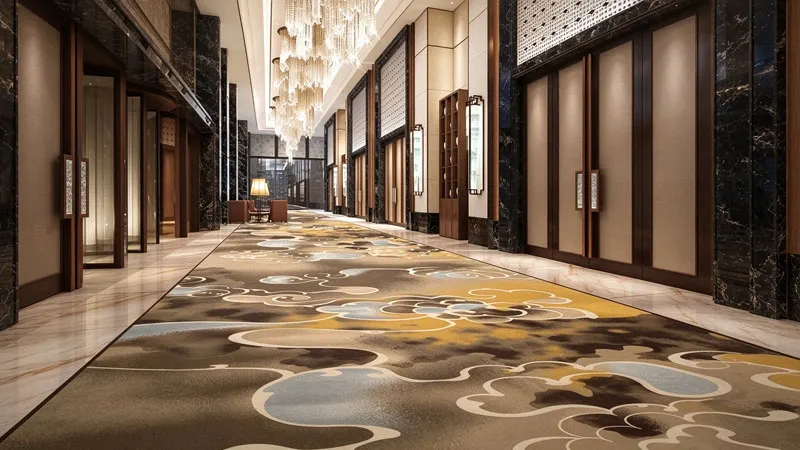
What Are the Best Rugs for Hotel Lobbies and Corridors?
For most projects, specify an 80% wool, 20% nylon Axminster broadloom. It runs continuously down a corridor, locks a woven pattern into the pile, and meets the fire and wear thresholds hotel brands ask for. Hand-tufted wool comes second. Use it where the design needs a custom shape, a logo or a thicker feature zone.
Terms matter here. Buyers write “rugs” when they often mean wall-to-wall carpet. A rug is a finished piece with its own edges. Broadloom is cut to the floor plan. Corridors need broadloom. Lobbies usually need both: broadloom for the field, tufted rugs for seating groups and the reception approach. Put the difference in your spec so every bidder prices the same scope.
Lobby vs. Corridor: Two Different Wear Problems
Lobbies carry point loads: luggage wheels, bell carts, and hundreds of guests crossing the same line to the elevators. Wear concentrates in a narrow path.
Corridors carry steady linear flow plus housekeeping carts and room-service trays. Pattern alignment matters more there, because the eye follows the full length.
Entrances are the exception. Grit from outside wears pile faster than footsteps do. Fit walk-off matting at every door and plan an earlier replacement cycle for the first few metres of lobby floor.
How Do You Specify “High Traffic” in a Hotel Carpet?
Words like “durable” and “plush” cannot be tested. Numbers can.
Pile Weight, Pile Height and Density
Pile weight is the mass of yarn in each square metre. More yarn means more material to wear through. Our Axminster range runs 1,225–2,493 g/m² (36.1–72.6 oz/yd²) of pile. Effective pile height is 7.0–12.0 mm and total thickness is 9–14 mm. Pitch is 7 with 9–12 rows, and the pile density index is 4,344–6,263.
Try this check on any quote: divide pile weight by pile height. Two carpets of the same height can carry very different amounts of yarn. A supplier who will not state pile weight is a risk.
Lab Tests to Put in the Spec
These are the thresholds our 80/20 Axminster is built to:
| Test | Threshold | What it tells you |
|---|---|---|
| WIRA abrasion | More than 12,000 rubs to end point | Surface wear life |
| Hexapod | Min Class 3 after 12,000 turns | Appearance retention under castors |
| Static loading | 85% recovery after 24 hours | Recovery from furniture dents |
| Dynamic loading | Under 15% thickness loss after 1,000 impacts | Pile crush under repeated load |
| Tuft binding | More than 10 N | Resistance to pile pull-out |
| Fibre integrity | Under 42.5 mg loss per 1,000 cycles | Fibre shedding |
| Light fastness | Class 5 (ISO 105-B02) | Fade resistance near glazing |
| Dry rubbing | Min Class 4 (ISO 105-X12) | Colour transfer |
| Static resistance | Under 3.5 kV | Guest comfort at door handles |
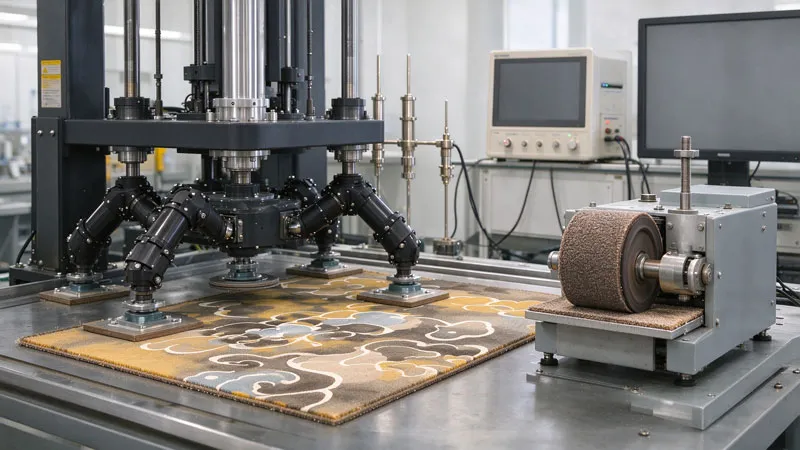
Our Traffic Rating, Stated Plainly
The 80/20 Axminster is classified Medium Heavy Traffic for Commercial use. That is the right band for hotel corridors and lobbies. Choose the upper pile-weight range for lobby routes and elevator halls. Choose the middle range for guest corridors. We rate carpet as tested, and the lab report should match the product you receive.
Axminster vs. Hand-Tufted vs. Hand-Knotted: Which Fits Which Zone?
| Construction | Fibre | Best for | Limit |
|---|---|---|---|
| Axminster | 80% wool, 20% nylon 6.6 | Corridors, lobby fields, guest rooms, foyers | Pattern repeats follow loom width |
| Hand-tufted | 100% wool, or wool with bamboo silk | Logos, custom shapes, suites, lounges | Lower volume capacity |
| Hand-knotted | Wool, silk by project | One statement piece | Timelines are project-specific |
| Machine and hand-made | Wool-based, by project | Detailed relief and edging at moderate volume | Scope agreed at sampling |
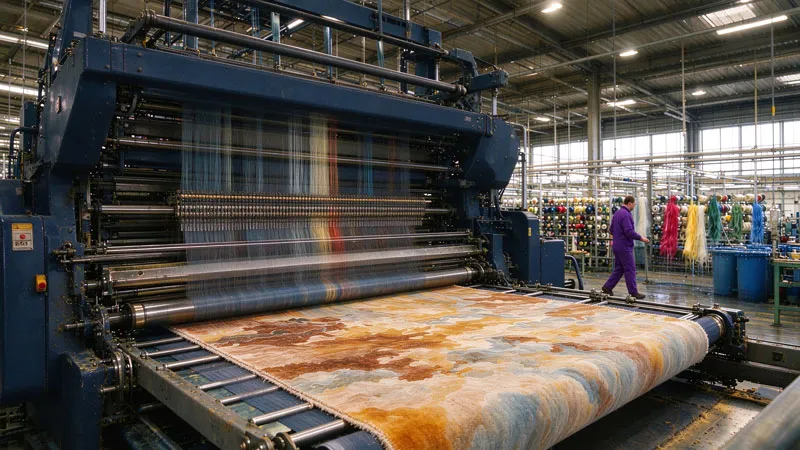
Our Axminster is woven on Van De Wiele high-speed gripper looms. Skein dyeing colours the yarn before weaving, with Huntsman dyestuff, so colour runs evenly through the full yarn. Backing is polypropylene weft with a cotton-polyester chain. A BASF SBR latex of about 360 g/m² resists fraying at cut edges, and Mystox CMP provides moth-proofing. See our Axminster carpet range for hotels.
Hand-tufted carpet is a different build. Total weight is 3,970–5,200 g/m², pile height 8–13.5 mm, with a cotton-polyester primary backing, a leno-weave secondary and Celanese VAE latex. Browse the custom hand-tufted hotel rugs for shape and logo work.
Capacity decides what is realistic. Annual output is 1.8 million m² of Axminster, 100,000 m² of machine-and-hand-made carpet and 36,000 m² of hand-tufted carpet. Match your volume to the right process.
Which Fire and Compliance Documents Should Specifiers Request?
Wool is often called naturally flame resistant. That claim is not a compliance document. Approval needs a test report for the exact construction you will install.
| Market | Typical requirement | Our evidence |
|---|---|---|
| North America | ASTM E648 Class I, CRI Green Label Plus | Class I; GLP9123 and GLP5308 |
| EU | EN 14041 (CE), EN 13501-1 | CE; Bfl-s1 |
| UK | UKCA / UKMCA | UKCA / UKMCA |
| Marine and cruise | IMO MED | MED Wheelmark |
| Management systems | ISO 9001, 14001, 45001 | All three |
Class I under ASTM E648 critical radiant flux testing measures how far flame spreads across a floor covering. Our Axminster also reports BS 4790 (hot metal nut), BS 6307 (methenamine tablet) and smoke density DM under 327.
CRI Green Label Plus covers indoor air emissions. Many green building programs accept it as evidence, so check your project’s credit wording. The local fire authority always makes the final call.
How Do You Control Noise in Hotel Corridors?
Three ratings get mixed up. NRC measures sound absorption inside a space. STC measures airborne sound blocked between spaces. IIC measures impact noise through a floor.
Carpet helps most with NRC and IIC. Total thickness of 9–14 mm, dense pile and a quality underlay all lower footfall and cart noise outside guest doors. STC depends mainly on the wall and floor assembly.
We do not publish an acoustic number without a test report behind it. Ask your supplier for lab data on the full assembly: carpet plus underlay.
What Drives Hotel Carpet Cost, MOQ and Lead Time?
Price follows six inputs:
- Yarn: wool share and pile weight
- Weaving and dyeing
- Backing and latex
- Custom development: artwork, CAD, strike-offs
- Packing and sea freight
- Installation wastage
Add lifecycle cost. A lighter carpet that matts in three years costs more than a heavier one that lasts ten. At Fab Carpet, design, R&D, production and testing happen in-house. Buying direct removes the trading layer, and one party answers for quality.
MOQ is 50 m², depending on the project. Volume tiers adjust the quote.
Samples take about 7 days. They are free. You cover freight, and we deduct the sample cost from your first order. You can request a free carpet sample.
Production takes 35–60 days, depending on schedule.
Warranty is 5 years. The warranty card lists what is covered and what is not.
Pattern repeats and cutting add waste, so plan an allowance with your installer. Use our carpet area and wastage calculator to estimate order area against MOQ.
What Goes Wrong in Hotel Carpet Projects, and How Do You Prevent It?
| Pitfall | Prevention |
|---|---|
| Bulk differs from the sample | Approve a signed strike-off; compare bulk against it |
| Colour varies between batches | Lock dye recipes; keep retained samples |
| Delivery slips past opening | Confirm production slots in writing |
| Pile weight falls below spec | Put tolerances in the contract (we state ±10%) |
| Fire report does not match the product | Match reports to the exact construction |
| Sea freight dampness | Specify moisture-barrier roll packing |
Supplier Qualification Checklist
- Do they own the factory? Ask for a live video tour.
- Are design, R&D, weaving and testing under one roof?
- Does annual capacity fit your area?
- Can you verify certificate numbers with the issuer?
- Have they delivered similar hotel projects?
- Is the warranty written, with exclusions listed?
Packing, Shipping and Installation: What Should Be Agreed Before Dispatch?
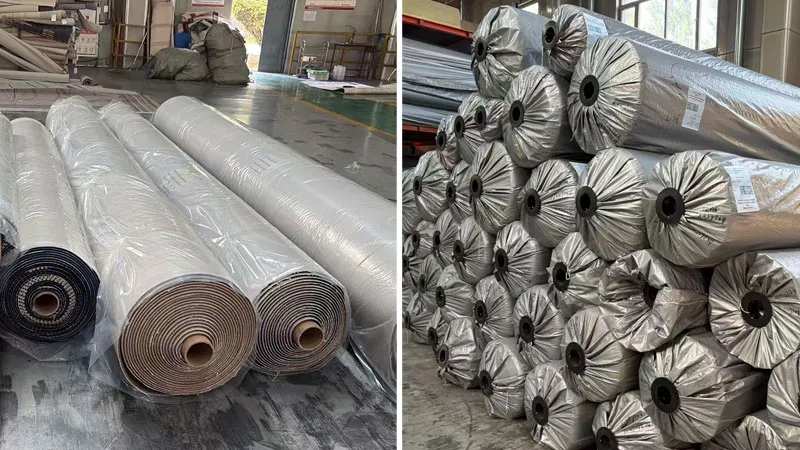
Roll packing protects sea freight. Specify moisture-barrier film and a label on every roll showing roll number, batch, colour and length. Arrange a third-party inspection such as SGS or BV before loading.
On site, check the subfloor for flatness and moisture. Fit underlay, then install rolls in sequence, batch by batch. Keep seams away from door thresholds and match patterns across rolls.
For maintenance, vacuum daily and keep entrance mats clean. Schedule hot-water extraction by traffic level: lobbies more often than guest corridors.
Where Has This Specification Been Delivered?
Three projects with the same 80% wool, 20% nylon Axminster base:
- 5-Star Hotel, Houston, United States: 2,100 m² for hallways, guest rooms and the gym.
- 5-Star Hotel, Singapore Marina: 12,600 m² of Axminster with over-tufting in guest rooms.
- Entertainment Venues, Macao: 24,600 m² of corridors. These are high-traffic commercial spaces, where wear and fire documentation carry the most weight.

FAQ
Who is a reliable custom hotel carpet supplier for lobbies and corridors?
Choose a supplier who owns the factory and can show it on video. Fab Carpet handles design, R&D, production and testing in-house, with capacity of 1.8 million m² of Axminster per year. We hold ISO 9001, 14001 and 45001. Ask any supplier to verify certificates with the issuer.
What are the Axminster carpet specifications for hotel corridors?
Our standard is 80% wool and 20% nylon 6.6, with 1,225–2,493 g/m² pile weight and 7.0–12.0 mm pile height. Total thickness is 9–14 mm, WIRA abrasion exceeds 12,000 rubs, and the traffic class is Medium Heavy Commercial. Full data sheets are available on request.
What certifications and fire ratings should a hotel carpet supplier provide?
Ask for ASTM E648 Class I and CRI Green Label Plus for North America, CE (EN 14041) with EN 13501-1 for the EU, and UKCA for the UK. Marine projects need MED Wheelmark. Ours are Class I, Bfl-s1, GLP9123 and GLP5308.
What are the MOQ and lead time for custom hotel carpet?
MOQ is 50 m², depending on the project. Samples take about 7 days. Production runs 35–60 days, depending on schedule. Share your area and drawings early so we can reserve a production slot.
How is hotel carpet price calculated?
Price depends on pile weight, wool share, dyeing, backing, custom development, packing and freight. We send an itemised engineering quote once we have your area, spec and artwork. Samples are free: you pay freight, and the cost is deducted from your first order.
What installation and warranty terms apply?
Install over a flat, dry subfloor with a suitable underlay, in roll sequence. The 5-year warranty applies under the terms on the warranty card, which lists coverage and exclusions. Share your installation method with us at the quoting stage.
Get Your Lobby and Corridor Specification Reviewed
Send us your floor plan, target market and fire requirements. Our engineers will review your spec, match the right construction to each zone and return an itemised quote.
- Request a free sample (about 7 days)
- Get an engineering quote with MOQ and lead time
- Get the Axminster and hand-tufted spec sheets