Call us now:

Problems with carpets rarely start on site. They start on the specification sheet. A mismatched dye lot, a missing fire certificate or a late container can delay a hotel opening and wreck the flooring budget. This guide shows architects, designers and procurement teams how commercial carpets fail, which specifications prevent each failure, and what to verify before paying a deposit. Each section gives you the symptom, the root cause and a fix you can write into the contract. Use the checklist at the end to audit your next quote before you commit.
Why Do Problems with Carpets Appear After Handover?
Commercial carpet fails differently from residential carpet. A hotel corridor sees hundreds of footsteps a day, rolling luggage, cleaning machines and strong light. A grade that survives ten years in a living room can look tired in ten months here.
Three points to take away:
- Most failures trace to the specification, not to cleaning.
- Low quotes usually hide lower pile weight, thinner backing or missing test reports.
- Problems appear 3 to 12 months after handover, when the warranty argument is hardest.
7 Common Problems with Carpets in Hotels and Commercial Spaces
1. Matting and Appearance Loss
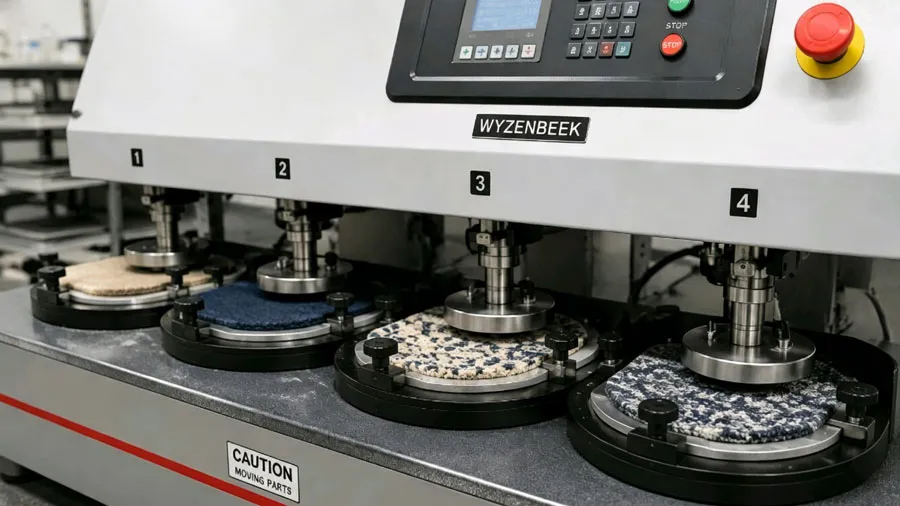
Cause: Pile fibres lose twist and crush under traffic. Low pile density makes it worse.
Fix: Specify minimum pile weight and density per zone, not just “heavy contract.” Choose resilient fibre (wool or nylon 6.6) for corridors and lobbies. Ask for simulated wear test results on the exact construction.
2. Pile Reversal and Shading
Cause: Cut pile tufts lean in different directions, so light reflects unevenly. It shows as dark and light patches. Soft, short-twist velvet cuts are the usual victims.
Fix: Pick a tighter twist, a loop construction or a woven Axminster with a firm structure. Require pile direction to run the same way on every roll during installation.
3. Delamination and Backing Failure
Cause: Layers separate when latex adhesion is weak or moisture gets in. You see bubbles in walkways and lifting at seams.
Fix: Ask for delamination strength data. Consider woven Axminster, where the pile is woven into the backing, over secondary-backed tufted product in wet-prone areas.
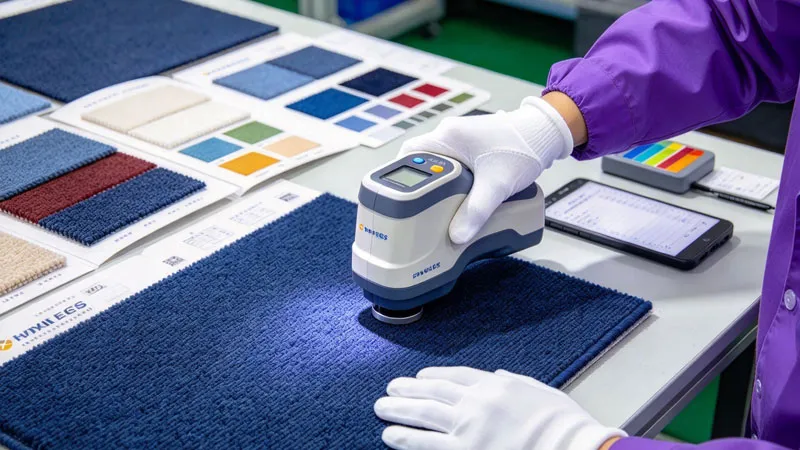
4. Dye-Lot Mismatch
Cause: Carpet is dyed in batches. Even with the same recipe, shade can drift between lots. It becomes a problem when you reorder or phase a project.
Fix: Order the whole project in one production run. Keep a small reserve from the same lot for repairs. Approve a signed lot sample before bulk.
5. Rippling and Buckling
Cause: Weak stretching, the wrong underlay, humidity or a damp subfloor.
Fix: Specify power stretching, a compatible underlay and a moisture-tested subfloor. A knee kicker handles a small edge ripple. It does not fix a room.
6. Fading and Staining
Cause: UV light bleaches dyes near glazing. Spills in high-traffic Entertainment Venues penetrate untreated fibre.
Fix: Choose solution-dyed fibre or a lightfast dye system for sun-exposed zones. Use darker, patterned designs in food-and-beverage areas and write a stain response routine for housekeeping.
7. Noise Complaints
Cause: Hard fibre, thin construction or no underlay. Carpet mainly improves impact sound, so judge it by IIC or ΔLw, and by NRC (ASTM C423) for room absorption.
Fix: Treat carpet and underlay as one system. Check that a thicker underlay does not raise the buckling risk.
Which Fibre and Construction Reduce Carpet Failures?
Fibre decides wear, feel and fire behaviour. Construction decides stability and design freedom.
| Fibre | Strength | Watch-out | Typical use |
|---|---|---|---|
| Premium New Zealand Wool | Resilience, natural flame resistance, soft feel | Needs lightfast dye planning near glazing | Guest rooms, corridors, ballrooms |
| Solution-dyed nylon 6.6 | Wear and colourfastness | Higher cost than polypropylene | High-traffic Commercial Spaces |
| Polypropylene | Stain and moisture behaviour | Lower resilience | Budget-driven, lower-traffic areas |
| Polyester (PET) | Colour richness, cost | Can crush under heavy traffic | Feature or low-traffic zones |
Construction choice also changes the risk profile:
- Axminster: woven, with strong pattern flexibility. A reliable choice for corridors and ballrooms.
- Hand tufted: design freedom for feature areas and VIP zones.
- Hand knotted: maximum longevity for luxury applications.
- Machine & hand-made: hand-finished detail at project volume.
Fab Carpet runs all four constructions. Annual capacity is 1,800,000 sqm for Axminster, 36,000 sqm for hand tufted and 100,000 sqm for machine & hand-made. That capacity matters when your schedule cannot absorb a queue.
Axminster carpet manufacturing capabilities
Pile Weight, Height and Density: The Formula That Prevents Matting
Two quotes can look identical on price and differ sharply in density. Density tells you how much yarn supports the surface.
- Imperial: Density = (pile weight in oz/yd² × 36) ÷ pile height in inches
- Metric: Density (kg/m³) ≈ pile weight (g/m²) ÷ pile height (mm)
Worked example. Quote A is 30 oz/yd² at 0.40 in pile height: (30 × 36) ÷ 0.40 = 2,700. Quote B is 24 oz/yd² at the same height: (24 × 36) ÷ 0.40 = 2,160. Quote B costs less because it holds 20% less yarn. In a corridor, that gap shows up as matting.
Write minimum pile weight, pile height and density into the contract for each zone. Fab Carpet’s technical team supplies recommended ranges per zone with each quote, based on factory test data and delivered projects.
What Certifications and Tests Should Procurement Demand?
Certificates answer specific risks. Match each one to your market.
| Certification | Market | What it proves |
|---|---|---|
| CRI Green Label Plus (GLP9123, GLP5308) | North America | Low VOC emissions for indoor air quality |
| ASTM E648, Class I | North America | Top flooring radiant panel fire classification |
| EN 14041 (CE) | EU | Conformity for textile floor coverings |
| Bfl-s1 (EN 13501-1) | EU | Fire and smoke performance |
| UKCA / UKMCA | UK | UK market conformity |
| MED Wheelmark (IMO standard) | Marine and cruise | Marine equipment approval |
| ISO 9001 / 14001 / 45001 | Global | Quality, environmental and safety systems |
Fab Carpet also holds the AAAAA Quality Standard.
Check five red flags in any test report: an expired date, a sample that differs from bulk, a non-accredited lab, a missing construction description and a certificate that covers a different product. Verify CRI listings in the public directory before you accept a certificate.
CRI Green Label Plus product directory
How to Source Direct Without Supply-Chain Traps
Each trader, agent or consolidator adds margin and distance. Distance is where specifications get changed, and where nobody owns the problem. Buying direct from the factory removes layers, so the person quoting is the person who controls production.
What a Factory-Direct Quote Should Show
Ask for fibre type and blend, pile weight, pile height, density, backing type, test reports and lot policy on the quote. If any item is missing, the supplier is guessing or hiding it.
MOQ and Sampling
Fab Carpet’s MOQ is 50 sqm, which suits boutique hotels and phased projects. Development samples take about 7 days. Sampling is paid, and the fee is credited in full against the bulk order once you place it. A paid sample means the factory builds to your spec instead of pulling a stock swatch.
Plan the order area before you enter the quote stage. Pattern repeat and room geometry drive cutting waste. The Carpet Calculator gives you a working area estimate to start from.
Lead Time and Shipping
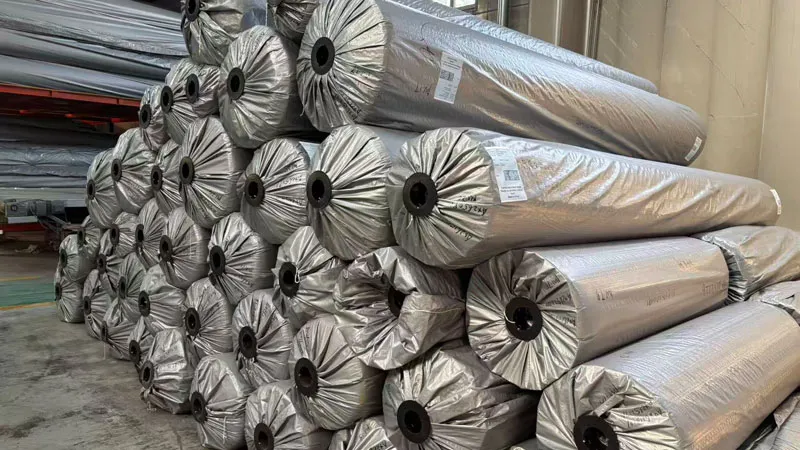
Production runs about 35 days after sample approval. Rolls ship in moisture-proof packaging for sea freight, and roll numbers map to your installation plan so the right lot goes in the right zone.
Third-Party Inspection
Inspect before the balance payment. SGS or BV can check quantity, dimensions, backing, labelling and shade against the signed lot sample. Fab Carpet supports third-party inspection at the factory.
Installation and Maintenance: Where Good Carpet Still Fails
Good carpet still fails on a bad subfloor. Test moisture and flatness before delivery. Match adhesive and underlay to the backing. Power-stretch wall-to-wall areas and follow the pattern layout for Axminster seams. Let rolls acclimatise on site before cutting.
After handover, set a routine: vacuum daily in corridors, spot-treat by stain type and schedule hot water extraction on a fixed cycle. Compare quotes by cost of ownership, not purchase price. A cheaper carpet that needs replacing earlier costs more.
hotel carpet project case studies
Frequently Asked Questions
What is the minimum order quantity, and can I customise size and pattern?
MOQ is 50 sqm. Fab Carpet customises size, colour and pattern across Axminster, hand tufted, hand knotted and machine & hand-made construction. Supply a drawing or design file and the team advises on the best fit.
Which materials and certifications are available?
We work with Premium New Zealand Wool, nylon and polypropylene, according to the project. Certifications include CRI Green Label Plus (GLP9123 and GLP5308), EN 14041 (CE), MED Wheelmark, UKCA / UKMCA, and Class I fire ratings (ASTM E648 and Bfl-s1). Confirm which applies to your product before ordering.
How does the sample policy work?
Samples are paid. The fee is credited in full against your bulk order after you confirm it. We quote the fee per design and construction.
How long do samples take?
About 7 days for development samples, depending on complexity.
What is the bulk lead time?
About 35 days from sample approval and order confirmation. Large or highly complex orders may need a schedule confirmed at quotation.
Which trade terms do you offer?
FOB and CIF are standard. DDP can be quoted for selected destinations. We confirm terms per project.
How is carpet packed for sea freight?
Rolls are wrapped in moisture-proof material and labelled with roll numbers to prevent damage and lot mixing.
What are your payment terms?
50% deposit and 50% balance. The balance is due before shipment, after inspection.
Can I use SGS or BV?
Yes. We support third-party inspection at the factory, and you choose the inspection scope.
What happens if there is a quality problem?
Send photos, roll and lot numbers and installation records. We review the claim against the warranty card. Fab Carpet gives a 5-year warranty. The card lists what is covered and what is not.
Request Your Quote and Samples
Send us your drawings, area and target market. Our team returns a specification review and quote, and you can start a paid development sample in about 7 days.
- Submit your RFQ for factory-direct pricing.
- Request a development sample, credited against your bulk order.