Call us now:

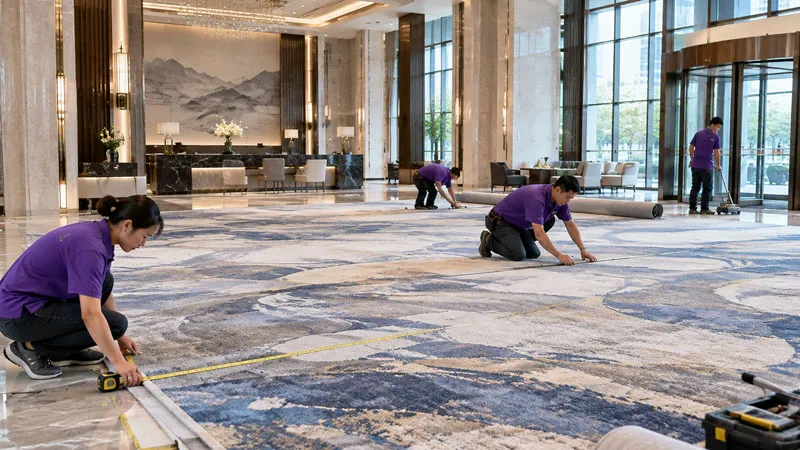
Getting the measurement wrong on a commercial carpet order does not mean a trip back to the store. It means a delayed opening, a fire-rating mismatch, or a shipment that sits in customs while your project timeline burns. So how do you measure for carpet when the stakes are a 200-room hotel instead of a living room? This guide breaks down the process the way factories and procurement teams actually run it — with the wastage rates, compliance checkpoints, and sourcing pitfalls that residential guides skip.
Why Commercial Carpet Measurement Works Differently Than Residential
A homeowner measuring a bedroom can round up, add 10%, and move on. A commercial project cannot. Fire-rating requirements, batch-dye consistency, and multi-floor logistics turn a simple area calculation into a coordination problem between architect, general contractor, and supplier.
The Real Cost of a 1% Measurement Error at Scale
On a 200-room property, a 1% shortfall in carpet yardage can mean re-ordering an entire production run — and waiting through a second lead time while rooms sit unfinished. Overage rates that work fine for a den floor can quietly cost thousands of dollars once you multiply them across a full renovation schedule.
| Factor | Residential Project | Commercial Project |
|---|---|---|
| Standard overage | 5–10% flat | Varies by construction method (see below) |
| Acceptance tolerance | Visual only | Documented spec sheet + batch records |
| Fire rating | Rarely required | Often mandatory (Class I) |
| Color/dye lot consistency | Not a concern | Must match across floors and phases |
| Responsibility for accuracy | Homeowner or installer | Split across architect, GC, and supplier |
Who Actually Owns the Measurement?
This is where most projects lose money. Architects hand off square footage from CAD drawings. Contractors assume the supplier will verify on-site. Suppliers assume the numbers they received are final. Nobody re-checks until the carpet arrives short. Set ownership in writing before production starts — ideally the supplier confirms final dimensions after framing and before cutting.
How Do You Measure for Carpet Accurately in Commercial Spaces
Standard Formula for Rectangular Rooms
The base math has not changed: length × width = area. For commercial projects, run this in three units simultaneously — square feet, square yards, and square meters — since North American teams and European suppliers rarely use the same standard.
Square yards = (length ft × width ft) ÷ 9
Square meters = square feet × 0.0929
Calculating Irregular Layouts and Curved Areas
Break the space into rectangles, triangles, and arcs, then sum the parts. For curved walls, measure the chord width and the depth of the arc, then apply the standard segment-area formula. On multi-room projects, build a simple takeoff spreadsheet — one row per space, columns for shape type, raw area, and applied wastage — rather than calculating room by room from memory.
Measuring Corridors, Stairs, and High-Traffic Commercial Spaces
Corridors and connecting areas in hotels, conference centers, and high-traffic commercial spaces wear differently than guest rooms. Measure these zones separately and apply a higher wastage allowance — foot traffic patterns here justify it, and it prevents a mid-project shortfall in the areas guests see the most.
Wastage Rates by Construction Method — What Factories Actually See
Generic advice says “add 10%.” Production data tells a different story. Fab Carpet’s manufacturing line data across hundreds of commercial orders shows wastage varies significantly by construction method:
| Construction Method | Typical Wastage Range | Why |
|---|---|---|
| Machine-Made Loop/Cut Pile | 5–7% | Wide rolls, minimal pattern matching |
| Axminster | 8–12% | Pattern repeat and border alignment |
| Hand Tufted | 10–15% | Custom shapes, seaming for large-format designs |
| Hand Knotted | 12–18% | Handwork tolerances, bespoke sizing |
Use these ranges when building your budget, not a flat industry average — they will change your final cost more than any other single variable.
Interactive Tool: Calculate your exact area and estimated wastage with our Carpet Calculator
Commercial carpet wastage rate breakdown by material
How Material and Construction Affect Your Measurement Plan
Wool Density and Pile Height Change Your Yield
Premium New Zealand Wool holds pile height and density more consistently through repeated cutting and seaming than blended fibers, which reduces the shape distortion that drives up waste on complex layouts. Density and pile height should be locked into the spec sheet before final measurements are cut into production orders — not adjusted afterward.
Axminster, Hand Tufted, and Hand Knotted Require Different Math
Axminster carpet is woven to a fixed pattern repeat, so room dimensions need to align with that repeat or you pay for extra length to keep borders matching. Hand tufted and hand knotted pieces are cut to custom shape, which gives more flexibility on odd layouts but requires tighter coordination between the designer’s drawing and the factory’s cutting plan.
| Method | Pattern Repeat | Standard Width | Seam Requirement | Typical Lead Time |
|---|---|---|---|---|
| Axminster | Fixed | Up to 4m | Border alignment critical | 8–12 weeks |
| Hand Tufted | Custom | N/A (made to shape) | Minimal, edge-bound | 6–10 weeks |
| Hand Knotted | Custom | N/A (made to shape) | None, single piece | 10–16 weeks |
Compliance Standards That Belong on Your Spec Sheet
Fire Rating: Why Class I Changes Your Layout Plan
Fire rating is not a checkbox — it dictates where certain carpets can go. Corridors, stairwells, and egress paths in hospitality projects typically require Class I performance under ASTM E648, or Bfl-s1 under the European classification. Fab Carpet’s product line is tested to Class I (ASTM E648 / Bfl-s1) as standard, which removes one variable from the compliance conversation before the spec sheet is even finalized.
Indoor Air Quality: CRI Green Label Plus
For LEED-tracked projects, the certificate number matters as much as the certification itself. Ask suppliers for the specific CRI Green Label Plus registration (GLP9123 / GLP5308 series), not a general claim of compliance.
Cross-Border Requirements: EN 14041, UKCA/UKMCA, and Marine Standards
European projects require EN 14041 (CE marking) for flooring, plus UKCA/UKMCA documentation post-Brexit. Marine and cruise projects add another layer: MED Wheelmark certification under IMO marine standards. Confirm which certifications apply before finalizing dimensions — a marine-rated carpet often ships in different roll widths than a standard hospitality product.
Supplier Vetting: Where Procurement Teams Lose Margin
Factory-Direct vs. Middleman — Where the 20–30% Goes
A trading company or local distributor adds a markup layer between the factory and your project — typically 20–30% before the carpet even ships. Sourcing directly from a manufacturing base like Fab Carpet’s Qinghai production facility removes that layer. The savings come from cutting the intermediary, not from cutting material quality.
A Short Supplier Qualification Checklist
- Ask for ISO 9001 (quality), ISO 14001 (environmental), and ISO 45001 (safety) certificates — not just a claim of “ISO certified”
- Request dye-lot consistency records across at least three prior production runs
- Confirm sample turnaround time in writing before signing an RFQ
- Ask how QC checkpoints are documented during production, not only at final inspection
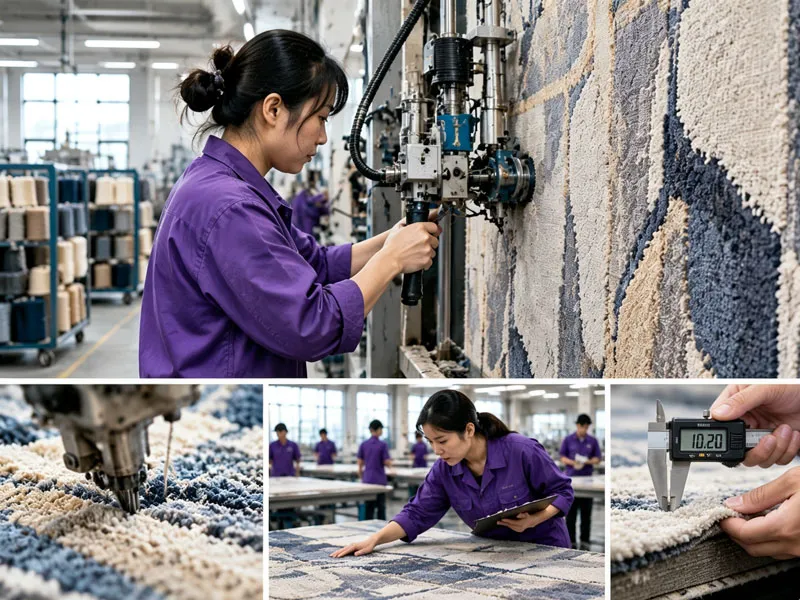
Fab Carpet runs its internal QC under an AAAAA quality standard, checking pile density, backing adhesion, and colorfastness at multiple stages rather than a single pass at the end of the line.
| Sourcing Route | Typical Markup | Lead Time Control | QC Transparency |
|---|---|---|---|
| Factory-Direct | Baseline | High — direct production visibility | Full batch records available |
| Trading Company | +15–20% | Moderate — relies on factory relay | Limited, often summarized |
| Local Distributor | +20–30% | Low — stock-dependent | Minimal, post-delivery only |
MOQ, Tiered Pricing, and Why Accurate Measurement Matters Here
Precise area calculations at the RFQ stage give you real leverage on tiered pricing and let the factory plan dye lots in one run — avoiding the color variance that shows up when a shortfall forces a second, separate production batch.
From Measurement to Installation: Keeping Data and Delivery Aligned
Turning Your Numbers Into a Production-Ready Spec Sheet
Your final measurement should translate directly into a document the factory can cut against: total area by room type, pattern direction, dye-lot grouping, and packaging dimensions for the container. Skipping this step is how “correct” measurements still produce a mismatched shipment.
Re-Verify On-Site Before Final Cutting
Framing shifts. Walls move a few inches during construction more often than architects would like. Build in a site re-verification pass after rough construction and before the factory cuts final production — this single step prevents most late-stage shortfalls on multi-phase projects.
Common Mistakes That Cost Commercial Projects Time and Money
- Applying a flat wastage percentage instead of one specific to the construction method
- Ordering fire-rated carpet for guest rooms but standard-grade for corridors that actually require Class I
- Splitting an order across two production runs without locking the dye lot first
- Measuring against architectural drawings only, with no on-site re-check before cutting
- Ignoring container dimensions (20GP/40HQ) when planning delivery against an installation deadline

FAQ: Commercial Carpet Measurement and Sourcing
What is the minimum order quantity (MOQ) for OEM/ODM commercial carpet?
MOQ depends on construction method — machine-made typically starts lower than hand-knotted, which requires a minimum run to justify setup. Confirm MOQ against your measured area before finalizing budget.
How long does it take to receive sample swatches?
Standard stock samples ship within a few business days. Custom color-matched or pattern samples typically take one to two weeks, since they run through the same dye process as production.
What is the typical sea freight lead time for a hotel-scale order?
Ocean freight adds four to six weeks on top of production lead time, depending on origin port and destination customs processing.
Can I get a copy of the fire rating test report before ordering?
Yes — request the ASTM E648 or Bfl-s1 test report directly from the supplier, not a summary certificate, before finalizing specifications.
Does pattern repeat affect how much carpet I need to order?
Yes, significantly for Axminster and other patterned constructions — align room dimensions with the pattern repeat early, or budget extra length for border matching.
How do I verify a CRI Green Label Plus certificate is current?
Cross-check the registration number directly against the CRI directory rather than relying on a supplier’s printed certificate alone.
Get Your Project Measured Right the First Time
Accurate measurement is the starting point, not the finish line. What happens after — spec sheet accuracy, dye-lot control, compliance documentation — determines whether your project stays on schedule.
Request free sample swatches, submit an RFQ for your project dimensions, or download the technical data sheet (TDS) for fire-rating and certification records before you finalize your order.