Call us now:

Specifying woven carpet for a hotel or commercial project comes with three real risks: a fire rating that fails inspection, a supplier who misses the install date, or a budget that blows past approval. This guide gives architects and procurement teams the specs, standards, and sourcing logic to avoid all three.
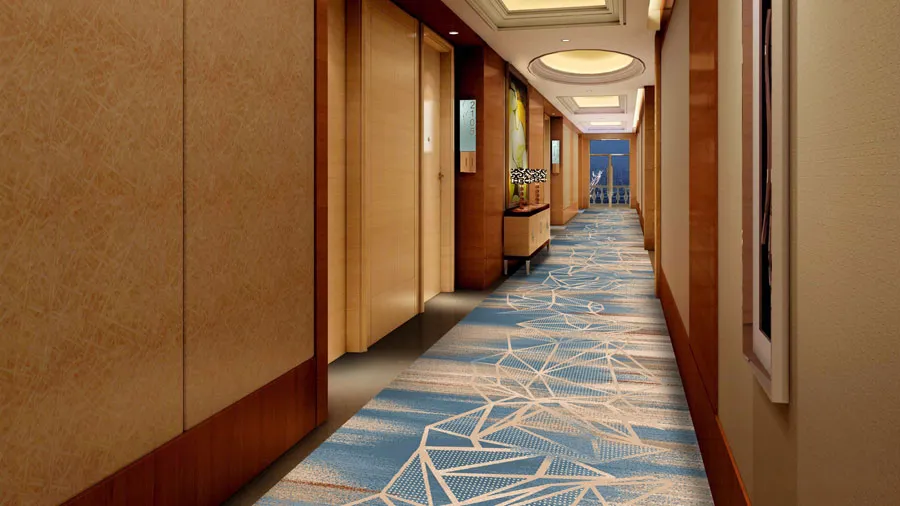
What Is Woven Carpet? An Engineering Definition Beyond the Marketing Language
Woven carpet is made on a loom. The face yarn and the backing yarn interlock during production, not after it. That single fact drives almost every performance advantage buyers care about: tear resistance, edge stability, and a pile that holds its shape under repeated rolling loads.
Woven vs Tufted Construction: The Structural Difference That Actually Affects Commercial Performance
Tufted carpet pushes yarn into a pre-made backing, then glues a second backing on top to lock it in. Under light foot traffic in a home, that holds up fine. Under a housekeeping cart running the same corridor forty times a day, the glue bond is the first thing to fail. Woven construction has no glue layer to fail — the yarn is structurally part of the backing. That’s why nearly every 5-star hotel corridor and casino-adjacent lobby (what we refer to here as High-Traffic Entertainment Areas, per commercial real estate terminology standards) still specifies woven carpet after decades of tufted alternatives entering the market.
Axminster vs Wilton vs Hand-Tufted vs Hand-Knotted: Matching Construction Method to Project Type
Each method solves a different design problem:
- Axminster — individual tufts inserted per color, so pattern and color count are nearly unlimited. Best for branded lobby logos, custom geometric corridors, ballroom medallions.
- Wilton — continuous yarn woven through, cut or looped. Fewer colors, but tighter density and a more uniform surface. Best for guest room corridors and suites.
- Hand-Tufted / Hand-Knotted — built for feature areas: reception desks, VIP suites, boutique properties wanting a one-off centerpiece.
- Machine-made — for large, repeatable runs across multi-property chains needing consistent stock.
At Fab Carpet’s Qinghai production facility, all four methods run under one roof, which matters when a single project needs Axminster for the lobby and machine-woven for 300 identical guest room corridors — one supplier, one QC standard, no coordination gap between vendors.
Explore Axminster carpet manufacturing capabilities
The Physics of Performance: Pile Weight, Density & Durability Formulas
Pile Weight, Pile Height & Density — The Formula Procurement Teams Should Actually Request
Density is what determines whether a carpet crushes flat in six months or holds its pile for a decade. The formula is simple:
Density = Pile Weight (oz/yd²) ÷ Pile Height (inches)
A carpet with the same pile weight but shorter pile height scores higher density — and higher density resists crushing under rolling loads. Ask any supplier for this number directly. If they can’t produce it, they haven’t tested the product.
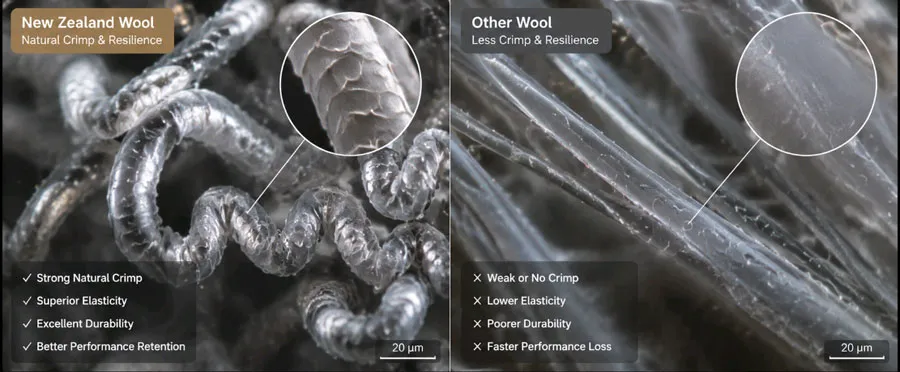
Premium New Zealand Wool vs Synthetic Fiber: Physical Performance Comparison
| Fiber Type | Resilience | Stain Resistance | Natural Flame Resistance | Acoustic Absorption | Expected Lifespan |
|---|---|---|---|---|---|
| Premium New Zealand Wool | Excellent | Good (natural) | High (self-extinguishing) | Excellent | 15–20 years |
| Wool-Nylon Blend | Very Good | Very Good | Moderate | Very Good | 12–15 years |
| 100% Nylon | Good | Excellent | Low (requires treatment) | Good | 8–12 years |
Wool’s crimped fiber structure is naturally flame-resistant — it chars rather than melts, and it self-extinguishes when the flame source is removed. That’s a physical property, not a coating, and it’s one reason wool-based woven carpet dominates hospitality specifications where fire code review is strict.
Fab Carpet grades incoming wool against an internal AAAAA Quality Standard, checking fiber length, crimp, and cleanliness before a single yard reaches the loom. Buyers rarely see this stage — it happens before the RFQ is even quoted.
Compliance Is Not Optional: International Certification Standards for Commercial Woven Carpet
Fire Safety Ratings Explained — ASTM E648 / EN 13501 (Bfl-s1): What “Class I” Actually Means
ASTM E648 measures critical radiant flux — how much heat it takes to spread a flame across the carpet surface. A Class I rating means the carpet requires a high radiant flux to ignite, the standard threshold for corridors and means-of-egress in commercial buildings. In Europe, the equivalent classification is Bfl-s1 under EN 13501 — low flame spread, low smoke production. Ask for the test report, not the marketing claim. A real report names the testing lab, the sample batch, and the test date.
ASTM E648 flooring radiant panel test standard
IMO MED Wheelmark — Why Marine, Cruise & Select Hospitality Projects Require Dual Certification
Cruise ship interiors and marine-adjacent commercial builds require the IMO MED Wheelmark, a certification separate from and stricter than standard building fire codes. It tests smoke toxicity and flame spread under maritime safety conditions. Very few carpet factories hold this alongside standard building certifications — Fab Carpet carries MED Wheelmark certification in addition to ASTM E648/Bfl-s1, which matters for developers running mixed marine and land-based hospitality portfolios.
CRI Green Label Plus & EN 14041 (CE Marking) — Indoor Air Quality and EU Market Access
CRI Green Label Plus (GLP9123 / GLP5308) tests VOC emissions — relevant for any project targeting LEED or WELL certification. EN 14041 with CE marking is the mandatory conformity mark for flooring sold into the EU market. Without it, customs can hold a shipment at the border.
CRI Green Label Plus certified product directory
UKCA/UKMCA & ISO 9001/14001/45001 — What These Certifications Actually Verify
Product certifications test the carpet. ISO 9001 (quality management), ISO 14001 (environmental management), and ISO 45001 (occupational health and safety) certify the factory — its processes, not just its output. A factory can produce one certified sample batch without holding ISO certification at all. Ask for both.
[Downloadable Resource: Download Free B2B Carpet Procurement Checklist PDF] — covers every certification code above, what it tests, and a document-request template to attach directly to your RFQ.
Acoustic & High-Traffic Performance: Data Retail Suppliers Rarely Provide
NRC & STC Ratings — How Woven Carpet Reduces Noise in Corridors and High-Traffic Commercial Areas
Woven carpet with a dense wool pile typically achieves an NRC (Noise Reduction Coefficient) between 0.25 and 0.40 — meaningfully higher than hard flooring, and directly relevant in guest corridors, conference floors, and High-Traffic Entertainment Areas where sound transfer between rooms is a design concern.
Martindale & Wyzenbeek Abrasion Testing — Decoding Wear Ratings
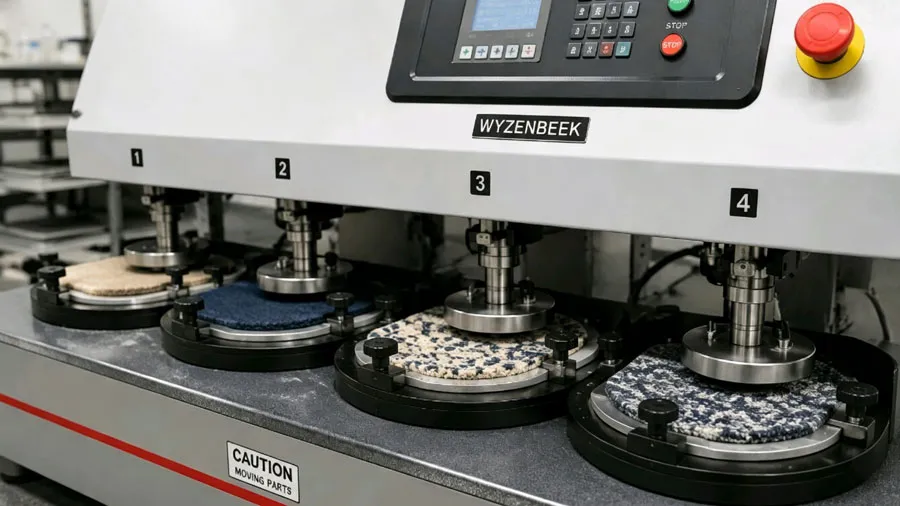
Martindale testing (used in Europe) and Wyzenbeek testing (used in North America) rub a carpet sample against an abrasive surface until visible wear appears. Commercial-grade woven carpet should test above 30,000 double rubs on Wyzenbeek for corridor-level traffic. Below that, expect visible wear paths within two years in a busy hotel.
Maintenance Cost Over a 10-Year Lifecycle — Woven vs Tufted in Real Hospitality Operations
A tufted carpet at a lower unit price often needs full replacement every 5–7 years in high-traffic corridors. A dense woven wool carpet, properly maintained, routinely runs 15+ years in the same location. Run the ten-year math before comparing unit prices — the cheaper carpet on day one is frequently the more expensive carpet by year seven.
Custom Woven Carpet for Hospitality Projects: From Design to Delivery
Bespoke Pattern & Logo Weaving — How Axminster Enables Brand-Specific Design at Scale
Axminster’s tuft-by-tuft insertion means a hotel brand logo, a custom geometric pattern, or a client’s exact Pantone palette can be woven directly into the pile — not printed on top, where it wears off. Color count is limited only by design complexity, not by the loom.
Color Matching, Sampling & Approval Workflow: What to Expect From a Source Factory
A proper process runs in four steps: Pantone/TPX color match, a physical strike-off sample sent for on-site approval, adjustment if needed, then bulk production. Skip the physical sample stage and you’re approving a screen color, not a fiber color — the two rarely match under hotel lighting.
MOQ, Tiered Pricing & Lead Time — Understanding the Real Cost Structure
MOQ and price scale with three variables: yarn type, pattern complexity, and construction method. A single-color Wilton run has a lower MOQ and shorter lead time than a 12-color custom Axminster medallion. Ask your supplier to break down pricing against these three variables specifically — a single flat “per square meter” quote hides where the real cost is coming from.
Sourcing factory-direct — as with Fab Carpet’s Qinghai facility — typically removes one to two intermediary layers from a trading-company supply chain, saving buyers an estimated 20–30% in margin stacking, and keeping lead-time control in one hands, not three.
Request a custom Axminster sample kit
Procurement Risk: How to Avoid Supply Chain Pitfalls When Sourcing Internationally
Supplier Audit Checklist — What to Verify Before Signing
Verify factory ownership directly — not a trading company’s claim of ownership. Ask for original certification documents, not photocopies. Cross-check third-party lab report numbers against the issuing body’s database. Request contactable references from completed projects of similar scale.
Red Flags — Mislabeled Fiber Content, Fake Certifications & Undisclosed Subcontracting
Watch for wool-content claims with no lab report backing them, certificate numbers that don’t resolve in the issuing body’s public directory, and vague answers about which factory physically wove the order. Undisclosed subcontracting is the single biggest cause of quality inconsistency between sample and bulk shipment.
Shipping, Incoterms & On-Site Installation Coordination
Confirm Incoterms (FOB vs CIF) early — it determines who carries risk during transit. Ask specifically how rolls are protected against moisture during ocean freight; humidity damage to wool backing is a common and preventable claim.
[Downloadable Resource: Download Free Supplier Audit & Red-Flag Checklist PDF]
Estimate Your Project Cost and Lead Time
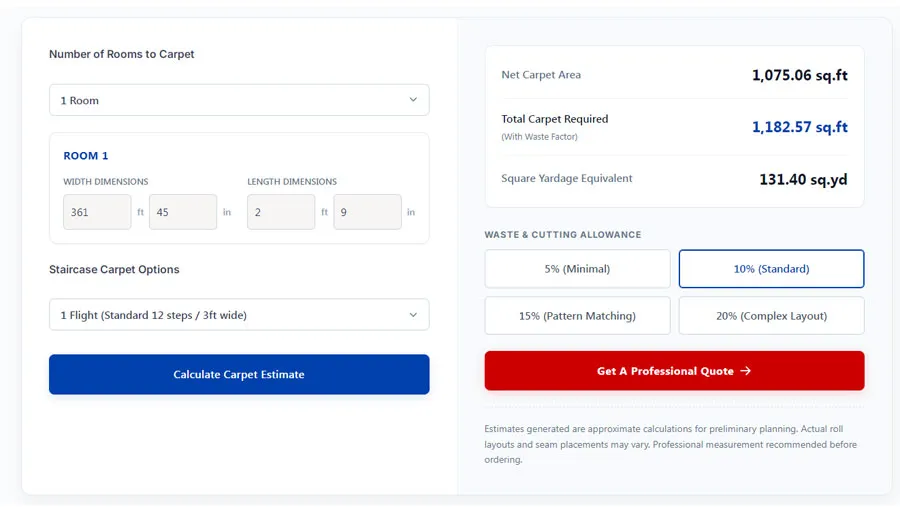
Before submitting a formal RFQ, run your project specs through the Carpet Calculator — enter area, construction method, and fiber type for an instant budget and lead-time range.
Woven Carpet Maintenance & Life-Cycle ROI for Facility Managers
Cleaning Protocols by Fiber Type
Wool requires pH-neutral cleaning solutions — alkaline cleaners strip the fiber’s natural protective coating over time. Synthetic fibers tolerate a wider range of cleaning agents but show soil faster between deep cleans.
Expected Lifespan Under Different Traffic Grades
Light traffic (executive offices): 15–20 years. Moderate (guest rooms): 12–15 years. Heavy (corridors, lobbies): 8–12 years. Extra-heavy (High-Traffic Entertainment Areas): 5–8 years, dependent on density and maintenance frequency.
Calculating Total Cost of Ownership vs Upfront Unit Price
TCO = (Unit Price + Install Cost + Annual Maintenance × Years) ÷ Years
Run this formula against every quote you receive. A carpet priced 15% higher upfront but rated for twice the traffic life almost always wins on TCO.
Woven Carpet Types at a Glance
| Construction | Pattern Complexity | Color Capacity | Achievable Fire Rating | Best-Fit Application | Lead Time | Price Tier |
|---|---|---|---|---|---|---|
| Axminster | Very High | Nearly unlimited | Class I / Bfl-s1 | Lobbies, branded corridors | Longer | Premium |
| Wilton | Moderate | Limited (5–8 colors) | Class I / Bfl-s1 | Guest room corridors | Medium | Mid-High |
| Hand-Tufted | High | Custom per piece | Class I (treated) | Feature rugs, suites | Longest | Premium |
| Machine-made | Moderate | Standard runs | Class I / Bfl-s1 | Multi-property chains | Shortest | Mid |
Compare fire-rated commercial flooring options
Frequently Asked Questions
What fire rating does woven carpet need for a hotel corridor?
Most jurisdictions require Class I under ASTM E648 or Bfl-s1 under EN 13501 for means-of-egress corridors. Confirm with your local fire marshal, as requirements vary by building class.
Is New Zealand wool or a wool-nylon blend better for high-traffic hospitality use?
Pure New Zealand wool offers better resilience and natural flame resistance; a wool-nylon blend offers slightly better stain resistance at a lower cost. The right choice depends on traffic level and budget.
What’s a typical MOQ for custom Axminster carpet?
MOQ varies by pattern complexity and yarn type — request a tiered pricing breakdown from your supplier rather than a single flat MOQ figure.
How long does production and shipping take for a custom hotel carpet order?
Sampling typically runs 2–3 weeks, bulk production 6–10 weeks depending on complexity, plus ocean freight transit time. Confirm total timeline before locking your install date.
Does IMO MED Wheelmark certification matter outside marine projects?
Only if your project has marine, cruise, or maritime-adjacent scope. For standard land-based hospitality, ASTM E648/Bfl-s1 and CRI GLP are the relevant certifications.
What’s the real cost difference between factory-direct and trading-company sourcing?
Factory-direct sourcing typically saves 20–30% by removing intermediary margin layers, while also giving buyers direct visibility into production timelines and QC data.
Next Step: Get Your Project Specified Right the First Time
Submit your project specs for a factory-direct quote, request free sample swatches in your chosen construction and fiber, or download the full Technical Data Sheet (TDS) covering fire ratings, density, and certification documentation for your compliance file.