Call us now:

Nylon carpet pros and cons look different once fire codes, wear ratings, and shipping deadlines enter the picture. A wrong fiber choice on a 300-room hotel order costs far more than a bad swatch pick — it costs re-inspection fees, delayed openings, and contract penalties. This guide breaks down what actually matters for commercial buyers.
What Nylon Carpet Actually Is (And Why the Fiber Type Matters)
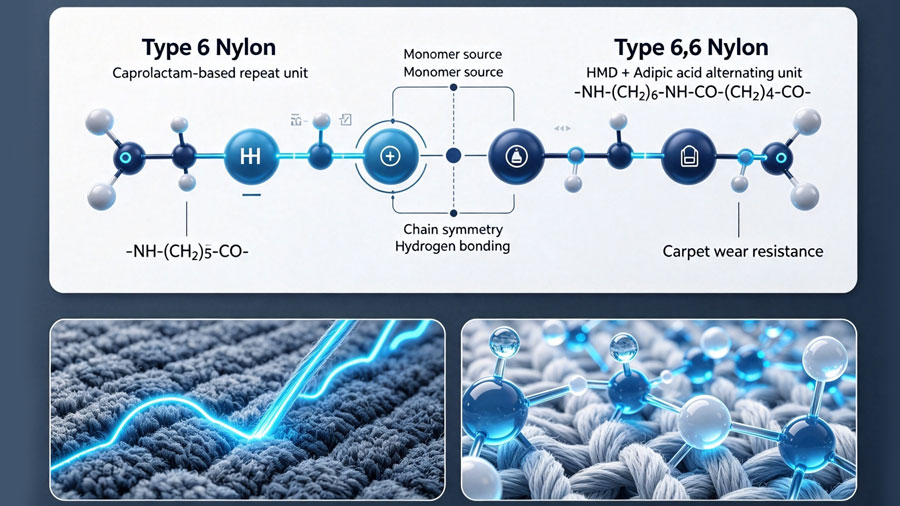
Nylon carpet is a synthetic fiber built from petrochemical polymers, extruded into filament and tufted or woven into pile. Two variants dominate commercial supply: Type 6 and Type 6,6 nylon. Type 6,6 holds a tighter molecular structure, which translates to better resilience under repeated compression — the kind you get in hotel corridors and lobby traffic lanes.
Most B2B buyers never ask which type they’re getting. That’s a mistake. A spec sheet that just says “nylon” tells you almost nothing about how the carpet will perform in year three.
Nylon Carpet Pros: What the Wear Data Actually Shows
Durability Under Sustained Foot Traffic
Nylon ranks well on standard industry wear tests. Under Wyzenbeek abrasion testing, quality commercial-grade nylon commonly holds up past 30,000 double rubs before visible wear — a benchmark relevant for corridors, meeting rooms, and other high-traffic commercial spaces. That resilience comes from the fiber’s ability to spring back after compression, rather than staying flattened.
Stain Resistance in Public-Facing Areas
Solution-dyed and treated nylon resists spills better than most natural fibers. For guest rooms, dining areas, and entertainment venues with heavy foot and beverage traffic, that resistance cuts cleaning labor and extends the interval between deep cleans.
Design Flexibility for Custom Specification
Nylon takes dye and pattern work well, which is why it remains the default fiber for large-volume commercial orders. Buyers can match brand colorways, custom logos, and repeat patterns across hundreds of rooms without losing consistency batch to batch — something that requires tight production control on the manufacturing side.
Nylon Carpet Cons: The Limitations Most Guides Skip
Upfront Cost vs. Lifecycle Cost
Nylon typically costs less per square foot than premium wool at the point of purchase. But total cost of ownership tells a different story once you factor in replacement cycles, cleaning frequency, and disposal at end of life. A lower entry price doesn’t always win over a 10-year hold period.
Static Generation in Dry, HVAC-Controlled Buildings
Nylon generates static more readily than wool or blended fibers, particularly in low-humidity climates or buildings running dry HVAC systems year-round. This matters more in commercial buildings than homes, since occupied hours and traffic volume are higher.
Fire and Smoke Compliance Gaps
This is where most nylon carpet content stops short. Not all nylon products meet the fire rating a given jurisdiction or building type requires. Buyers need to confirm actual test results — not just supplier claims — against ASTM E648 (critical radiant flux) for North America or Bfl-s1 under EN 13501-1 for the EU and UK. Fab Carpet runs Class I fire-rated product (ASTM E648 / Bfl-s1) as standard across its commercial line, with test reports available per production batch — because a verbal assurance doesn’t clear a fire marshal’s desk.
Commercial-Grade Metrics Buyers Should Check Before Signing Off
Face weight and density determine how a carpet actually performs, not the fiber name alone. The formula procurement teams should ask suppliers to walk through:
Density = (Face Weight × 36) ÷ Pile Height
A higher density figure generally means better crush resistance in high-traffic zones. Ask for this number on the spec sheet, not just face weight in isolation — a heavy face weight with excessive pile height can still test poorly under load.
Interactive Tool: Calculate your project’s carpet density and estimated material needs
Nylon vs. Premium Wool for Hospitality Projects
For guest-facing areas — lobbies, ballrooms, executive corridors — many hospitality developers now specify premium wool over nylon, despite the higher unit cost. Wool carries natural flame resistance, stronger acoustic dampening (relevant for NRC/STC targets in guest corridors), and a softer underfoot feel that guests notice immediately.
Fab Carpet works primarily in Premium New Zealand Wool, produced through Axminster weaving, hand-tufted, and hand-knotted construction depending on project specification. These methods support custom pattern work at a level synthetic tufting can’t match — relevant for branded hotel groups replicating a signature carpet design across a portfolio of properties.
| Metric | Nylon | Premium NZ Wool |
|---|---|---|
| Wear resistance (traffic zones) | Strong | Strong, with natural resilience |
| Fire performance | Requires verified treatment | Naturally flame-resistant |
| Acoustic dampening | Moderate | Higher (denser fiber structure) |
| Underfoot feel | Firm | Soft, higher perceived quality |
| Biodegradability | No | Yes |
Compliance Checklist for International Commercial Buyers
Certification requirements shift by region and project type. Before issuing a purchase order, confirm the supplier holds documentation for:
- CRI Green Label Plus (GLP9123 / GLP5308) — indoor air quality standard referenced across US commercial specs. [verify certification status]
- EN 14041 (CE Marking) — required for flooring products placed on the EU market
- MED Wheelmark — IMO marine standard, mandatory for cruise and marine vessel projects
- ISO 9001 / 14001 / 45001 — quality, environmental, and occupational safety management systems
Fab Carpet maintains certification across this full set, verified per production run rather than as a one-time factory audit — a distinction worth asking any supplier about directly, since certifications can lapse between audits.
see full certification breakdown by region
Sourcing Without Getting Burned: A Procurement Perspective
Trading companies add a markup layer between the mill and the buyer — typically 20-30% — without adding manufacturing capability. Sourcing direct from a factory removes that layer, but only works if the buyer can verify production capacity, MOQ terms, and lead times upfront.
Fab Carpet’s Qinghai production facility runs standard commercial MOQs starting at project-scale volume, with custom tufting and weaving lead times typically running 4-8 weeks depending on pattern complexity and order size. Sample swatches ship within days of request, not weeks — a detail that matters when a design deadline is already tight.
review typical lead times and MOQ tiers
FAQ: Common Questions from Procurement Teams
What’s a typical MOQ for custom commercial carpet orders?
MOQs vary by construction method — hand-tufted orders generally start lower than woven Axminster runs. Most commercial projects clear standard thresholds easily; confirm exact figures per pattern complexity.
How long does sample swatch delivery take?
Standard swatches ship within days. Custom color-matched samples typically take 1-2 weeks depending on dye lot availability.
What fire rating does US commercial carpet need?
Most US commercial applications reference ASTM E648 critical radiant flux testing, with Class I as the higher-performance threshold for public corridors and means of egress.
Can nylon and wool be combined in one project?
Yes. Many hospitality projects use wool in guest-facing lobbies and ballrooms, with nylon in back-of-house or lower-visibility high-traffic zones to balance cost and performance.
What’s the typical ocean freight lead time from a China-based mill?
Production plus ocean freight to North America or Europe typically runs 8-12 weeks combined, depending on port and season. Confirm current transit estimates before locking a project timeline.
Do you provide fire rating test reports per order?
Fab Carpet provides ASTM E648 / Bfl-s1 test documentation per production batch, available on request before shipment confirmation.
Get a Project Quote
Choosing between nylon and wool depends on budget ceiling, fire code requirements, and how much acoustic and visual performance a project demands. Request Sample Swatches or submit a project RFQ to get MOQ, lead time, and certification documentation specific to your build.