Call us now:

Carpet grades determine whether your hotel corridor survives five years or fails inspection in eighteen months. Procurement teams lose budget on mismatched fiber specs, missed fire ratings, and shipments stuck at customs. This guide gives you the exact numbers, standards, and sourcing checkpoints commercial buyers need before signing a purchase order.
What Does “Carpet Grade” Mean in Commercial Procurement?
Residential blogs define carpet grade as “entry, mid, or high.” That language breaks down the moment you’re specifying flooring for a 300-room property with a five-year performance warranty attached to the contract.
Commercial grade is a measurable output of six variables: fiber type, face weight, density, twist level, pile construction, and certified performance class. Each variable has a number. Each number belongs in your spec sheet, not your gut feeling.
Three Tiers Buyers Actually Use
- Residential Grade: Face weight under 30 oz/yd², density under 1,200. Fine for a bedroom. Wrong for a lobby.
- Light Commercial Grade: Face weight 30-40 oz/yd², density 1,200-2,000. Suits offices and low-traffic retail.
- Heavy Commercial / Hospitality Grade: Face weight 40+ oz/yd², density 2,000+, twist rating 5 or higher. This is the baseline for hotel corridors, ballrooms, and Entertainment & Leisure Venue floors.
Fab Carpet classifies every production run against these three tiers before a spec sheet ever reaches a client. That classification runs on top of the company’s internal AAAAA Quality Standard, which sets a stricter pass threshold than the tiers above.
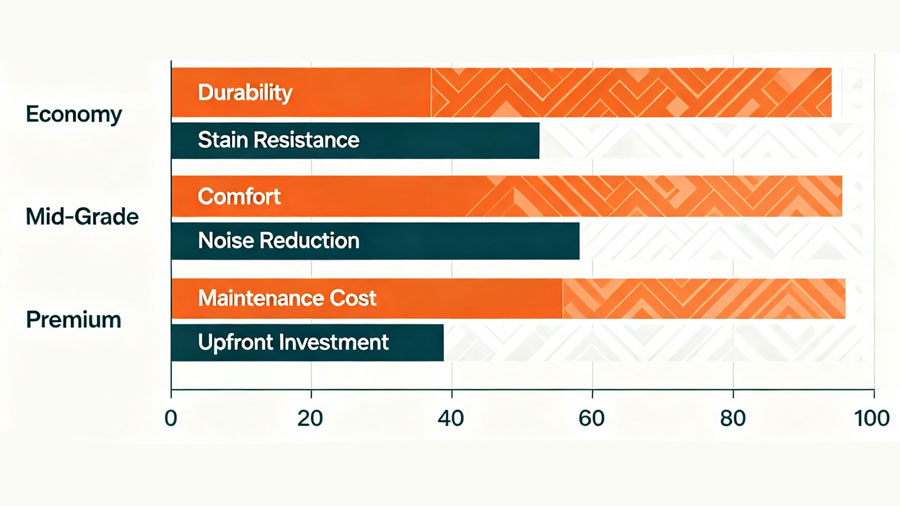
Face Weight, Density, and Twist: The Formula Behind the Number
Here’s the math procurement teams skip, then regret.
Density formula: Density = (Face Weight × 36) ÷ Pile Height
A carpet with a 44 oz face weight and a 0.5-inch pile height gives you a density rating of 3,168 — well inside hospitality-grade territory. A carpet claiming “40 oz” with a 0.75-inch pile only hits 1,920. Same face weight claim. Different product entirely.
Why Twist Level Gets Ignored — And Shouldn’t
Twist measures how tightly fibers wind per inch. A twist rating below 5 crushes under rolling luggage carts within two years. Fab Carpet tests twist retention on every hospitality-grade batch before shipment, not on a sample swatch three months earlier.
Fiber and Construction: Wool, Nylon, and the Hospitality Standard
Nylon and olefin work for budget-conscious light commercial jobs. Neither matches wool’s crush recovery or natural flame resistance in a five-star lobby.
Premium New Zealand Wool remains the fiber hospitality buyers specify when the contract includes a long-term maintenance clause. It recovers pile height after heavy foot traffic, resists soiling longer than synthetic alternatives, and carries natural fire resistance before any topical treatment.
Construction Methods, Compared
- Axminster: Best for intricate patterns at scale. Standard for large hospitality contracts with branded design elements.
- Hand-Tufted: Faster turnaround, strong design flexibility, mid-range cost.
- Hand-Knotted: Premium durability and detail, longer lead time, highest cost per square meter.
- Machine-made: Fastest production, most cost-efficient for uniform corridor runs.
Fab Carpet runs Axminster, hand-tufted, hand-knotted, and machine production under one facility in Qinghai. That means one factory audit covers every construction method a hotel renovation might need — not four separate vendor relationships.
Fire Rating and Certification: The Section Most Guides Skip
A carpet that fails Class I fire testing isn’t a design problem. It’s a liability your project cannot legally open with.
Class I Fire Rating under ASTM E648 (Critical Radiant Flux) is the U.S. baseline for hospitality corridors. The EU equivalent, Bfl-s1 under EN 13501-1, applies to European projects. Buyers sourcing for cruise or marine hospitality need MED Wheelmark certification under IMO Marine Standard — a certification stack most manufacturers simply don’t hold.
Fab Carpet’s certification portfolio covers Class I (ASTM E648 / Bfl-s1), CRI Green Label Plus (GLP9123 / GLP5308), EN 14041 (CE), MED Wheelmark, UKCA/UKMCA, and ISO 9001/14001/45001. That range matters when your project spans U.S., EU, and UK code requirements in a single procurement cycle.
verify certification status
review ASTM E648 test method details
Supply Chain Reality: MOQ, Lead Time, and Where Buyers Lose Margin
Third-party distributors add 20-30% markup with zero technical input on your spec. That markup buys you nothing — no lab testing, no factory audit access, no direct QC accountability.
Direct factory sourcing changes the cost structure and the risk profile:
| Factor | Distributor | Direct Factory |
|---|---|---|
| Cost markup | +20-30% | Base production cost |
| Lead time control | Indirect, delayed | Direct scheduling |
| Sample-to-bulk consistency | Variable | Factory-verified |
| Quality accountability | Diffused | Single point of contact |
Before signing with any supplier, verify: factory audit reports, sample color match against bulk production batches, and documented lead time history — not a quoted estimate.
Try it now: Carpet Calculator — enter your project square meters, construction type, and grade tier for an instant cost range and lead time estimate.
compare hospitality-grade lifecycle costs
How to Choose the Right Grade for Your Project
Match the tier to the traffic load, not the budget line alone:
- Guest rooms: Light to heavy commercial grade, wool or wool-blend
- Corridors and lobbies: Heavy commercial grade, Axminster or hand-tufted, Class I certified
- Ballrooms and conference floors: Heavy commercial grade, acoustic-rated construction
- Entertainment & Leisure Venue floors: Maximum density and twist rating, heavy commercial grade only
- Marine and cruise hospitality: MED Wheelmark certified, Class I fire rating mandatory
A grade mismatch here doesn’t show up on day one. It shows up in the maintenance budget eighteen months later.
Frequently Asked Questions
What is the minimum MOQ for OEM/ODM hospitality carpet orders?
MOQ varies by construction method. Machine-made runs typically start lower than hand-tufted or hand-knotted custom orders. Request project-specific MOQ through an RFQ.
How long does sample development take before bulk production?
Standard sample turnaround runs 2-3 weeks from confirmed design to physical swatch, depending on construction complexity.
What fire rating do U.S. hotel corridors require by law?
Class I fire rating under ASTM E648 is the standard baseline for hospitality corridor and public-area carpet in most U.S. jurisdictions.
Can one supplier provide both CRI Green Label Plus and IMO Marine certification?
Yes, though few manufacturers hold both. Confirm current certificate numbers directly with the supplier before contracting.
What’s a realistic ocean freight lead time from a China-based factory?
Ocean freight typically runs 4-6 weeks depending on destination port, on top of production lead time — confirm both separately in your timeline.
Does higher face weight always mean better quality?
No. Face weight must be read against pile height and density together. A high face weight with excessive pile height can still produce a low density rating.
Get Your Project Specified Correctly
Don’t guess your grade tier. Request free sample swatches, submit an RFQ for project-specific pricing, or download the full Technical Data Sheet (TDS) for Fab Carpet’s hospitality-grade product line before your next procurement deadline.